
Martín Sastre (Montevideo, Uruguay, 1976) presented Fantastic, his most recent and most ambitious multi-media project, from August 25 to October 1. Fantastic was specifically conceived to interact with the architectural topology —neither neutral nor ascetic, well beyond the classic minimalist cube— of the young gallery Leme, designed by architect Paulo Mendes da Rocha. The corpus of Sastre’s exhibition encompassed a never-before-seen metafictional video-art piece produced between Montevideo and Madrid and titled La Conspiración de la Rosa, followed by 20 photographs that in reality are stills or video-frames of the former video piece, printed on vinyl in a 120 x 80 cm format and interspersed throughout the ample gallery space.
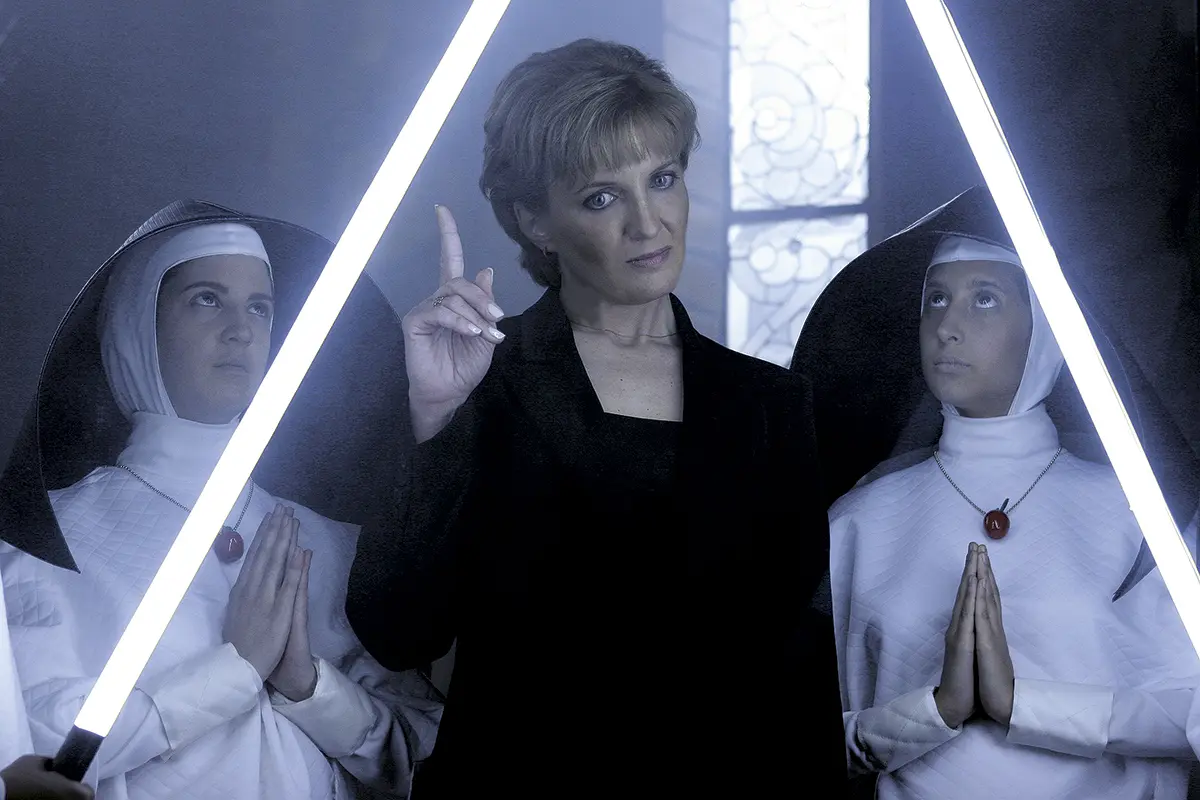
In La Conspiración de la Rosa, a suggestive, strongly narrative work, Sastre takes as his starting point an aesthetic appropriation of one of the Twentieth-Century most abundantly photographed personalities: Diana, Princess of Wales. Focusing his interest on this glamorous, tragic character’s public life, the young Uruguayan artist generates a parallel story, entirely metafictional and idyllic, in the manner of the best fairy tales, from a highly contemporary artistic platform that includes clear undertones of a corrosive humor, a critique of the establishment, irreverence, and mordacity. At the same time, it is important to note the presence of the artist not only as director of his innovative film proposition, but also as actor (video performer) in the script or plot that vertebrates this great simulacral apparatus, in which, paradoxically, a cascade of vertiginous images, be it original or intertextual, coexist in an ecumenical fashion, reverberating against one another. In that sense, for Sastre pure events become materialized in a nexus that is wisely entangled with causes and effects, articulating a complex network of discourses, arguments, counterarguments, and clonings linked to the most famous world celebrities. For this reason, the eternal event appears to the eyes of the viewer as a perfect, beautifully produced effect. And here Sastre deliberately allows meaning to float at the limit of synchrony and the succession of images, at the border between words, visual codes, messages, and actions. While in La Conspiración de la Rosa Sastre begins with a series of originating data, these very data allow him to imbue all his filmic surfaces, extrapolated from the mass media with which he interacts, with a differential aesthetic surplus. His strategy is to bring everything that is exterior (his para-text) inside, and everything that is interior outside, in a double movement, simultaneously centripetal and centrifugal.
Through the video’s 18 minutes and 41 seconds, a simulacrum freed to the interplay of sense and non-sense, to cultural mixture, to the hybridization of images of synthesis, to the non-place, to non-fixity, becomes a sophisticated, polyscenic, multiplied theater, one that is fragmented and sewn up, in scenes that ignore each other but comment each other at the same time by way of winks and wisecracking signs. In this way, the “idols of the gaze” proposed by Sastre are visual tools correctly manipulated to create an aesthetic reflection of the multiple, moreover, of a disperse, nomadic, diffuse multiplicity in which he himself plays a substantial role. Displacing and linking issues, La Conspiración de la Rosa proposes a continued agitation, a frantic visual and audio rhythm, with some relenting tempos through which some dream-like, melancholy, bucolic visions do seep. However, a quota of suspense is always present in this work, as is the citation spiral of the new literary modes of the post-historical thriller. For Sastre it I essential to preserve the presence of a globalized environment, saturated of images that are devoid of cause and consequence, this is to say, a universe of images of synthesis, a very current encyclopedia of post-images, integrating them into the mobile, fluctuating totality of the public macro-space and the intimate, domestic micro-space. For this purpose, Sastre transforms illusion into a large-scale fictional artifice, at once generating a crisis of video’s image-time and image-movement. Traversing borders, in the very line that separates art and the world of entertainment, the artist’s cunning intuition has been able to foresee the aesthetic reach of certain effects of disruption that are incorporated into his most recent productions, which inhabit the hybrid territory of Live Art and Total Art.
The piece’s provocative, ironic, and critical nature is emphatically concentrated in the series of 20 photographs printed on vinyl, where the tactical strategy of visual shock and the pretended spontaneity of each shot generate a chain of associations that can be understood as a true storyboard.