
This summer, Prague hosted two biennial exhibitions. Both must have required superhuman effort from their organizers, even though it was evident that one of them—presented with government support in the modern facilities of the National Gallery (GN), a palace that has its own catacombs and medieval cloisters—had great resources at its disposal while the other—installed inside Karin Hall, a crumbling building, by the editors of Flash Art—seemed poor and, even worse, not greatly creative. I will identify the first as the GN Biennial and second as the PK Biennial for its curators, Giancarlo Politi and Helena Kontova.
But what in great measure ended up undoing both efforts was the fact that both institutions reduced the event to an episode from a narrative of intrigue among art magnates that were former partners in the first Prague Biennial. Registering this in the inaugural address, the GN director Milan Knizak declared that the removal of Politi and Kontova from the coordinating team for the Prague Biennial was due to murky background politicking. Illustrating how opportunists pullulate in the art circuit, the hosts at Karin Hall embraced a project by Virginia Hackermann that launched a boycott against Knizak and the GN Biennial.
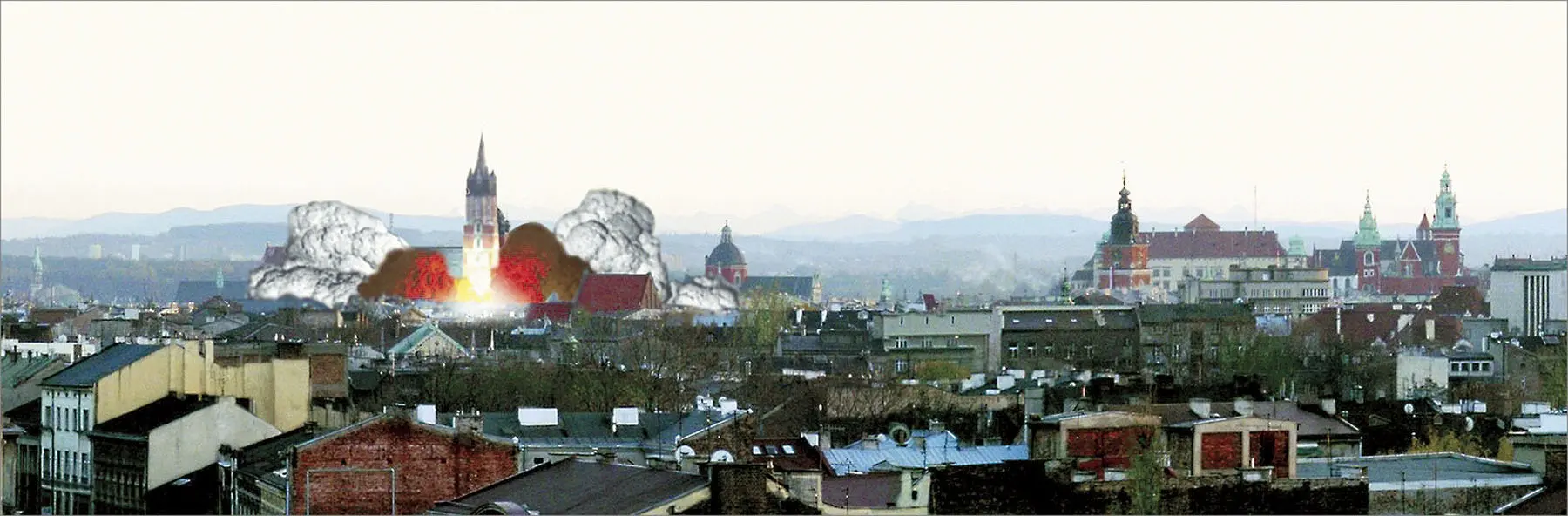
Knizak is a polarizing figure. An innovative musician since the early 1960s and a member of the legendary Fluxus group, he enjoys a position of power in Czech culture; this makes him both an admired figure and a target of attacks. At the center of Jacob Dahlgren’s work, a wall onto which the public could throw darts was a postcard of Hackermann’s project featuring Knizak’s photograph. In the GN Biennial catalog, Jiri Suruvka wrote, “One man, in particular, has excelled and made a name for himself in this field [art]. Eventually, he became Director of the Gallery of the Nation, among other things. Any old grandma from a godforsaken village knows Milan Knizak. She knows nothing about contemporary art, only that M.K. wears a ponytail and earrings. The artists who want to make it in this country are aware that the only way is over his dead body...” Apparently many would like him to disappear from the horizon, like the self-propelled buildings in Departure, a video by the Polish artist Janek Simon.
Tensions of this sort are common but rarely do they escalate to the point of impacting an event’s conceptual proposition. It would be possible to infer, for instance, that the disproportionate number of curators invited by the GN Biennial—more than thirty—represented a show of force against Politi, in terms of the exhibition’s scope and its international pull.
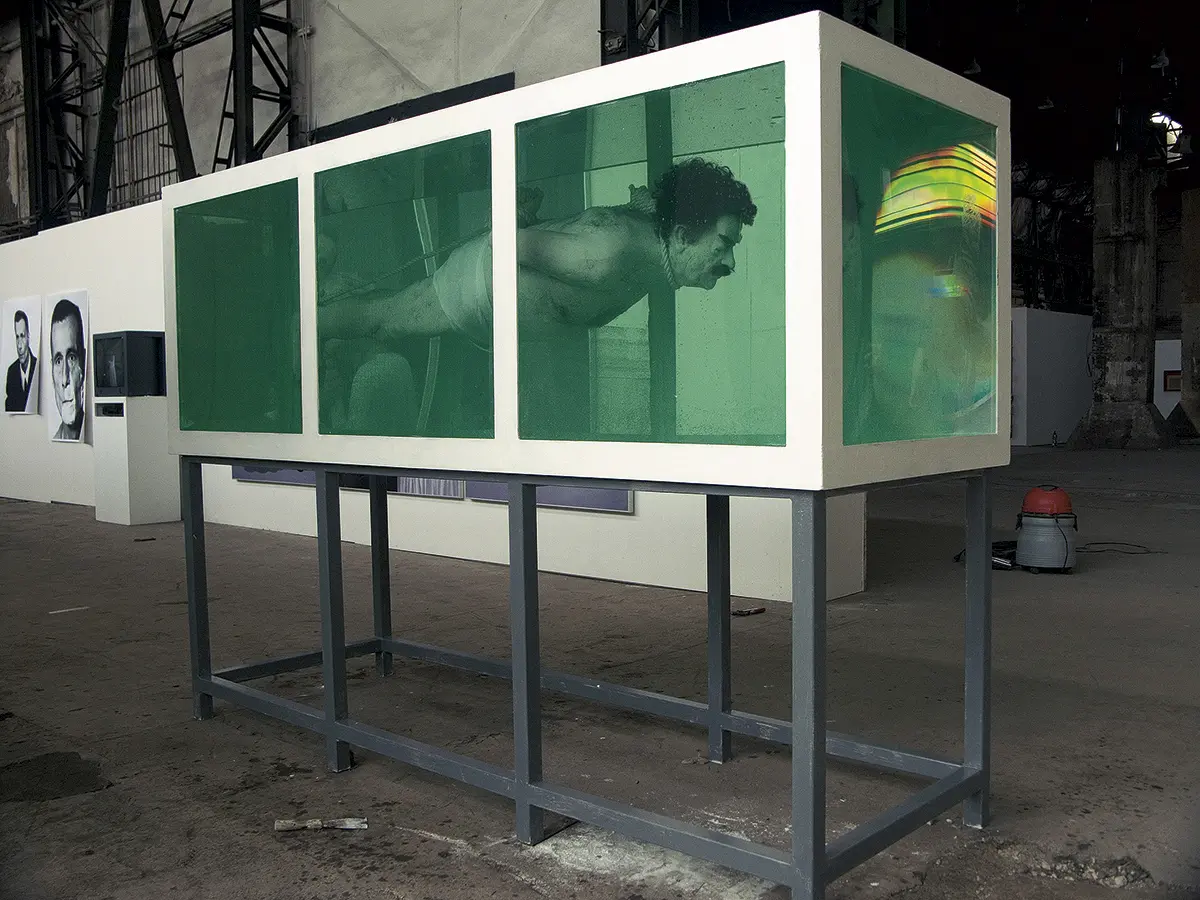
Budget limitations may have been a decisive factor in forcing the PK Biennial to recycle ideas and projects instead of proposing new ones. It is unbelievable that they included as the catalog’s central text Rosalind Krauss’s well-known “Sculpture in the Expanded Field,” which dates from 1978, to propose a transfer of her ideas to the area of painting. Perhaps it was because they are editors that the installation was not carefully planned, and their space looked haphazard, more like a fair’s pavilion. Only the area reserved for “The New Czech Scene” displayed a measure of cohesion. There one found reused advertising lightboxes by Pode Bal, Jan Kadlec’s installation Pig, and David Cerny’s Shark, an impressive underwater sculpture of Saddam Hussein, gagged and dressed in his underwear.
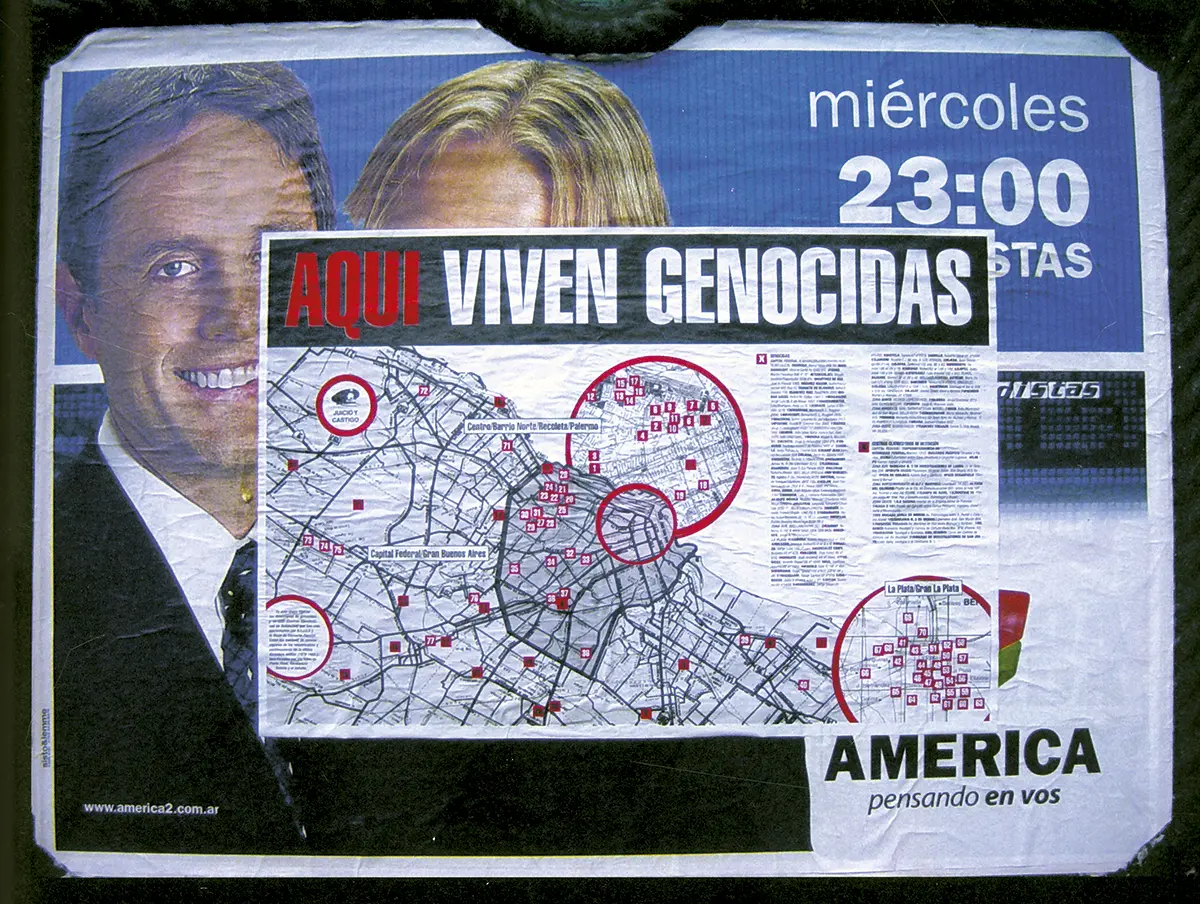
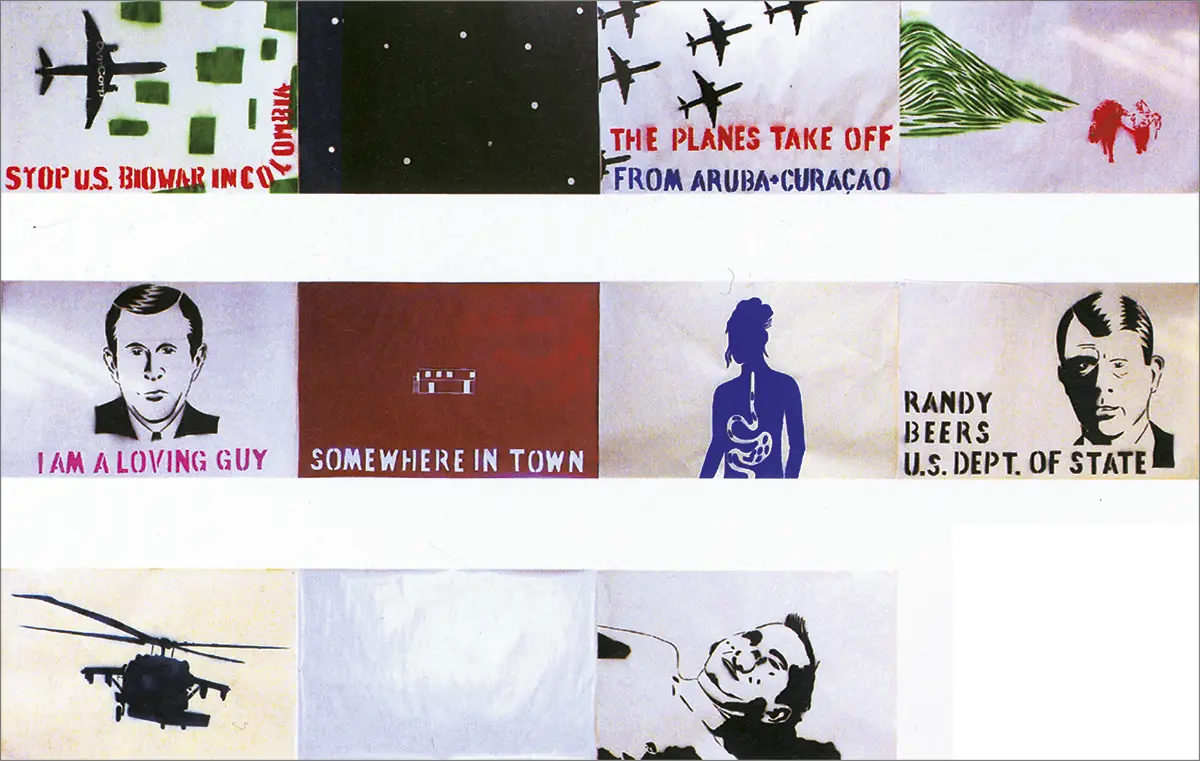
Despite these problems, both Biennials presented very interesting projects, and among them, several had a regional character. “Direct Action,” organized by Marco Scottini for the PK Biennial, was significant and brought together forty Latin American artists who emphasize process art and social commitment. The works were grouped thematically; under the theme “Direct Information” was a selection of works related to marginal communities through workshops and editorial efforts in support of popular movements, such as the templates of Coca Crónica and Los vivos by Raimond Cháves and the station Arte y Resistencia, by Grupo 24/7. According to the curator, the section titled “Virtuosity” focused on “the performative character of many contemporary artistic projects.” He included everything from playful works such as a video of skaters showing off their skills on a ramp built by Chemi Rosado to the accusatory forcefulness of Aquí viven genocidas, a map by GAC (Grupo de Arte Callejero) in Buenos Aires.
Other topics developed by Scottini were “Self-Organization,” or “the appropriation of spaces that suffer a political, productive, economic, and communicative crisis,” demonstrated by Alexandre da Cunha, who creates shelters by assembling parts of furniture and discarded equipment.
The GN Biennial featured an exhibition of Chilean art organized by Patricia Ready. Pieces by seventy-eight artists occupied a privileged area, the palace’s medieval cloisters, but that was not enough to disguise the show’s inarticulate nature. The pallid representation, due to the fact that there was only one work per artist, and the fact that many of them were merely decorative objects combined to make a visit to the cloisters a rather disappointing experience. The only element uniting some of the pieces seemed the fruit of chance. It was a reference to travel, to displacement, and to a movement that produces an itinerary. This element links the shoes in Carlos Leppe’s installation and José Balmes’s painting, the reference to mail-in Nury González’s installation with sewing tools and objects, Eugenio Téllez’s map called Campos de batalla, and Loty Rosenfeld’s march of ants.
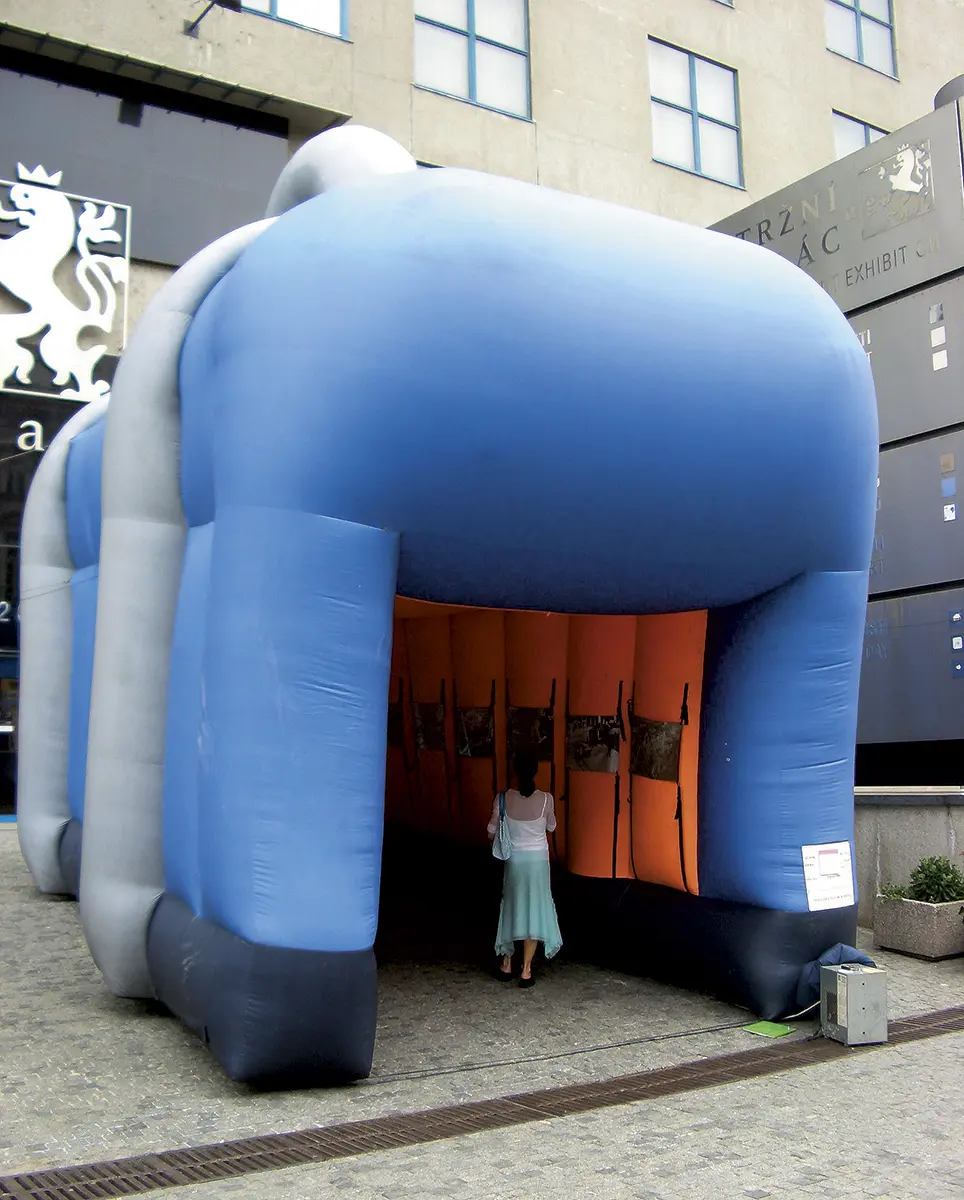
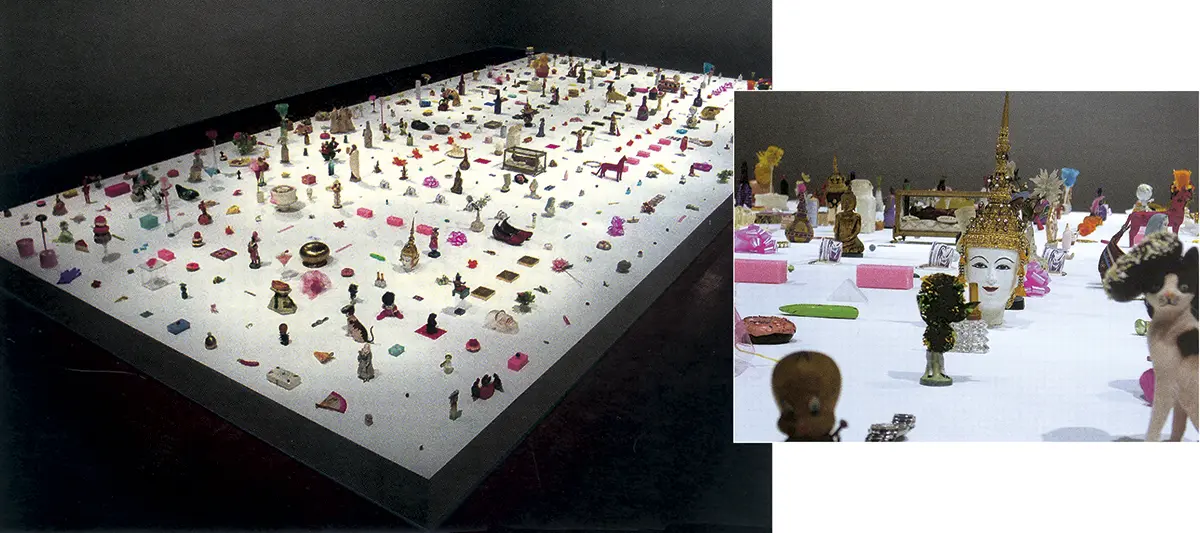
However, the Latin American presence at the GN Biennial was solid. Carlos Blanco’s and Charles Juhazs-Alvarado’s monuments (a large inflatable in the shape of a penetrable portfolio transformed into a photo gallery and a wooden shoe-shine box, respectively) and Franco Mondini-Ruiz’s installation of objects converged in their use of pop-culture elements and of popular aesthetics. Alexander Apóstol’s videos (a drag queen reciting texts about architecture by Le Corbusier) and Daniel Chust Peters’s constructions (models of buildings with similar plans) confronted the issue of architecture from diverging perspectives. They were all part of Paco Barragán’s proposal nEUclear Reactions, praised for its reformulation of the problem of European identity in the face of integration and the sense of a diaspora of Old World emigrants throughout the world. An analogous proposal referring to Africa was presented some years ago by Gerardo Mosquera at the Johannesburg Biennial.
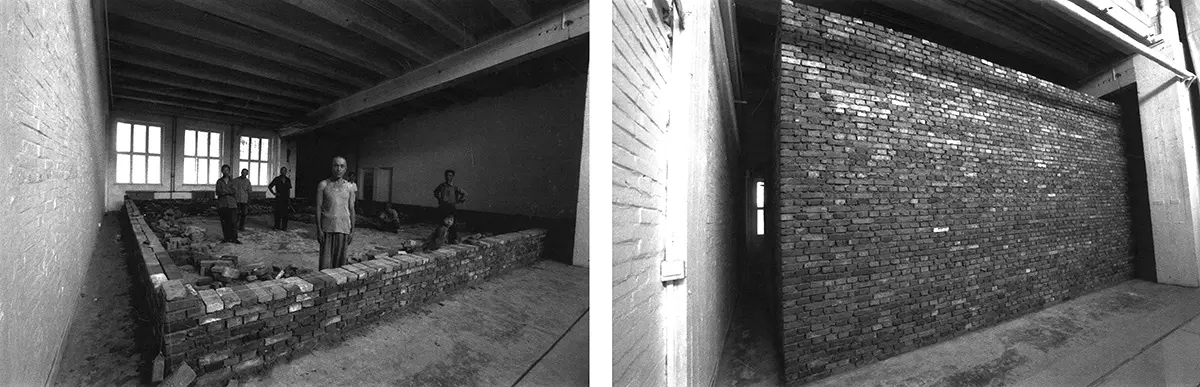
For their part, Los Carpinteros gave their traditional approach to the issue of construction a new twist. In this case, it was an installation, Frío estudio del desastre, in which they froze the moment when pieces of concrete blocks shot up from a wall. There are certain similarities between this work and the video/photographic series Temporal Space, by the Chinese artist Wang Wei. This series documents the process of a construction worker building border walls in a room, closing himself within the space; later, a group of people tore down the wall.
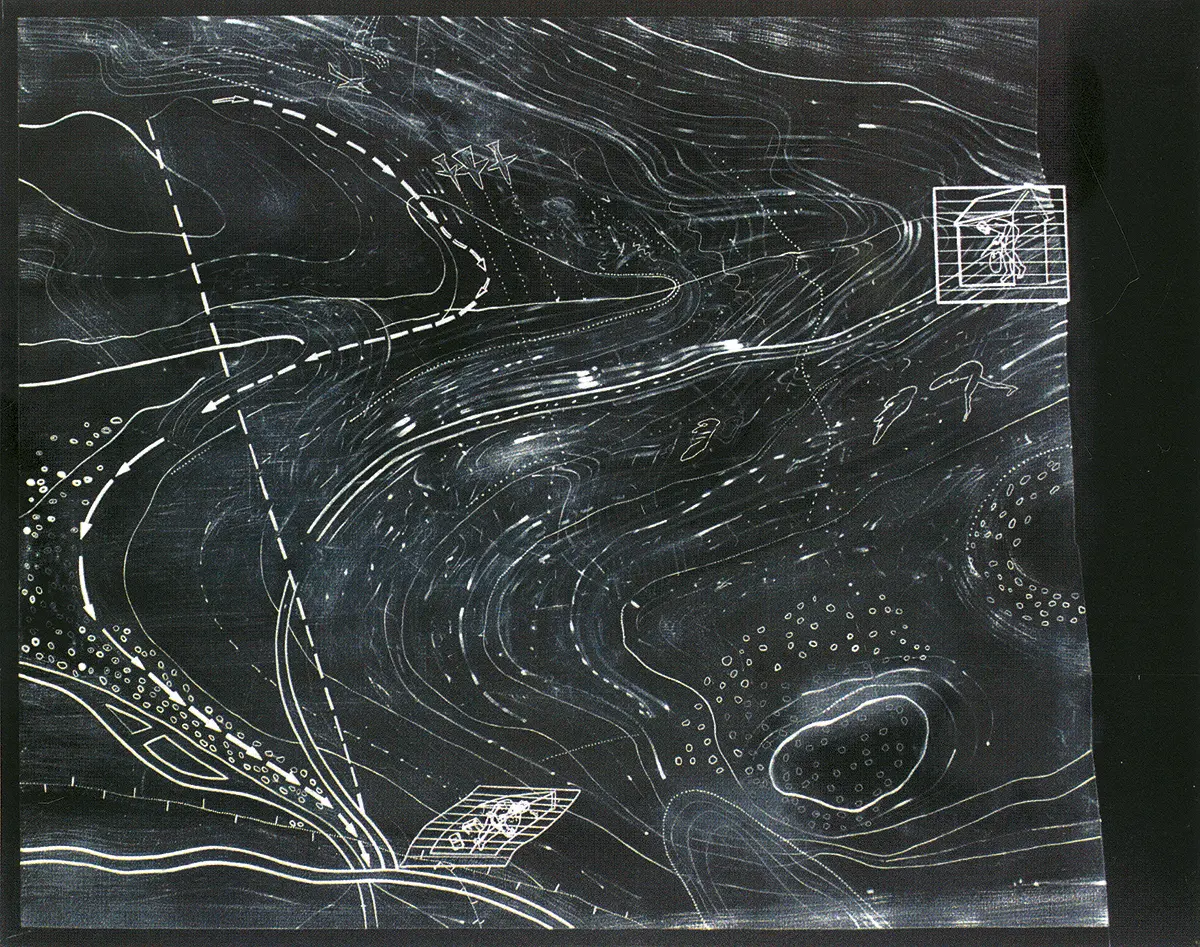
Óscar Muñoz presented a series of ephemeral portraits very closely linked to Alfredo Jaar’s video Epílogo, where the portrait of a white-haired black woman fades into a white background. In both works, we find references to the fragility of identity and of memory. From a similar perspective but using a different technique, Jorge Macchi presented carved maps of urban spaces in Ciudad del silencio and Lisboa.
Prague possesses central importance in the border region between Eastern and Western Europe. Two competing events represent an additional attraction but they can also exhaust the will of their sponsors. For this reason, it seems unlikely for a second Biennial to survive, especially since it doesn’t really represent an alternative. The reasons for the breakup were not conceptual or aesthetic but administrative; the Prague Biennials are in the end two cups of the same soup, and the public will soon have had enough.
ELVIS FUENTES
Art historian based in San Juan, currently working as curator of the Instituto de Cultura Puertorriqueña.