
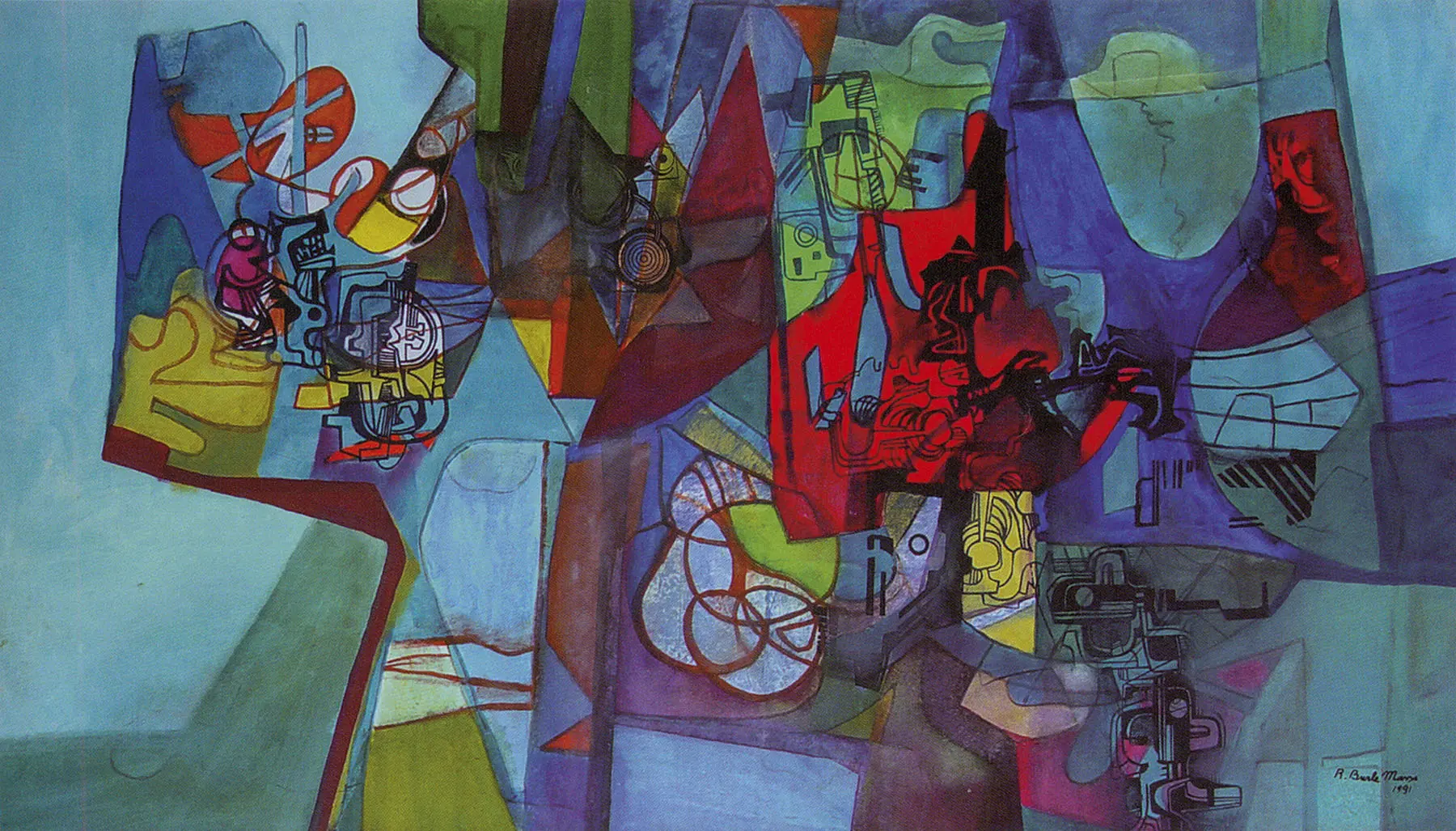
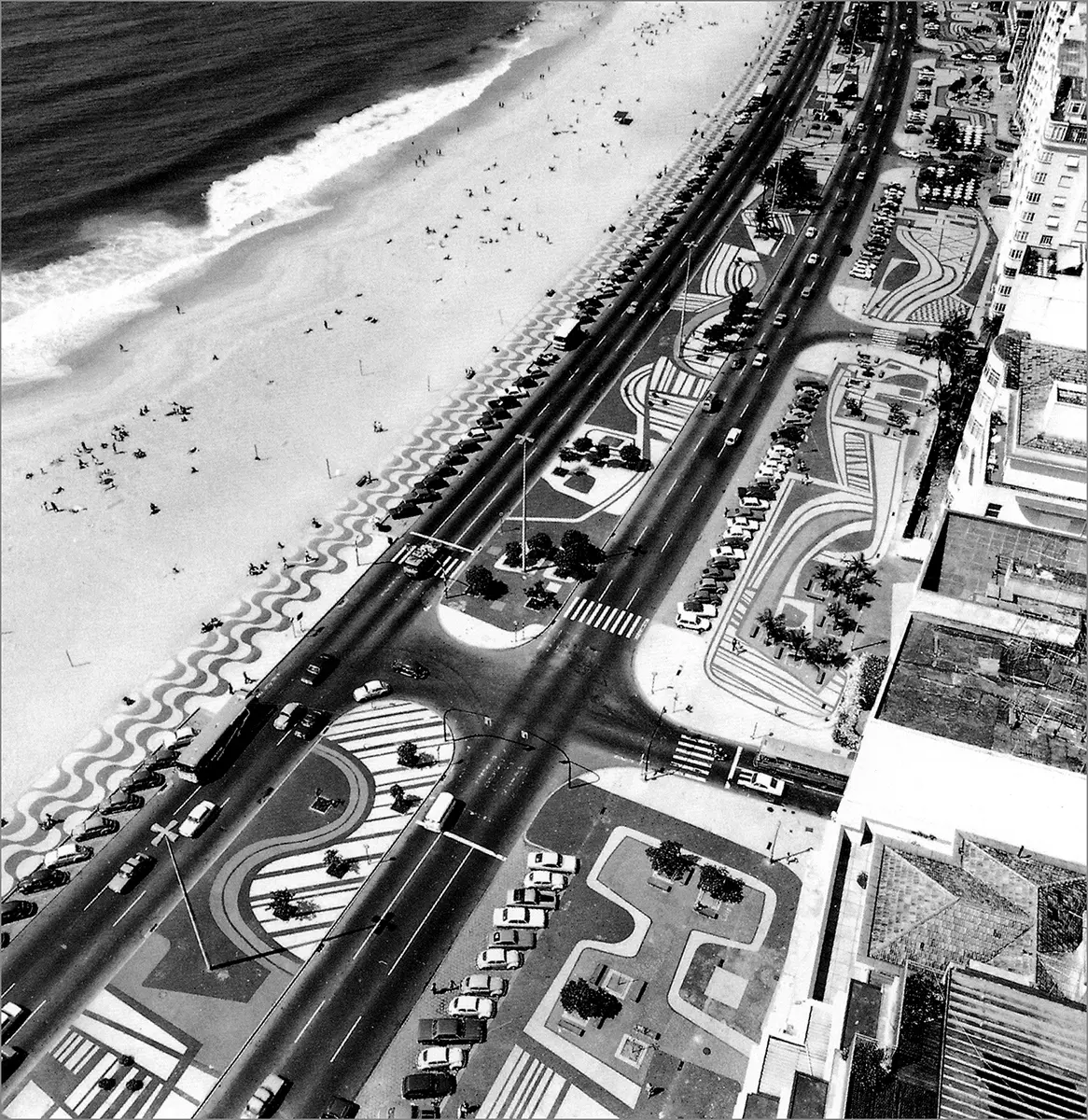
Possessed of a forcefully expressive artistic personality, Roberto Burle Marx bequeathed to Brazilian culture his fertile production in the field of visual arts and added to his many achievements in the realm of landscape design through his work both in public spaces and private properties. Some examples that can be mentioned are: his walkway projects in Copacabana Beach; the Museum of Modern Art gardens; and Flamengo Park1—all of them in Rio de Janeiro. Equally important points of reference are the Pampulha public gardens in Belo Horizonte; the Guarapiranga Park project in São Paulo; and many works in Brasilia, such as the gardens for the Brazilian capital Monumental Axis, an architectural project by Oscar Niemeyer. Burle Marx is also renowned for his work abroad, such as the interior patio for the UNESCO building in Paris, France; his garden project for the Organization of American States (OAS) in Washington, D.C.; his projects for the Maracaibo Botanical Gardens, the Caracas Concert Hall garden, and the Diego Cisneros residence, in Venezuela; and many projects in Argentina, Italy, and the United Arab Emirates, among other countries.
Roberto Burle Marx entered the visual arts scene in the 1930s, in the context of the Arte Moderno Brasileño movement, where the talents of, among others, Portinari, Pancetti, and the Santa Helena group (Rebolo, Bonadei, Clóvis Graciano, Volpi, Zanini, and Penacchi,) also flourished.
His work in the visual arts included still lifes, compositions on the subject of work, portraits, landscapes—where nature is the center of attention—and urban scenes. Burle Marx is perfectly integrated with that generation of Brazilian artists, a generation that contributed greatly to the consolidation of the modern art movement with the Modern Art Week in 1922.
Within Burle Marx’s artistic legacy it is important to note the way in which the artist lyrically captures formal conjunctions, the structural essence of form, and vis-à-vis these concerns it becomes necessary to mention the importance of pictorial space in his creative work.
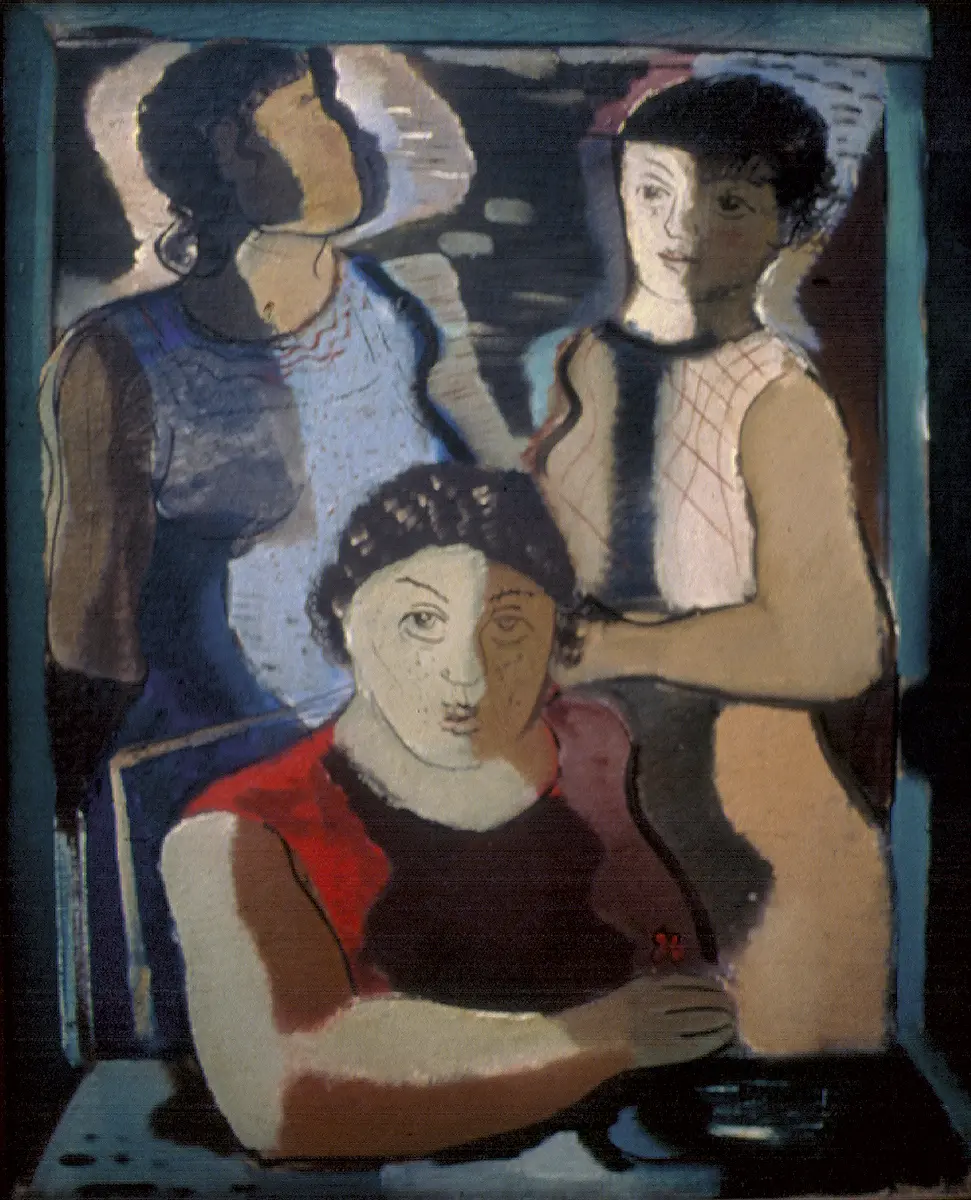
Burle Marx’s career, both as a visual artist and as a landscape designer, was marked by a permanent process of research and creation. Architect and urban planner Lúcio Costa, analyzing Burle Marx’s creative personality, defines him as unique in Brazilian culture, observing that “the work of the botanist, of the gardener, of the landscape designer, feeds, in a simultaneous movement, on that of the visual artist, the draftsman, the painter, and vice versa."2
And it is precisely by means of a poetics of space that the central meaning of the “back and forth” between painting and landscape in Burle Marx’s work, often highlighted by critics, is articulated.
It is interesting to note that one of his earliest drawings, from 1929, when the artist lived in Berlin, Germany, was a drawing of a garden. We must remember also that later Burle Marx was to build his workshop in a sítio (small farm). Sítio Santo Antonio da Bica in Barra de Guaratiba, Rio de Janeiro, was the 365,000-square-kilometer area he purchased in 1949. There, Burle Marx organized a collection of botanical species, which he not only used in his gardens but also incorporated into his compositions. Undoubtedly, the articulation of art and landscape design had central importance throughout his career.
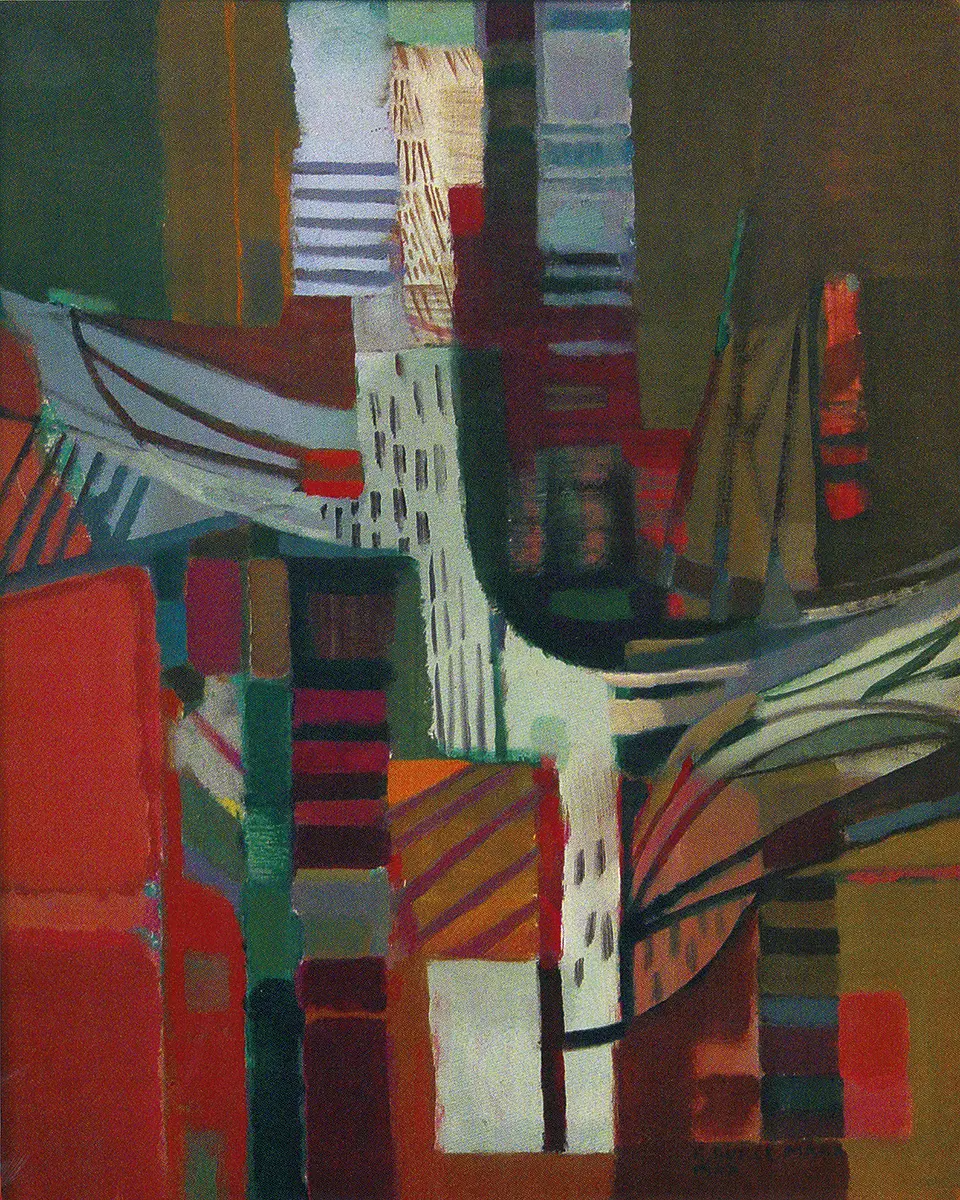
In the construction of his paintings, Burle Marx efficiently articulates line and color, and through those elements, he reveals spatial problems. For him, each composition, each new piece is the result of a “production process” in a particular study of spatial order that needs to be explored. During the 1950s, in the midst of a heated debate between abstraction and figurative in the Brazilian art world, Burle Marx began his own investigation of abstraction, reinforcing the evidence of his concern for pictorial space. His work in this period is marked by one characteristic: his compositions are “constructive” and “lyrical” at the same time with line and color assuming a decisive role in the definition of his pictorial space.
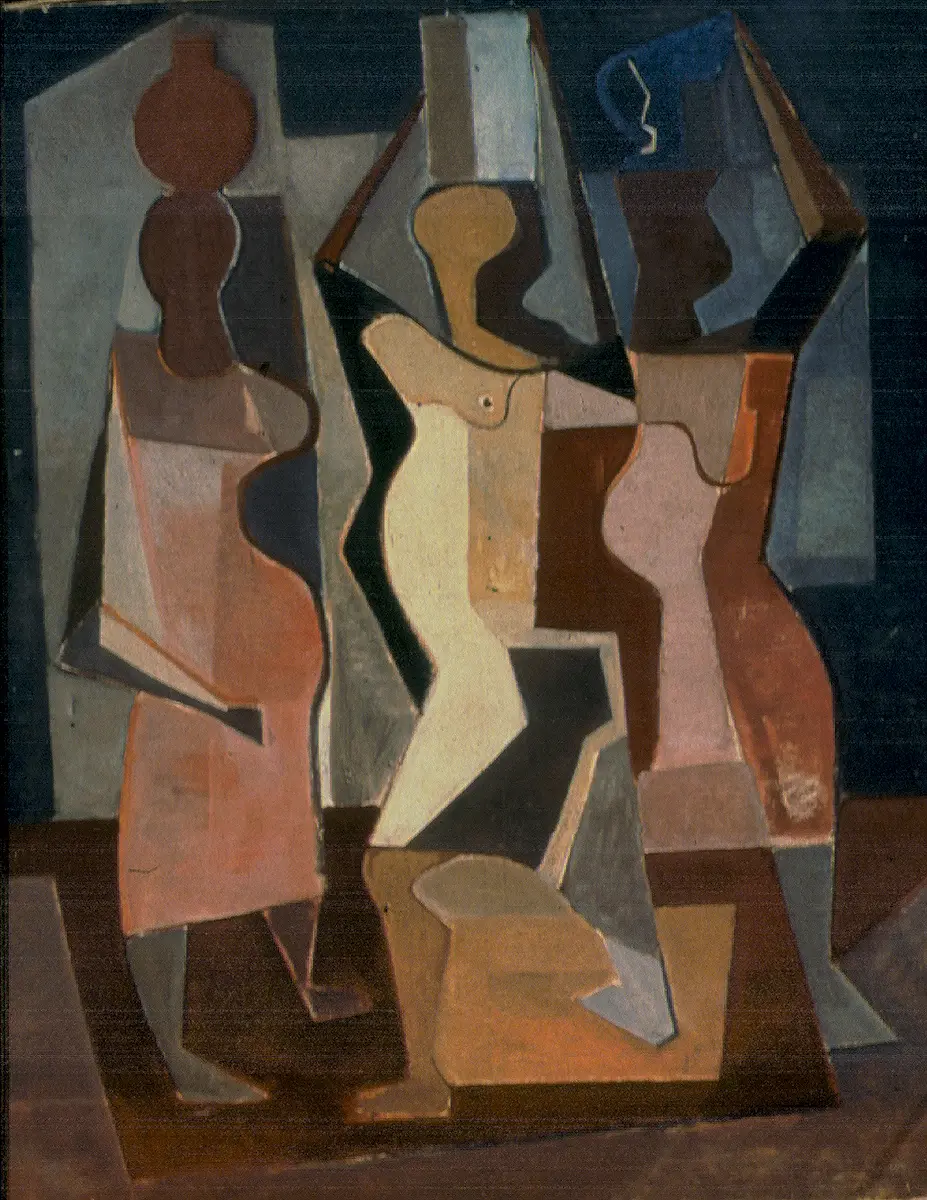
The compositions that are part of his investigation of abstraction reveal an aesthetic foundation that is also present in the gardens he designed during that time. In fact, some critics believe that it is during this period more than at any other time that Burle Marx’s paintings most resemble his gardens. One such critic is Clarival do Prado Valladares, who explains this symbiosis as “a biomorphic, more than an abstract, archetype.” He writes: “his motivation is the intimate structure of elements observed in natura. Antimimetic drawing and painting, despite originating in live textures, is the way in which his world appears and communicates with the eyes of a bird, of an insect, of a poet..."3
From the 1980s to the end of his life in 1994, Burle Marx remained close to a more “impulsive,” existential informalism centered on the creative act, the gesture of painting as lived experience. Without great premeditation, the artist frees himself as he faces the canvas. Imagination can travel, marks and colors acquire a rhythmic choreography, but the structural reason that defines the composition in formal terms never disappears. His canvases in this period are symphonic, according to critic Olívio Tavares de Araújo.
A good way to understand the issue of abstraction in Roberto Burle Marx’s work is to think about it from the point of view of gestalt, a fruitful way of approaching the aesthetic problem we want to highlight here: the problem of space.
To understand abstraction from the point of view of gestalt, it is important to remember, as a supporting text, Rudolf Arnheim’s Abstraction, and Art.4 The gestalt formulation, as Arnheim suggests, indicates that, given one objective, one representational option will be chosen from among many and the chosen option is the one that represents the “best” structure in the circumstances."5 The lines that form a given configuration tend to stand out and to be perceived first; this is to say, certain structural functions are selected.
This is not a process of intellectual synthesis reached after experiencing a large number of cases, but a case of pure and spontaneous kinds of sensory perception, which may be explained by a tendency toward a structural “pregnancy” in processes that unfold in the visual cortex as responses to stimuli.
Perceptual characteristics can be described in such an abstract and general way because they are not limited to objects; rather, objects are discovered in them. From there we can infer that the fundamental process of perception, rather than being a passive register, is a creative act that occurs in the comprehension of structure; it is in no way limited to grouping or selecting parts. What happens in perception corresponds to what, at a different level, we would describe as insight.
It is clear, then, that for Burle Marx abstraction is the assimilation of a given reality’s most general formal quality. In this way, a general quality like “round,” rectangular,” or “cylindrical,” whether or not drawn from a real object, can be understood in Burle Marx’s work as form stripped of “accidental complexities,” as the best form, the good form for a configuration in the present conditions.
If from a certain point on the artist prefers simpler models, these can be understood, in the language of gestalt, as the resultant of conceptual forms that can be more or less complex, more or less close to reality. The product is essentially a structural elaboration, with the structure being determined through the work of “abstracting.”
In this behavior, the treatment of painting becomes a painstaking problem, where creation can expand in full. Thus, for artists, perceiving a reality means finding form in its structure.6
Form and structure are also the main values in Roberto Burle Marx’s landscape design.
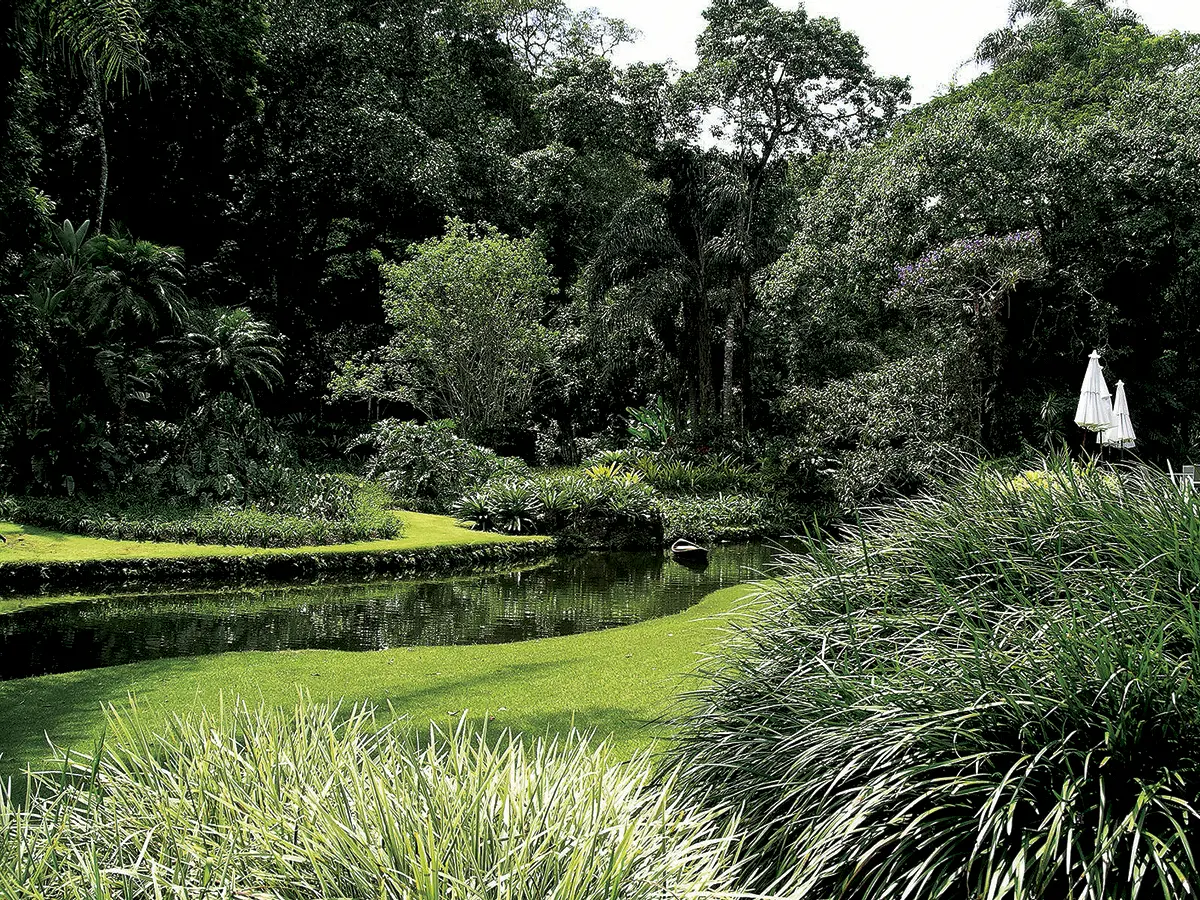
Professor Giulio Rizzo’s analysis7 reveals that the problem of space is the central problem in Burle Marx’s landscape design. This author points out that, in the first place, Burle Marx understands and assimilates the laws governing nature in order to apply them correctly later to the creation of his built landscape, respecting all species’ botanical and environmental requirements. He underscores the fact that the landscape designer revisits the spatial structures found in his landscapes when remodeling the space he is to work on: that color is used to create contrast, vibration, and rhythm in the local luminosity, and that his use of light is directly connected with his use of color.
There is, then, an aesthetic dimension driving explorations that are common to both creative fields in which Burle Marx is active: art and landscape.
Reflecting upon his work in landscape design, Burle Marx has acknowledged that nature must be adapted and used in all its strength and its quality of organized matter, in the terms and to the purposes of artistic composition, and it is in those terms that he understands landscape design as an art. He probably adopted that metaphor, linking landscape design with painting, in order to make its artistic construction more clearly understood.
Roberto Burle Marx was born in São Paulo, on August 4, 1909. His family moved to Rio de Janeiro in 1913.
Between 1928 and 1929, when the Burle Marx family lived in Berlin, Germany, Roberto studied design and painting at the Degner Klemm School. He visited museums and was strongly impressed by the work of Van Gogh; he also became familiar with Klee, Picasso, and Matisse. Although he had decided to become a painter, Burle Marx frequented the Dahlem Botanical Gardens and discovered in its collection the richness of Brazilian flora. He also studied singing—he was an excellent baritone.
Upon returning to Brazil in 1930, Roberto Burle Marx entered the Universidade Federal do Rio de Janeiro to study Fine Arts, a course of study that was to undergo a renovation under the directorship of Lúcio Costa. Burle Marx studied with teachers like the expressionist Leo Putz, Celso Antonio, and Pedro Correa de Araújo. In 1933, invited by Lúcio Costa and Gregory Warchavchik, important figures in the history of Brazilian architecture, he did his first project for a garden, at the Schwartz family residence. Shortly thereafter, at the age of 25, he moved to the city of Recife, his mother’s hometown in the state of Pernambuco, in the Brazilian Northeast. There, as Director of Parks and Gardens, he developed six projects. He also expanded his botanical knowledge, going on hikes to research the vegetation in the cerrado (dense forest) and starting what was to be his long career as a landscape designer and researcher in the field of botany in different regions of the country.
In 1955, Roberto Burle Marx founded Burle Marx & Co. Ltd. Starting in 1968 he collaborated with two architects, José Tabacow (until 1982), who in 2004 published a book about their work, and Haruyoshi Ono, who took over the company’s direction after Burle Marx’s death.
In March of 1985, he donated his Sítio and everything in it to the old Fundación Nacional Pro-Memoria, today renamed the Instituto Brasileño de Patrimonio Cultural. Following his death on June 4, 1994, and through this institution, his work is in the process of being cataloged.
Throughout his career, Roberto Burle Marx had a large number of one-person shows and was part of many group exhibitions, both as an artist and as a landscape designer. In 1996, the Museu de Arte Contemporânea of the Universidade de São Paulo presented a retrospective of his work.
2004 marked the tenth anniversary of Roberto Burle Marx’s death. Several exhibitions commemorated his presence in Brazilian art.
NOTES
1. Translator’s note: This park was built on land recovered from the sea.
2. Lúcio Costa, quoted by Léila Coelho Frota, in “Roberto Burle Marx: Un Homenaje,” in Arte y Paisaje: La estética de Roberto Burle Marx, ed. Lisbeth Rebollo Gonçalves (São Paulo: Universidade de São Paulo/Museu de Arte Contemporânea, 1997), p. 10.
3. Clarival do Prado Valladares, Roberto Burle Marx (São Paulo: Museu de Arte de São Paulo, 1974), exhibition catalogue.
4. Rudolf Arnheim, “Abstraction and Art,” in Psychological Review, ed. Herbert Langfeld (Washington, D.C.: Princeton University, 1947).
5. Ibid.
6. Arnheim confirms this argument, in the book above: “the models of non-objective art, when considered from the point of view of the natural world, are extremely abstract in reducing all representations of reality to a visual equivalent of universal psychological and physical forces, which can be expressed as harmony or disharmony, dominion and coordination, contrast and similitude, movement and rest, balance and imbalance, and so forth. According to this author, from the standpoint of form, basic non-objective patterns are not abstract. The elements of visual comprehension are the pillars of the composition created by the artist in order to capture, in his interpretation, the painting’s structure. In perception, there will be a tendency towards the best possible balance, and creative transformations can occur in the sense of establishing a more balanced, more symmetrical, more regular structure—in other words, a more “pregnant” one.
7. Giulio Rizzo, “Mayeútica de una nueva Estética,” in Gonçalves, Arte y Paisaje.
LISBETH REBOLLO GONÇALVES
Professor at São Paulo University and President of the Brazilian Art Critics Association (AICA-Brazil section).