
At its most fundamental level, sculpture involves a play with space. For Waltercio Caldas, this has led to an investigation into the ways that two- and three-dimensional space differ and overlap, as constructed by the artist and apprehended by the viewer. In his recent solo show at the Christopher Grimes Gallery, Caldas continues to explore questions that he began asking over thirty years ago. His current solutions, five new sculptural compositions collectively titled The Black Series, are as provocative as the works were at the beginning of his career.
The range of materials deployed is largely consistent with the artist’s trajectory. These pieces function as composites of earlier sculptures; polished granite stones, crystal wine glasses, and figures made of stainless steel rods all reappear. Upon entering the gallery, the viewer is confronted with four compositions, each dominating a quadrant of the room (a fifth sits behind a partition in the back corner). The works are constructed of the same formal building blocks. Black steel table frames provide the structure for each, by supporting the compositions; nothing happens below the surface of the table. In each construction, one or two slabs of black granite are laid across the table frame, stainless steel sculptures made of shiny silver rods sit on top, and strands of colored wool yarn hang from the ceiling. Some incorporate other materials like sheets of clear glass or black granite stones. It is evident that all of the elements have been arranged very deliberately; spaces and intervals are carefully measured and edges are perfectly aligned.
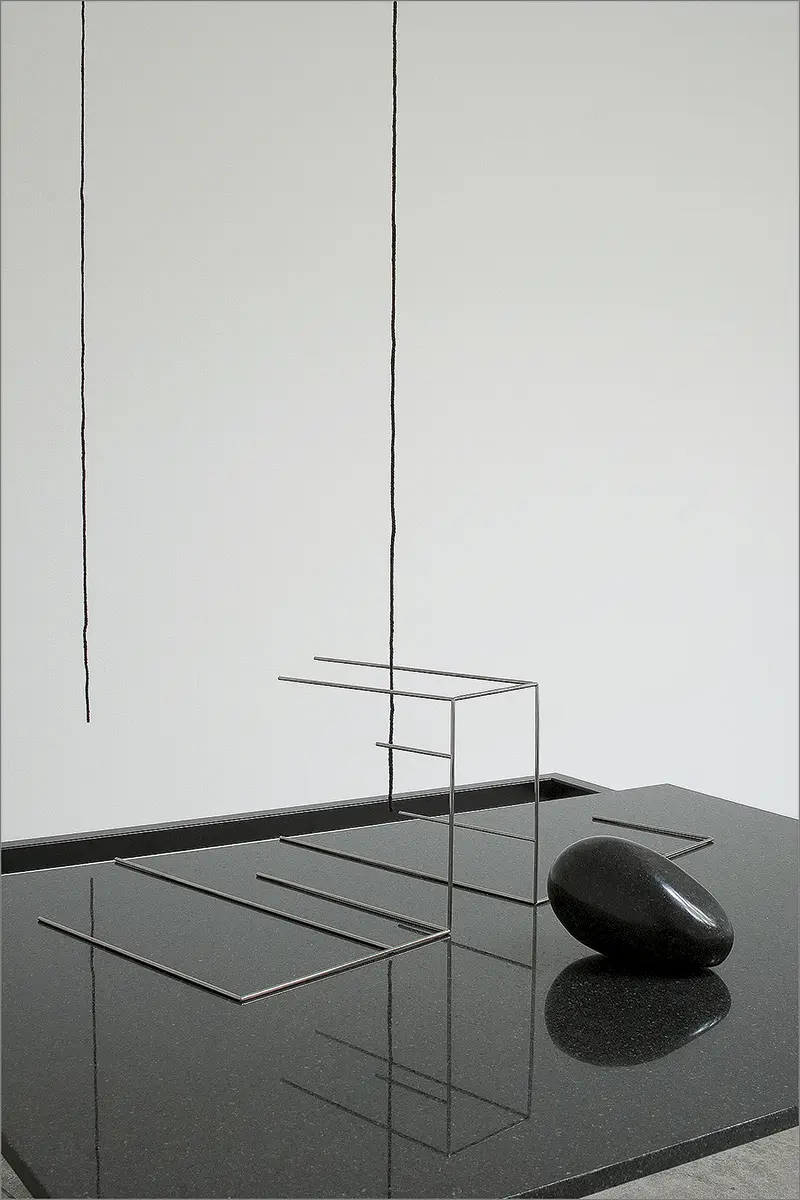
Although this assortment of objects seems random, the choices are meticulously calculated and signal a fundamental point of interrogation for Caldas. Opposites attract and repel on several levels in these works. Each composition combines materials that are light and heavy, transparent and opaque, fragile and indestructible. The delicacy of a piece of yarn that moves easily with the slightest draft hangs in contrast to the oppressive weight and near immobility of the granite slabs. This juxtaposition foregrounds the material nature of the elements in each work, creating a tension between their antithetical qualities. Rectilinear and curvilinear forms are also contrasted with each other. As the compositions stretch to the floor and ceiling, even these two architectural poles are forced into dialogue in these works. Caldas delights in the antagonism between oppositions, forcing them to commune within the space of the gallery.
In a recorded interview, Caldas characterizes these works as sculptures while Gary Garrels discusses them in terms of drawing. The works play with the tension between these mediums by confusing the representation of two- and three-dimensional space. Two-dimensional space, like that used in drawing, is evoked in some of the three-dimensional compositions which appear to pivot around a central vertical plane. One of the most successful examples of this is Still Life. In this work, a sheet of clear glass is sandwiched between two granite slabs, bisecting the table vertically. On either side of the pane are two clear wineglass-shaped sculptures, two stainless steel objects, and two strands of white yarn hanging from the ceiling. Each object sits diagonally from its twin on the other side of the glass pane so that, as the viewer circumambulates the composition, the central vertical axis appears to rotate, depending on which elements one is looking at. This illusion illustrates why the height of the tables plays such an integral role; they raise the compositions to the viewer’s eye level, which is essential for these optical illusions to succeed. The play of elements would be entirely altered from a different height and the mediation between two- and three-dimensional space would be lost.
This visual game belongs to the tradition of trompe l’oeil and Op Art and is not Caldas’s first foray into this arena. In earlier works, quotations from European art history such as Velasquez, Duchampian ready-mades, and games with perspective are more likely to appear than a Brazilian flag or another political symbol. Unlike many of his contemporaries, Caldas, who came of age in Rio de Janeiro in the 1970s at the height of the Brazilian dictatorship, has never made overtly political work. Instead, he directly engages the history of art. Even the titles he applies, such as Landscape, Machine, and Still Life, relate to familiar genres. The history of Brazilian art plays an equally important role, and he actively responds to concepts inherited from the Neo-Concrete artists of the 1950s and 1960s. Their engagement with phenomenology, which led to the incorporation of a mobile viewer into their works, is a clear precedent to his compositions in The Black Series. Although there are fewer formal connections to the Neo-Concrete movement in this series, it is apparent that Brazilian art history continues to inform Caldas’s conceptual content.
ALECA LE BLANC