
An emotional study of the cosmos is what Mexico City’s Galería Myto presented last spring, April 14 thru June 3. The show Nada, by Cuban artist Yunior Mariño, presents recent painting and photography series whose languages course in a double play in which the relationship with the universe is captured both by the brushstroke and the photographic eye, granting each medium the specificity of its language, but in a relationship that can be almost perceived as symbiotic.
In his paintings Nada (2004) and Obsesión (2005,) Mariño creates spaces of emptiness and fullness that bring to mind the mystery of black holes, where gravity is able to absorb everything towards the vacuum, or, rather, towards the pictorial space, because through the repetition of those words —nada (nothing) and obsesión (obsession)— painting generates a conceptual implosion that moves between abstraction and cosmic realism. Similarly, the mantra-like repetition of those words takes painting into the realm of ancestral prayer forms, mixed with visual poetry, which generates a dialectic where nada (nothingness) is what forms the work, which is to say, the whole, the universe. Both paintings are large-format and have a black background on which words appear and disappear like galaxies; in Obsesión, the text is written in white paint and it refers to images of cosmic dust, although it also brings to mind cells in expansion. In Nada, in turn, the text appears in blue, like rain that resembles some images from the Matrix film trilogy.
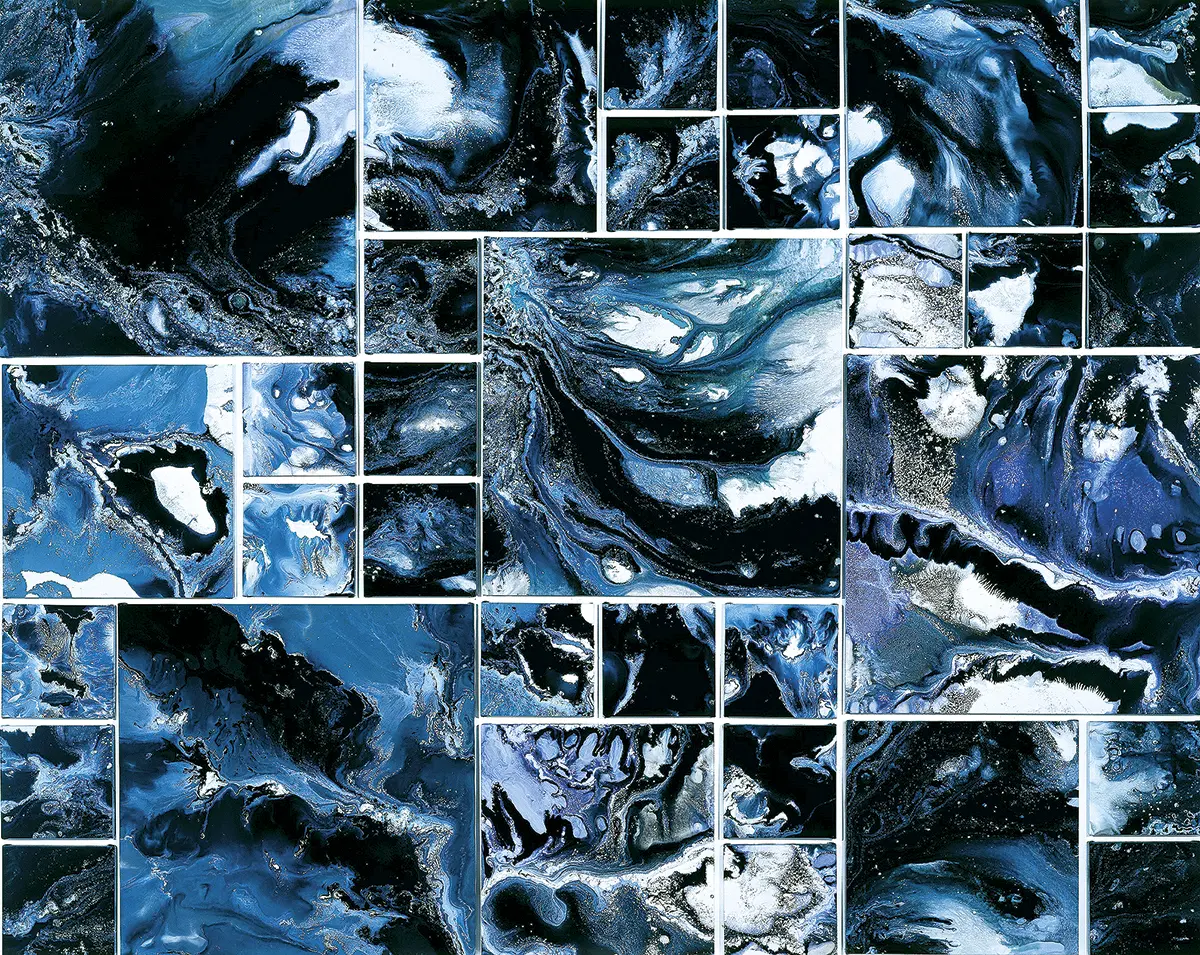
In his 2005 series of polyptychs Agua en el humo y cielo en el fuego, Mariño continues to create pictorial constructions where the image hovers at the border between abstraction and realism since painting is only poured onto the canvas —which brings to mind the technique of dripping—, and it is chance and the chemical structure of each color that create the stamp of color on the canvas, but at the same time, the use of these abstract technique acquires new realistic dimensions by invoking the series title, which refers viewers to the haphazard shapes of fire, clouds, and waves, and ultimately demonstrates that all abstract art can be seen as naturalistic art, and more specifically conceptual art.
Just like cosmos and nature are constants in the work of this Cuban artist, the issue of time is also repeated series after series, situating Mariño as a Labyrinth artist, directly connected to On Kawara, Jorge Luis Borges, or Pliny the Elder, where the constants of creation link the spiritual reality with the realm of science and the realm of emotion through topographies that encompass the stars, planets, dreams, and temporality. Such is the case of his paintings Radio Reloj (1998,) where the artist records the passage of time with the help of a radio station that gives its audience the exact time at regular intervals. The artist paints one line every time he hears the time and leaves a blank space while a song is played, or while he went out to eat and left the painting waiting, thus generations a logbook that is just as mediatic as it is spiritual or pictorial. The same occurs in his photographic series 24 horas (2003,) where Mariño takes one photograph of the sky every hour and arranges them as if in a clock, offering the viewer a record of the passage of time in nature, not as an abstract idea, but as a physical phenomenon that affects living things. This work also makes reference to the relativity of time, as viewers encounter 24 hours in a single moment, in movement and static at the same time.
Thus, this show was conceived as a brief glimpse of Man’s relationship with the universe, an approach to the cosmovision of contemporary Man, hit hard in his ego by the scientific theories of relativity and chaos, which have forced him to leave aside all anthropocentric and geocentric theories, resulting in a dichotomous relationship between curiosity and anguish, a constant awareness of the link between macrocosm and microcosm, translated by Mariño into the creation of fractal and poetic images.
LARISA ESCOBEDO