
Two white wooden beams are placed in parallel, traversing the center of the gallery. This unusual arrangement surprises viewers and leads them along an oblique path. The dynamics of this flow compels an unencumbered, almost everyday experience of Carmelo Fontánez’s exhibition.
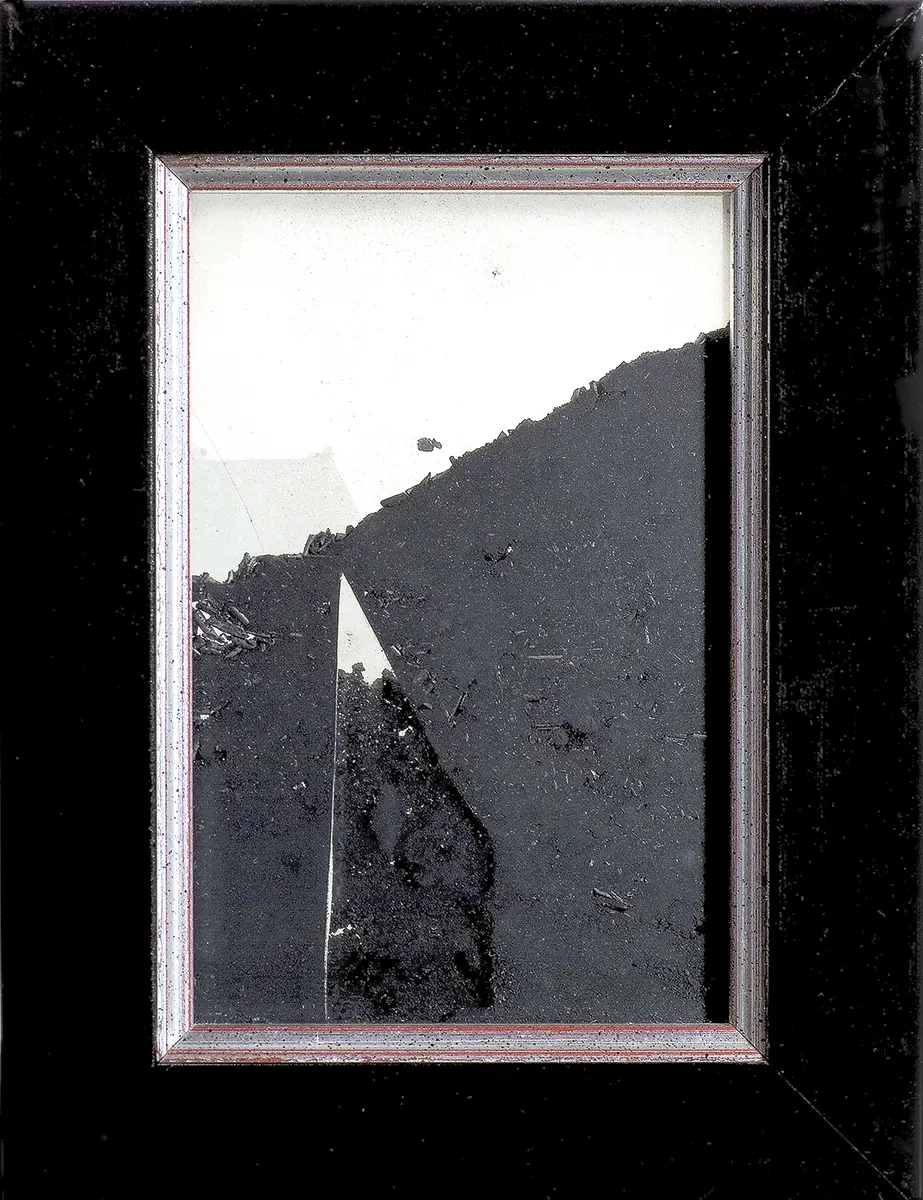
A simple shift in perspective encourages people to forget about the walls and focus their gaze on the pieces that parade on the beams. There is a series of boxes formed by framed sheets of glass. The superposition of these sheets creates spaces that the artist fills with materials typical of the draftsman’s trade: charcoal dust, ground graphite, and pastel. With them, Fontánez achieves rich effects of textures, veilings, and transparencies. Also, their appearance has a certain ephemeral character; as the position of the boxes is changed, their contents shift inside, creating new shapes.
This Partículas series suggests a geological sample. The composition of sheets that slide to create unlevel surfaces resembles geological fault lines. To this, one must add the use of mineral materials and the fact that some of the shapes suggest rock formations. Lastly, the show’s design highlights this meaning by emphasizing the installation’s character of exposition. In this way, the path between the beams is like a passage between fish tanks or windows, behind which a world of miniatures is on exhibit, a world of gemstones that have been transformed into instruments of an art.
The architect Otto Reyes’s intervention in the design of this exhibition was essential. This demonstrates that exhibition design should be left in the hands of this kind of professional. Indeed, there is an emerging need to create an area of specialization in the architecture curriculum because architecture offers the best tools to work creatively with space.
The most notable aspects of these pieces are their sculptural presence and their unaffected, natural demeanor. As Rafael Trelles notes in the catalog, these works “navigate between the waters of sculpture and drawing.” Each one constitutes a double drawing since each of the box’s two faces presents a particular composition. The use of glass as support enhances this richness because its transparency produces the integration of the elements that surround the piece.
What I have called the work’s natural demeanor is perceived in those “simple things from everyday life that can detonate an artist’s creativity: a piece of broken glass, the abrupt texture of mountains painfully sliced through by a highway . . . the tactile qualities of a piece of charcoal.” To these we must add happenstance—chance plays a key role in the configuration of these drawings—which was present early on in the artist’s poetic universe.
Carmelo Fontánez, born in 1945 in Río Piedras, Puerto Rico, built his first boxes—closer in spirit to those of Marcel Duchamp than of Joseph Cornell—in the 1970s, using wood and Plexiglas sheets. In those days he filled the spaces with salt, colored wood shavings, plastic beads, little tubes, and sequins. Later he explored more conventional draftsmanship, with an abstract bent.
His return to constructions occurs with this decidedly mature series. Fontánez has removed the paper and dislocated the remaining elements of the traditional work of art. Only the frame serves its conventional function. The glass is broken and creates shapes in space, the border of some land. The draftsman’s tools are now integrated as raw materials, without any mediation by the symbolic language of art. Everything becomes more direct and corporeal.
But the results go beyond making the exquisite object. The agglutination of art materials confined to a pre-determined area could represent a metaphor for the limits of expression. However, as they break the logic of the glass sheets’ structure, the materials offer a paradox. Even in a space closed twice, by the glass sheet and by the frame, there is room for expressions of chance, of freedom.
ELVIS FUENTES