
In L’Idée fixe; ou, Deux hommes à la mer (1933), the French poet Paul Valéry states that what is deepest in man is his skin. This seemingly contradictory statement describes, in principle, the recent works Catharina Burman presented at the University of Salamanca Cultural Center in Bogotá. The show was divided between the two main rooms of the colonial house occupied by this foundation. In the first room, there was an installation with a group of mannequins, their torsos made of parchment paper and resin so that the objects contained within were visible. These objects, which ranged from the religious to the lascivious, seemed to allude to the many aspects of the female condition. On the mannequins, hung like clothing inside an armoire, the skin fused to the content, which often surpasses its insignificance, in an attempt to illustrate the fact that the skin is not only a container but also content in itself. In the second room, the meaning of Valéry’s phrase acquired full meaning with a series of photographs titled Mujeres, which floated in space, inviting the viewer to follow a path between them. Unlike the size-8 mannequins in the first room, these photographs moved away from the ideal image of the female form to affirm flesh and physicality, with all the gravity and forcefulness of lived experience.
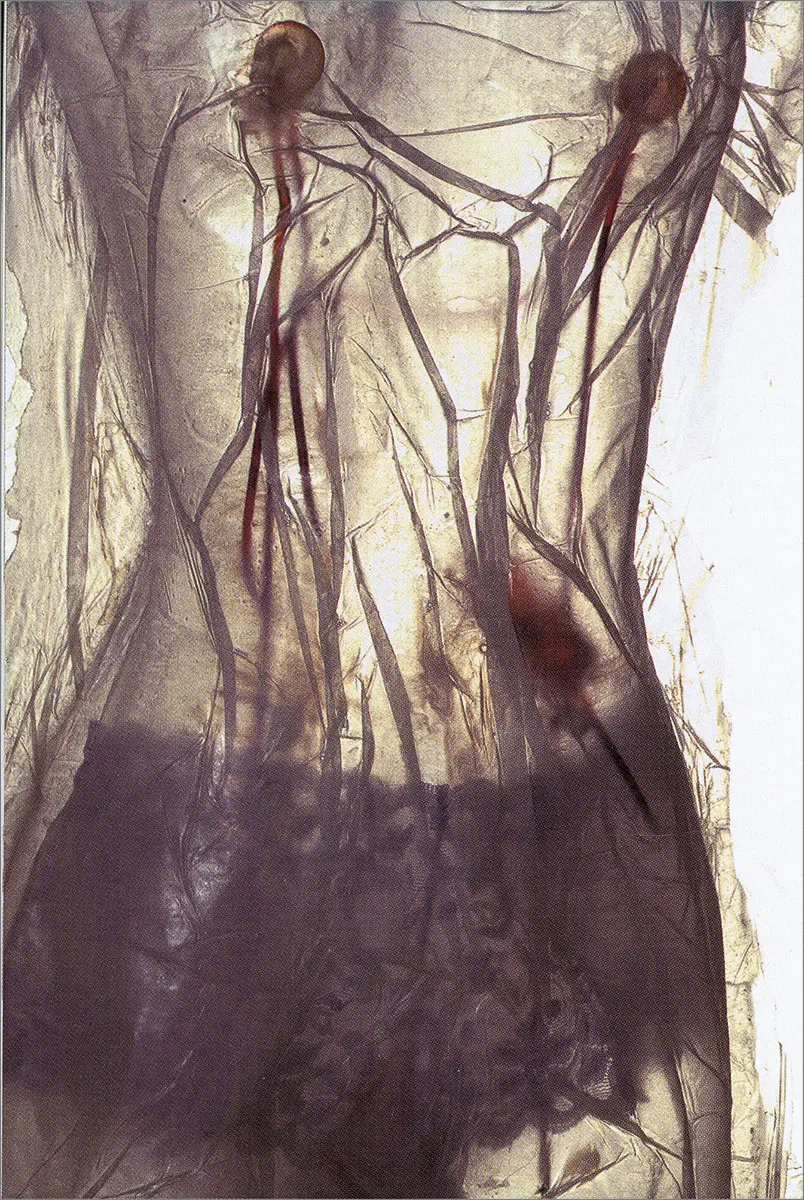
The topic of the female body is as old as art. From fertility and desire to the field of political debate, its symbolism and its implications have changed according to time and place. In that sense, Burman’s work does not propose anything new; yet its importance resides in its pertinence, as it emphasizes a current situation from a highly personal point of view. With the recent widespread popularity of plastic surgery and “extreme makeover” reality shows, the female body has become a collective obsession. In the context of these developments, the idea of the body as a kind of raw material that is there to be modified in the image of an ideal, which is further and further away from reality, has a very strong influence on the way we face our own corporeality. Photography plays an important role because it is through photography that ideas about the care for and the presentation of the body are disseminated and consumed. It is thus ironic for Burman to have chosen the same medium to speak of the mundane aspects of the female body and how close it is to nature, even as we attempt to rebuild it using science. The irony is nonetheless understandable, inasmuch as the artist attempts to make a statement that is contrary to what the mass media does with the same language. In the bold half-nakedness of her protagonists, Burman searches for beauty in bodies that are far from possessing advertisement-like perfection but are beautiful as maps of lived lives.
The Corpus series, then, is a cruel and emotive reminder of the nature of the human body and its push towards decay. Photography becomes a celebration of that process, turning the everyday body into something that deserves to be immortalized. The skin of each woman makes visible an entire life. By placing a mirror in the back of her photographs, Burman warns her viewers, as in a memento mori, of the fate that awaits their own bodies. Thus, Catharina Burman’s photographs confirm the validity of a sentence used by the American artist Barbara Kruger: Your body is a battlefield.
MARÍA CLARA BERNAL