
The title of this show refers to David Lamelas’s (Buenos Aires, 1944) permanent condition since leaving Argentina in 1968 to begin a long journey that took him to London, Berlin, Brussels, Milan, Los Angeles, and New York, only to resettle in Buenos Aires in 2001.
Lamelas’s life journey had as its purpose to achieve internationalization and to transcend Argentina’s isolation in the 1960s from the circuits and trends of contemporary art; his work could not but reflect that sustained state of transit. Lamelas has used a variety of media and languages, from minimalist abstraction to the purest conceptualism, media art, structural cinema, and a Pop parody of television.
Lamelas’s works emphasize the relationship between sculpture and architecture. His pieces 28 placas ubicadas en dos formas no convencionales (1966–68) and Situación de cuatro placas de aluminio (1966), both spreading around the floor and leaning against the wall and atop a table, propose a provisional sculptural situation that provokes thoughts about space as it is used for exhibitions.
Lamelas devotes himself to the exploration of the mass media and the ways in which they mold reality. Among the most emblematic pieces from that period is Situación de tiempo (1967), an installation of 17 static-projecting TV monitors lined up on a raised base, which proposes a luminous and spatial experience. Límite de una proyección (1967) operates in the same sense; there, a high voltage light cannon inside a dark room illuminates a photograph of that same light beam, as well as itself as an instrument of the spectacular.
One of Lamelas’s more radically conceptual works is Time as activity (Dusseldorf) (1969). It is a film divided into three four-minute sections that contain the same type of information: a soundless registry of the activity that takes place in three different locations filmed with a fixed camera. Accompanying the projection are three photographs with the date and time of their shooting, which constitute a record of urban activity in which time remains identical to itself.
Lamelas has been linked to Europe’s most significant conceptual artists, and his work was permeated by the artistic contexts of the cities where he lived. Yet, Lamelas reacts to the objectivity inscribed in conceptualism, appropriating media stereotypes and narrative strategies from film and TV. As a result of that turn, he produced Film Script (Manipulation of Meaning) (1972), a minimal film in 16 mm. His resources come out of an artistic context; the protagonist is the assistant in the gallery where the piece was to be exhibited, and the film appropriates the conventions of the thriller. The same images are repeated in three slide projections, but the script of each has been modified by changing the sequence of actions or by cutting scenes, making explicit the effects of a “manipulation of meaning,” as noted by curator Inés Katzenstein.
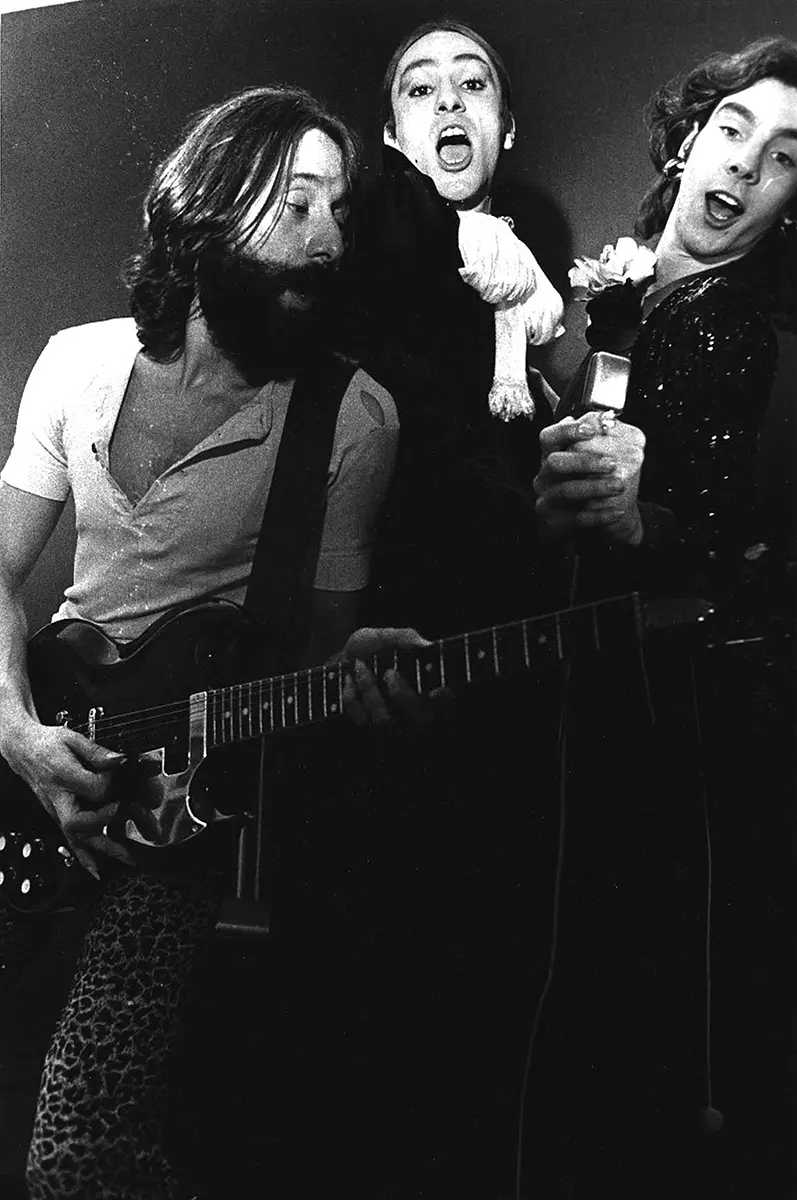
With the same intention, he created in London the series The violent tapes (1975), a sequence of 10 still shots from an imaginary film. This piece is formed as a parody of action or spy movies and highlights the dramatic points of view. In the series Rock Star (Character Appropriation) (1974), in eight black and white photographs against an austere but suggestive backdrop, the artist adopts different postures and attitudes characteristic of rock musicians.
Lamelas captured moments in the cities where he lived and did the same with a large number of artists and friends he met. His series LA Friends (Larger than Life) (1976) comprises 40 pencil drawings and the projection of 80 slides of portraits of friends, artists, and lovers with their name and place of residence, in an attempt to keep detailed records of the social “accidents” that, thanks to his nomadic existence, never ceased to happen to him.
Also dating from his time in Los Angeles are the videos The Dictator (1977) and Scheherazade (1980), both created in collaboration with Hildegarde Duane and both an ironic critique of the language of TV in the United States, a parody of the phenomenon of immigration, with the figures of an exiled Latin American dictator and an Arab potentate who despises U.S. culture.
RUBÉN BONET