
Ernesto Pujol’s exhibition The Promised Land featured photographs and sculptures from three different projects that the artist developed with local communities over the past five years. These projects, commissioned from the Cuban-born, Brooklyn-based artist by regional museums, were based on exchanges with community leaders, artists, farmers, and ranchers, and originally resulted in ephemeral site-specific installations, which later were transformed into documentary material, exhibited here for the first time in New York. These photographs are from environmental projects based on the landscapes of Kansas, Pennsylvania, and South Carolina.
The first project, titled Becoming the Land, was commissioned in 2003 by the Salina Art Center in Kansas and curated by Saralyn Reece Hardy. It was a meditation on the transformation of the Midwestern prairie into grid-like farmland during the nineteenth century. Pujol traveled back and forth between Kansas and New York and worked with the local citizens, bridging the gap between art and society. This first group of seven C-Prints, each measuring 40 by 60 inches, is a condensed version of a larger exhibition that originally included photographs, an installation, architectural elements, and video.
The photos refer to a utopian dream of local people walking into the prairies, longing to bond with nature. Pujol depicts archetypes of the traditional North American immigrant family. He placed lonely children with their backs to the viewer in the open prairie, a clear reference to landscapes by the German Romantic painter Caspar David Friedrich, such as Monk by the Sea (1808). He also opts for low horizons reminiscent of Dutch landscape painting, even as they accurately represent the geography of Kansas. The idea of longing for a past that no longer exists connects the three projects on view.
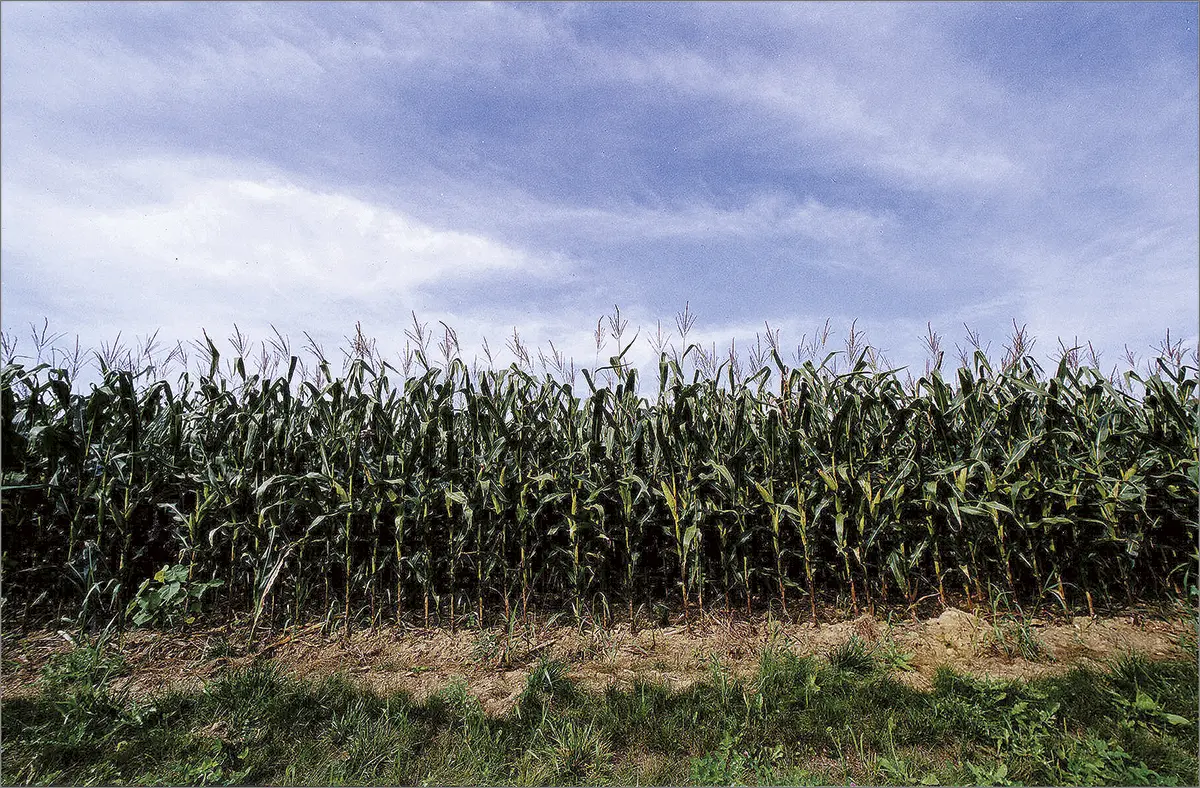
The second project was curated by Julia Herzberg in 2002 for the Jersey City Art Museum and is titled American Fields. The artist presented prints of the changing landscape of the Lehigh Valley in Pennsylvania, as industrial parks replaced old cornfield farms.º In this suburban landscape, one industry is substituted for the other, creating vast industrial parks where technology supplants nature. In this series of three photographs, all 40 by 60 inches, Pujol showed images of cornfields, accompanied by a dozen cast-aluminum corncobs placed on a rustic farm table. With this installation, Pujol comments on the American landscape, whether in the form of grid-like fields of cultivated corn or the constructed industrial grids of factories and vast storage spaces. Throughout the exhibition, the American landscape unfolds as a place that bears the wounds of a utopian past.
The last and most recent project, from 2004-2005, was represented by five digital photographs of various sizes; the original project was curated by Mary Jane Jacob for the 2004 Spoleto Festival in Charleston, South Carolina. The artist was part of a collaborative team that created a temporary urban rice garden titled Water Table, exploring the rice economy that historically supported the peninsula. The original project emphasized the wetland and vast rice plantations that became the major symbol of the region. However, the images chosen by Pujol for this exhibition are about the transformations that took place in this charged landscape. Pujol’s images show local people fishing in the marshes at low tide. They convey the way in which the colonial industry based on rice and slavery is no longer in place and was substituted by the industry of entertainment and tourism.
Pujol is known for his body/performance-based artworks about gender, masculinity, race, exile, ethnicity, and memory. In his 1999 series Hagiography, he masqueraded as a female nun, in a reference to his upbringing by missionary nuns and the years he spent in a cloister as a monk, being trained as a Catholic priest. This new body of work about the landscape is less biographical and is instead more oriented toward other peoples’ experiences, memories, history, and narrative. Nevertheless, Pujol’s personal research into the landscape characteristically bears the memory of the past. Pujol’s interest in environmental issues relates to his training as a landscape painter in Puerto Rico in the seventies. In this series, the artist plays with large-format photographs with a soft, grainy quality that gives them a texture reminiscent of painted surfaces. Memories of displacement seem to persist as the main theme in Pujol’s work, even if he here expresses them not through his own body but through the body of the American landscape.
CLAUDIA CALIRMAN