
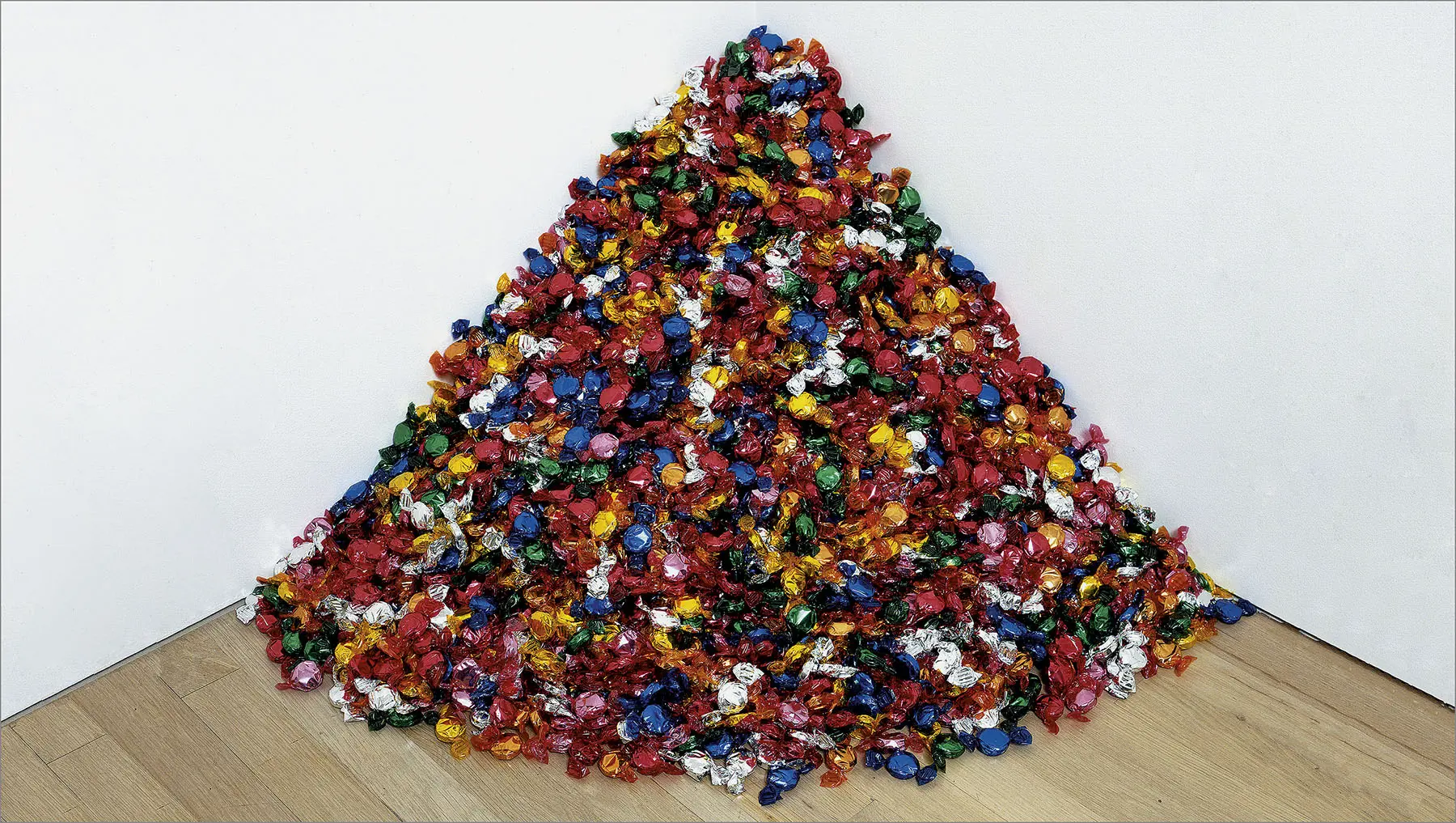
The compilation and research of materials from Félix González-Torres’s creative period in Puerto Rico (1978–1985) has unveiled a history that was unknown to many. These works in video, photography, printing (including some art pages in newspapers) letters, projects, and documentation of performances and installations allow us to trace the origin and trajectory of some of the artist’s concerns.
We know, for example, that his work was viewed favorably by critics and contributed to fields like photography and the graphic arts. González-Torres’s use of Polaroid technology, of ephemeral printing, the conceptual base of his work, and his experimentation outside the traditional aesthetic framework resulted in early recognition of his work.1
This essay presents some aspects of the relationships between the artist’s formative period and his cataloged work. It summarizes a research project currently in progress, but we believe it will be useful to viewers.
In October of 1985, González Torres took part in the II Muestra Nacional de Fotografía Puertorriqueña at the Museum of the Universidad de Puerto Rico (UPR), Río Piedras, with a series of fifteen works combining color photography and texts. We are not familiar with these works, but their features can be deduced from the information gathered.
In the catalog, which included a portfolio, we find Untitled (1985), the image of a sculpture that was probably a public work, and a poetic text. This is the format used since 1985 when González-Torres published his first fotonovela.2 The artist’s manifesto explains the choice: "It is difficult to separate the image from the text. Our verbal articulation is a logical reaction, immediately upon seeing an image. Even when there is no written text."3
The image/text is presented in various forms: pages of periodical art (fotonovelas), interventions in postal art through printing processes (the image is readymade, with postmarks and stamps), and photographs showing commercial advertisements. Even in his performances, González-Torres often distributed a declaration. The text was part of the work and, at the same time, it established a context.
This characteristic was pointed out by the writers in the catalog exhibition. According to Nelson Rivera, González-Torres’s images mix with texts that refer to the photographic act itself.4 Liliana Ramos says that “this bad conscience [of the usefulness of the photograph] hardens in the fotonovelas the photographs reduced to texts and the texts risen to the level of photographs".5
The image in the portfolio represents two male bodies, nude and interwoven. It is an allusion to homoeroticism, which appeared already in his earliest publications.6 The text reads: “The place [was] so photographic, he would have said, almost like a postcard. The blue sky, the clouds, the exact moment . . . . Then he aimed the camera. Click...”
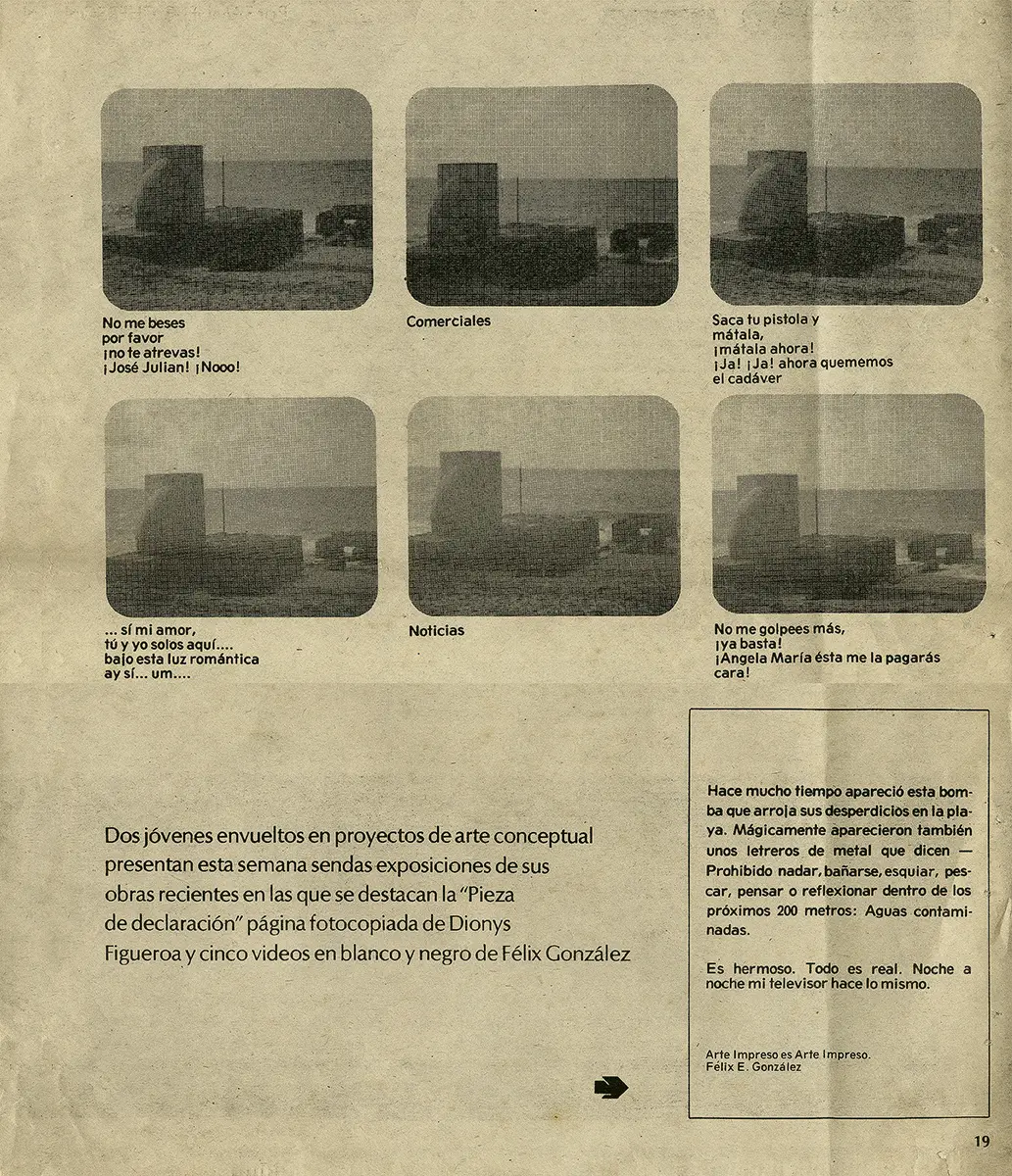
The ironic counterpoint that results between an image and its text is common. For example, in Environ/Mental Pollution (1980), six identical photographs show a plant that dumps black waters on the beach. The “speeches” refer to television: sentimental, violent, and commercial scenes. A footnote explains: “A long time ago there appeared this bomb that throws its residues on the beach... Night after night my TV does the same."7
In other words, “An innocuous object from the material world is allegorized in order to denounce TV’s contaminant function [...] We are invited to discover similarities between the excrementitial and the mediatic..."8
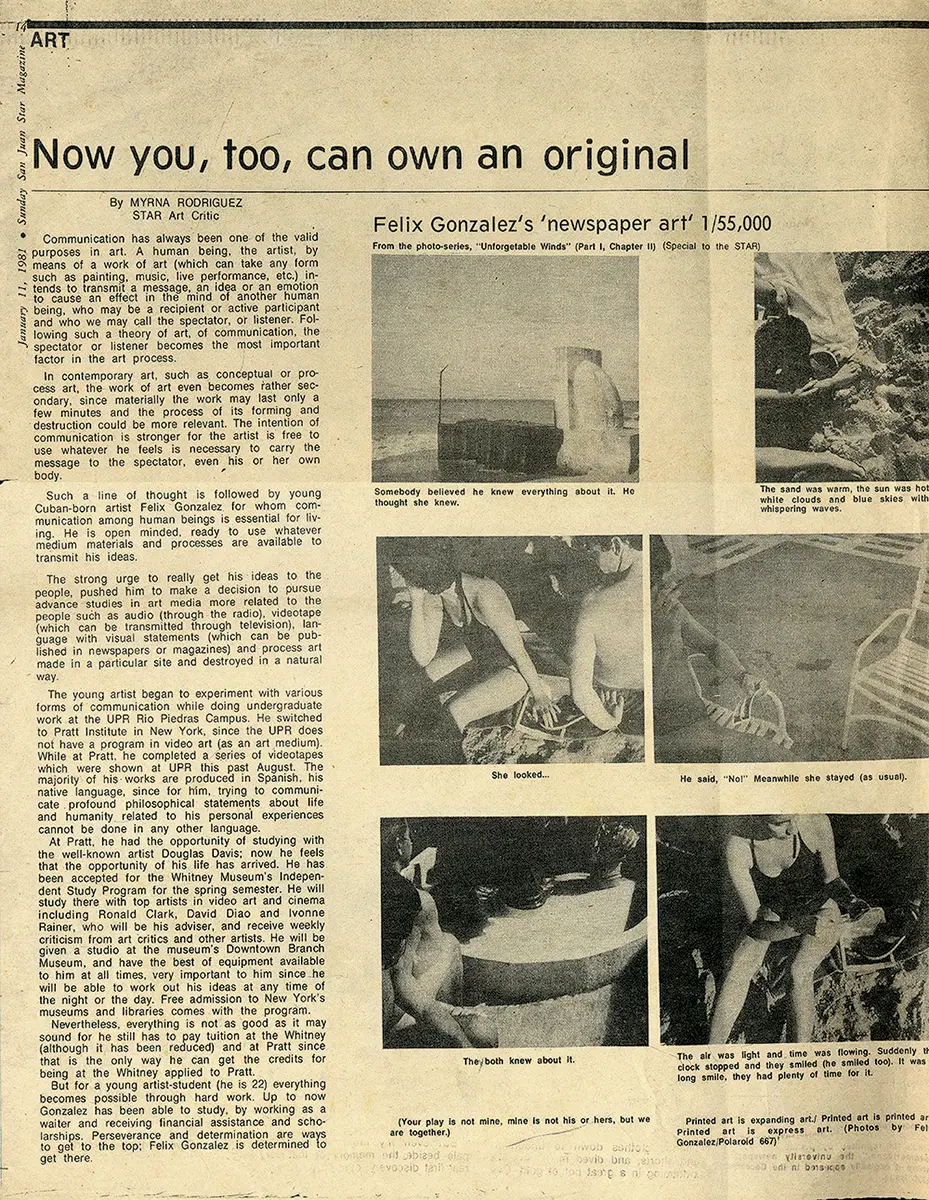
The same photograph heads the second insert, Unforgettable Winds (1981).9 Here it is a seemingly extraneous element because it is followed by images of a couple at the beach. The camera avoids their faces, and the descriptions are impersonal. This contributes to rarefy the sequence, even as the link to the previous one is explicit.
González-Torres recycles motifs from his own work; this can be confirmed by thumbing through the catalog raisonné. He did this already in his initial experiments, which do not record the origin of many of his themes.
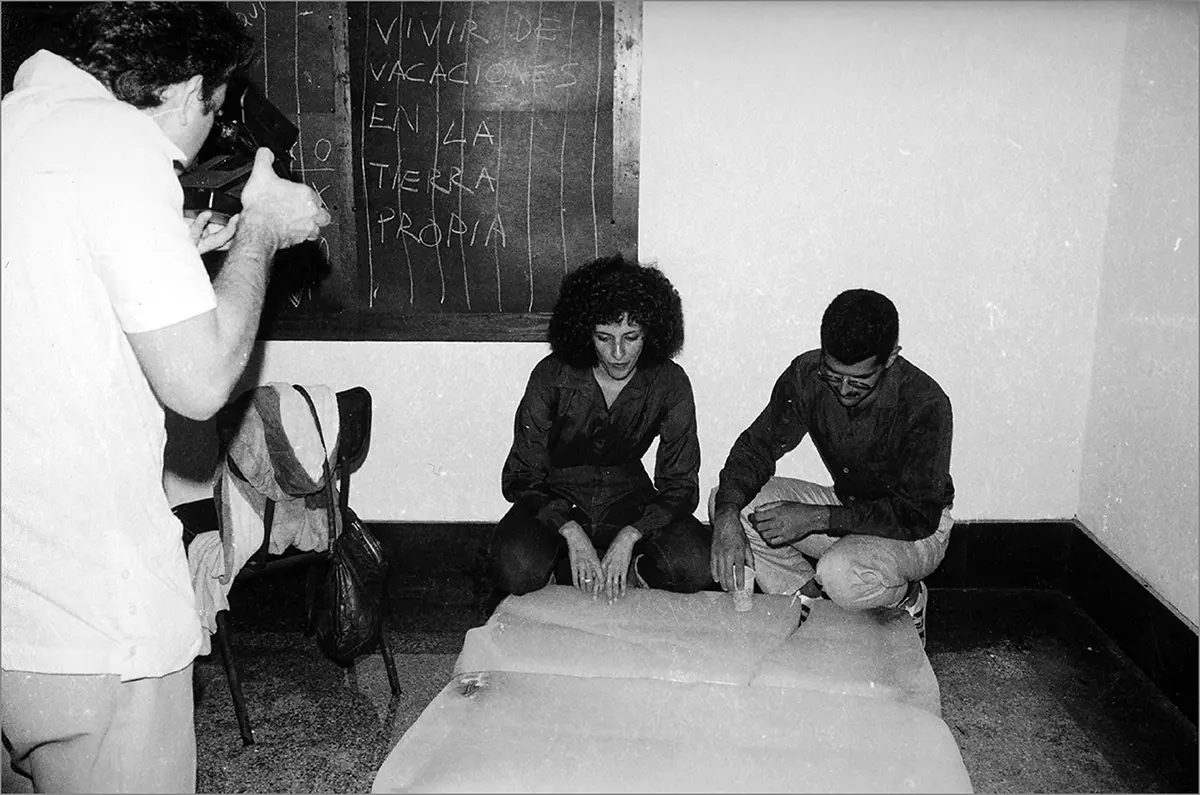
For instance, the paper maché masks used in Society or The Melting of Society (1978), a project conceived by González-Torres and executed in collaboration with students Rosa Balsera and José Pérez Mensa, along with a work that consisted of a line of ice blocks placed in the Antonia Martínez Square at the UPR, performed in 1978 and reviewed by the local press, reappear in the video Self Portrait 3 (1979) and again in his series of platinum-on-palladium prints (1983.) But their meaning varies. They refer, respectively, to social conventions that need to be deconstructed, the limits of representation, and the game of veilings of taboo sexuality.
There are beach chairs in the insert Unforgettable Winds and the performance The beach is nice (1983). Likewise, this element is used in two puzzles: Untitled, # 182 of 1991, and Untitled (Paris, Last Time, 1989), # 55 of 1989.10
Finally, the photograph of the sculpture in the portfolio is recycled as is one of the puzzles, Untitled, # 32 of 1988. Nevertheless, the text disappears or follows a different path. This intertextual relationship reveals a change in González-Torres’s proposal.
This change can be seen in the comparison between the two works. The first was created by González-Torres for the Public Art Bus Show (1984.) The text in question, alluding to militarism, was part of a diptych alongside an image of the sky seen through palm fronds: “sometimes he had many nice dreams, mostly about his weapon and his duties. Nice."11
Later, in a one-person show at Intar Latin American Gallery in 1988, the artist prints only the phrase “I always wonder if men in uniform sleep better after performing their duties.” The text gains independence, becoming itself an image, as in the timelines of the first “paper stack” in photocopy (Untitled, 1988, # 26). To “our verbal articulation” of the visual, González-Torres opposes the transit from text to the symbol.12
Moving in this direction are the press clippings reproduced in González-Torres’s posters and his linguistic portraits. Moreover, the photos of inscriptions in the monument of Untitled (Natural History) and the details of the letters are forms of the written word, typography, and calligraphy. In the letters, he plays with the ambivalence of the word, which means both a written message and each of the symbols used in writing. The letters join content and form and reach the artist’s greatest aspiration: “Content must be integrated into the form, and vice versa."13
Why does the artist attach such importance assigned to the letter? A study of the formative period and the history of Puerto Rican art offers some answers.
Poetic expression was what initially attracted González-Torres and began his course of study at UPR. In 1979, he published several poems and short stories in a student publication titled Contornos. Later the visual arts, video, and photography, were to replace writing, but he always found a way to incorporate it.
For example, the documentation of Rust: Dreams on an Ice Bed (1982) was published along with a text in verse and prose. Likewise, the CEPA Gallery bulletin included a poem titled Fetichism and information about the project of “Public Art Metro Show” in Buffalo in 1984.
Another formative element in González-Torres’s work is the graphic tradition in Puerto Rico. The modernist renewal in Puerto Rico took place through posters linked to activities with a political reach, such as the work of the DIVEDCO starting in the late 1940s.14 Due to its educational purpose, which required didactic texts, and the persistence of its practice, Puerto Rican poster art opened two paths: “letter-ism” and the conceptual variant of the graphic arts.
Also, the mass character of this production influenced printmaking, especially the portfolios that became a popular format with large print runs. The idea was to bring art to the people. In terms of criticism, an analogy was made for posters with the metaphorical expression of a “freed sheet."15
Marking a turn toward the visual arts, González-Torres took for the first time a graphic arts class at UPR. Some of the principles of this discipline were to be assimilated into his work, especially its communicative function, for the effectiveness of which one can bring mass culture to bear, and the possibility of reaching a wide public.
González-Torres used to say that The New York Times was his source of inspiration. Indeed, upon becoming a member of Group Material, he took part in an art insert in that newspaper. But his interest in the media has its roots in his Puerto Rican period.
The performance TV Empty-Empty (1979) consisted of two people sitting in front of a TV monitor without a signal, while the artist read an ironic text about everyday topics related to television. Around the same time, he published an epistolary short story titled “...Dear TV,” a diatribe against the banality of the mass media. His source of information, he declared, had been the San Juan newspaper El Mundo.
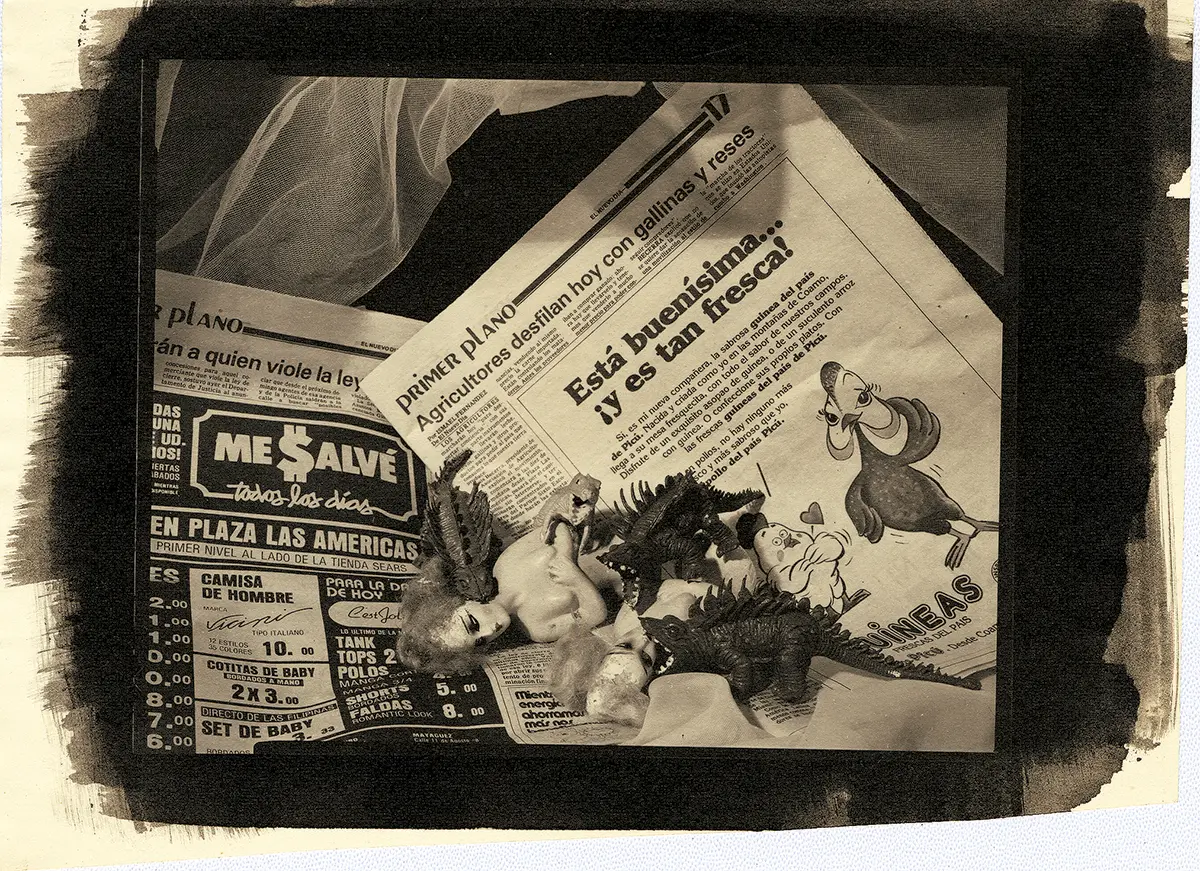
In his series of platinum-on-palladium prints, which are like still-lifes, newspapers appear as background. The narrative sequence describes a group of dolls being attacked and devoured by toy caimans. The texts from the newspaper are integrated into the anecdote and work like speech (“It is soooo good... and so fresh!”).16
Such self-assurance demonstrates a profound empathy with the graphic medium, where González-Torres recognizes a destabilizing power against the institutional power of art. Taking as example a work by Dionys Figueroa,17 he comments on “these anachronistic notions [of what ‘is’ and ‘isn’t’ appropriate and elegant with regards to current creative media] make no sense once he dares to present a few thousand Xerox copies as original works of art. The power exercised by the artist through his use of photocopies of an image as a work of art is for many a very dangerous act."18
The newspaper pages with the comments “Now you too can own an original” and “Printed art is expanded art” prepare the field for an editorial concept. González-Torres planned an “exhibition of printed art” using as his “gallery” an avant-garde publication, Reintegros, edited by Liliana Ramos. Unfortunately, Five pages by five artists (1984) were canceled for lack of funds.19
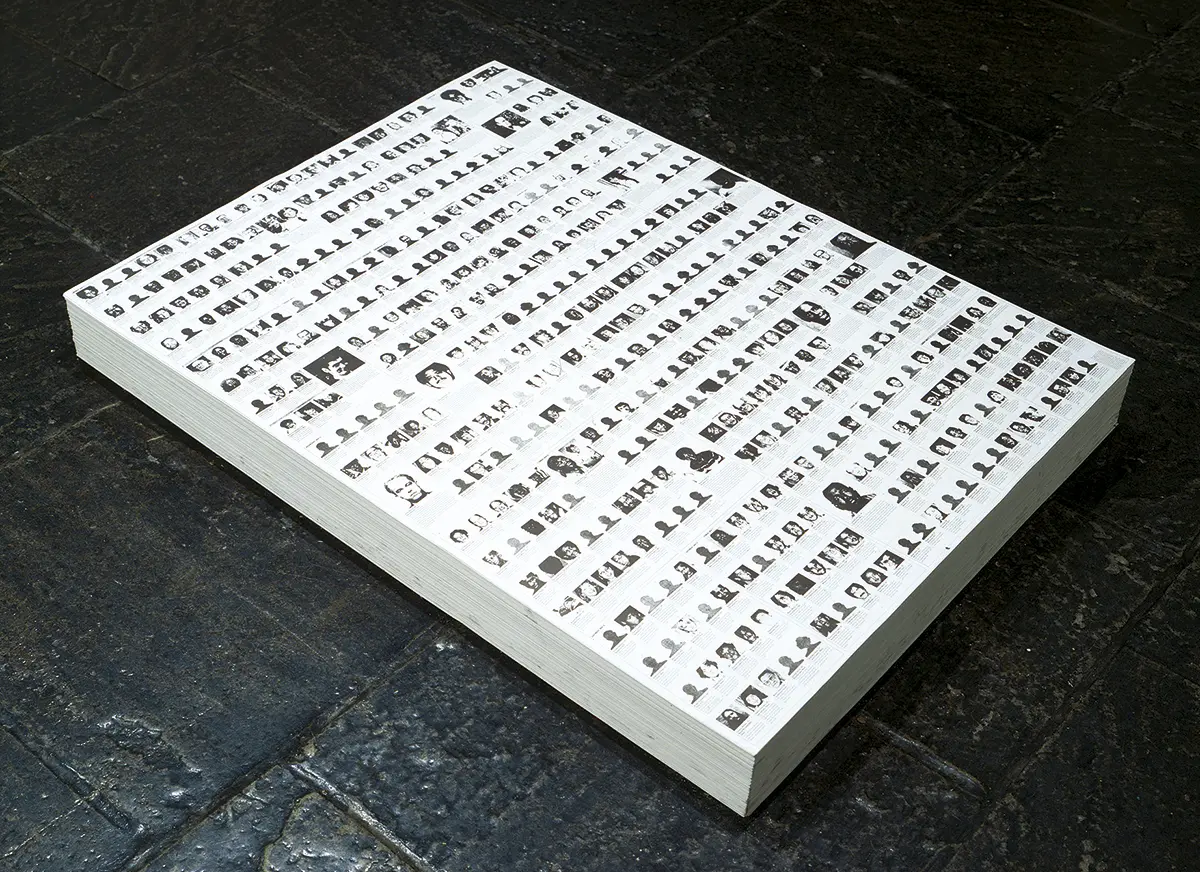
González-Torres expressed himself in photocopy, postal art, postcards, and video art, which was seen as an alternative to commercial TV. He was after a typology or medium that allowed him effective communication and then democratization of art. For him, the reproduction of the work of art “lays the ground for an artistic Democracy.” Finally, he arrived at the stacks of posters, the first of which was done using photocopies.
The bibliography about González-Torres has reinterpreted this typology in relation to minimalist art. However, documentary finds lead us to, first, the mass reproduction implicit in the photocopied declarations he distributed at his events and, second, the poster art tradition.
González-Torres valued the use of photocopies and used that medium. He made artist’s books, one of which he exhibited in 1983 Artist’s Books at Franklin Furnace, New York, and his first stack of posters in photocopy (Untitled, 1988, #26).
Since the 1970s, Puerto Rican poster art has been in crisis. The decline in production, the adoration afforded the masters, and the emergence of an incipient market among other factors stimulated a practice focused on technique. Posters became collector’s objects, created for the gallery in limited editions and even signed. In this way, artists gave up the medium’s mass potential and political function.
González-Torres’s stacks are a parody of those “gallery posters.” They locate themselves in a previous moment; they bring to mind the packs of freshly printed posters warehoused before being taken to the streets and stuck to walls. Also, they reject traditional art techniques in favor of mechanical means of reproduction.
In his performance Rust: Dreams on an Ice Bed, at Casa Aboy on January 23, 1982, González-Torres assumed the role of the tourist. After covering his body with sunscreen, he laid down, wearing his swimming trunks, on a block of ice. In his declaration published in High Performance, he prompted us to “Come and enjoy/ come and forget... You don’t have to be involved/ you don’t have to know the land."20
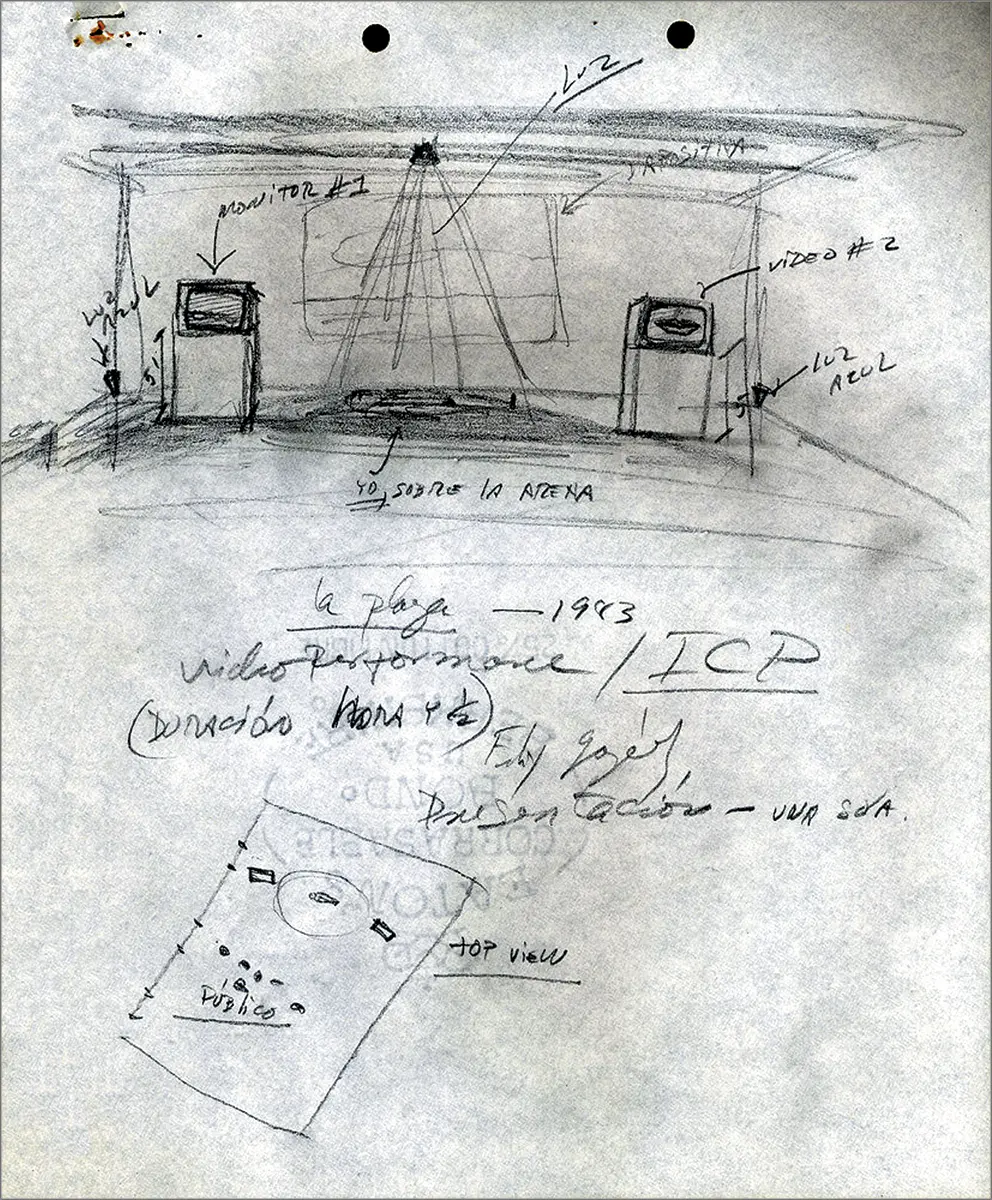
The Beach (1983), a project that was never performed, proposed an installation/video/performance where the artist was to remain on a sand carpet while a slide showing a blue image of the sea was projected onto a wall.21 Two monitors to the sides and loudspeakers were to broadcast recordings of beach sounds and news updates. “My purpose is to show in a lyrical and denotative way how the ‘beach’ subject is formed by contradictory elements. A metaphorical place of escape (vacation) and a real and literal place of escape."22 He is referring to the fact that it is a place shared by refugees, immigrants, and tourists.
This kind of work points in two directions. First, the presence of the personal is incisive in its earliest expressions, such as the short story Mario (1978) and the video 10 years, 10 hours, 10 mothers (1979). In them, González-Torres explores the fragility of the memory of a child forced to emigrate (“At the age of ten you are a package sent to Spain,” he narrates in the tape).
This fragility takes shape later in the series of puzzles in which the artist condenses the visual and the literal with great cunning. The impossibility of remembering is expressed in the Spanish phrase “breaking one’s head”; in a figurative sense, it means thinking hard about something without being quite able to bring it to mind. The English word “remember” is transferred to physical action, remembering, as construction of memory.
The second direction leads to the fallacy of the innocuous image: “The image [...] is used constantly in an attempt to establish structures of thought to help preserve and reinforce the economic, political, and social status quo. The most innocuous photographs, such as family pictures, contribute to this [...] Through the family picture, cultural roles like patriarchal society are established [...] Everything or almost everything has been photographed. However, printed images still do not occur through spontaneous generation. Who decides what will be reproduced?"23
This awareness of an ideology or political force is one of the essential features of González-Torres’s work. The tourist’s vacations and idleness are later transformed into the jumbles of candy and bon-bons. They both typify society and consumerist habits. Likewise, the photographs of symbols taken from the mass media (the Pope’s church, the Supreme Justice’s hand, Klaus Barbie’s family,) printed in the form of puzzles, respond to a deconstructive tactic that the artist himself had set as his goal in 1981: “The image is an instrument of codification. It would be facile to use an analysis of the mass media as a pretext for a partial political critique."24
Experimentation in photography and the graphic arts; a close relationship with the media, especially the press; the importance of the text as image; a dialogue with the tradition of the poster; and the themes of the beach, memory, the migratory experience, and the family are some of the threads that link the work of Félix González-Torres to his formative period in Puerto Rico. The documents gathered for this project allow us to see some lines of communication and demonstrate the need to study this relationship in greater depth.
NOTES
1. In his manifesto, he warned: “Many photographers assume the equation of ‘injustice and exploitation’ with photographic realism, using a conventional means of representation and presentation of the works, which means a simplistic attitude about the relationships between content and conventional form: frames, mirrors, protectors, ‘good’ photographic printing, etc.” Félix González, “The Image as Product/Power,” Domingo magazine, El Nuevo Día (July 26, 1981) 17.
2. Environ/Mental Pollution (1980) accompanied Samuel Cherson’s article “Art as Idea,” in the Domingo magazine of El Nuevo Día (August 24, 1980) 19. According to Liliana Ramos Collado, it was an “advertisement for a 1980 video exhibition.” From her essay “Untitled: Portrait of Félix González-Torres in Puerto Rico, 1980–1983”. ArtPremium (May 2005) 70. However, I disagree with this assessment, which negates the work’s autonomous character. The artist described it as a “page of printed art” in his curriculum vitae at the time. The note that refers to the exhibitions reviewed in Cherson’s article of videos by González-Torres must have been added by the editors.
3. Félix González, op. cit., p. 16.
4. Museo de Historia Antropología y Arte, Universidad de Puerto Rico at Río Piedras, II Muestra Nacional de Fotografía Puertorriqueña. Puerto Rico: Museo de Historia Antropología y Arte, Universidad de Puerto Rico at Río Piedras, 1985, p. 2.
5. Ibid, p. 4.
6. For example, in the poems “Drógame de ideas locas” (dedicated to his friend Miguel) and “Hoy soy alegría” (which is read as gay and reinforces it in verses like: “strange germ of madness, / I am a little corny flower”), both in Contornos (Vol. IV, #2, first semester of 1978–79).
7. Félix González, Environ/Mental Pollution. Printed art page. Domingo magazine, El Nuevo Día (August 24, 1980) 19.
8. Liliana Ramos Collado, “Untitled: Portrait of Félix González-Torres in Puerto Rico, 19801983,” ArtPremium (May 2005) 70.
9. “Félix González, Winds Unforgettable,” Sunday San Juan Star (January 11, 1981) 12.
10. The numbers indicated in these works correspond to the order established in the artist’s catalog raisonné. Dietmar Elger, Felix Gonzalez-Torres: Text & Catalogue Raisonne. Germany: Cantz Verlag, 1997.
11. CEPA Gallery Bulletin. Buffalo, New York: November 1984.
12. Félix González, op. cit., p. 17.
13. Idem.
14. The Community Education Division (DIVEDCO) was a government initiative. It provided rural communities with the necessary tools for the betterment of their living conditions. Its educational resources were directed toward developing the concept of self-help. Film, posters, and the publication of children’s and didactic literature were the forms produced. DIVEDCO offered employment for many artists in its film and graphic arts, photography, and theater workshops. It was closely linked to the experiences of the Works Progress Administration (WPA), implemented by the Roosevelt administration in the United States in the 1930s. For poster art in the context of the DIVEDCO, see Teresa Tió Fernández, El cartel en Puerto Rico. San Juan, 2003.
15. Margarita Fernández Zavala, “Inscrit@s y Proscrit@s, desplazamientos en la gráfica puertorriqueña.” Instituto de Cultura Puertorriqueña, Trans/Migraciones, la gráfica como práctica artística contemporánea. San Juan Polygraphic Triennial: Latin American and the Caribbean. San Juan: Instituto de Cultura Puertorriqueña, 2004.
16. Teresa Tió, “El portafolios gráfico o la hoja liberada.” Instituto de Cultura Puertorriqueña, El portafolios en la gráfica puertorriqueña. Tribute exhibition. 11th San Juan Latin American and Caribbean Printmaking Biennial. San Juan: Instituto de Cultura Puertorriqueña, 1995.
17. The reference is to the conceptual work Pieza de declaración (1980), reviewed in Samuel Cherson’s article “El arte como idea.” In the same article, Cherson comments on González-Torres’s video-art exhibition at the UPR.
18. Félix González: “The Image ad product/Power”. Domingo magazine, El Nuevo Día (July 26, 1981) 17.
19. Interview with Liliana Ramos Collado, in San Juan, June 2004. This editorial/curatorial concept is similar to Group Material’s insert in The New York Times.
20. “Félix González -Torres: Rust, dreams on an ice bed,” High Performance (Spring–Summer, 1983) 83. Coco Fusco says in Corpus Delicti that the next year, and over a period of thirteen consecutive days, another action took place where González-Torres once again assumed the role of the tourist. The artist himself says that: “The piece was performed right into the ‘real’ world and in complete anonymity. No press release, no specific props, actions, or text. Only trivia . . . I simply laid under the sun for the duration of the performance.” This performance appears as The beach is nice (1983) in Coco Fusco’s Corpus Delecti, Performance art of the Americas (London: Routledge, 2000). The location is Santurce, and it must be Ocean Park beach. We have been unable, however, to obtain more information than what is offered in this book. Dyonis Figueroa, a Dominican conceptual artist, was the photographer.
21. The color blue is used constantly by González-Torres as a visual reference to “the beautiful,” often in an ironic sense.
22. Félix A. González-Torres’s file in the archives of the Art Program in the Instituto de Cultura Puertorriqueña.
23. Félix González, “The Image as Product/Power”. Domingo magazine, El Nuevo Día (July 26, 1981) 16.
24. Idem.
* This article was done in conjunction with the exhibition ‘’Félix González Torres: Early Impressions’’, presented at El Museo del Barrio in New York, from February 24 through May 21, 2006.
ELVIS FUENTES
Lives and works in San Juan. A curator, editor, and art critic, he has organized retrospective exhibitions of the work of Marcelo Pogolotti (Havana, 1999), Félix González-Torres (in San Juan, 2004), and Lorenzo Homar (in Cayey, 2005).