
Now that Gabriel Orozco’s historical importance has been cemented in the annals of contemporary art, the imperative to assess his oeuvre from a more critical position is more crucial than ever. Orozco appeared on the scene in New York in the early 1990s and evinced an uncanny artistic sensibility in manipulating signifiers of the quotidian world and reconfiguring them into works of beauty that were cerebral as well: a haphazard pile of dilapidated wood leaned up against a wall visually echoed the Manhattan skyline which one could see in the distance; a massive sculptural ball of rubber juxtaposed with a truck and the tires from which it was made created a semiotic tension via temporal and cross-cultural vacillation. It simultaneously referred to the pre-Hispanic past via the Mesoamerican ballgame as it did to contemporary global socio-economic circuits vis-à-vis commodities that are transferred by truck. Maybe Orozco’s most famous Duchampian gesture that signified his complexity with the simplest of means were the four yogurt lids that he placed on the walls of the Marian Goodman Gallery that constituted an early one-person exhibition. Now with his seventh one-person show at the same gallery, Orozco has constructed quite an artistic trajectory, albeit that the myriad detour his work has taken has occasionally been far from convincing.
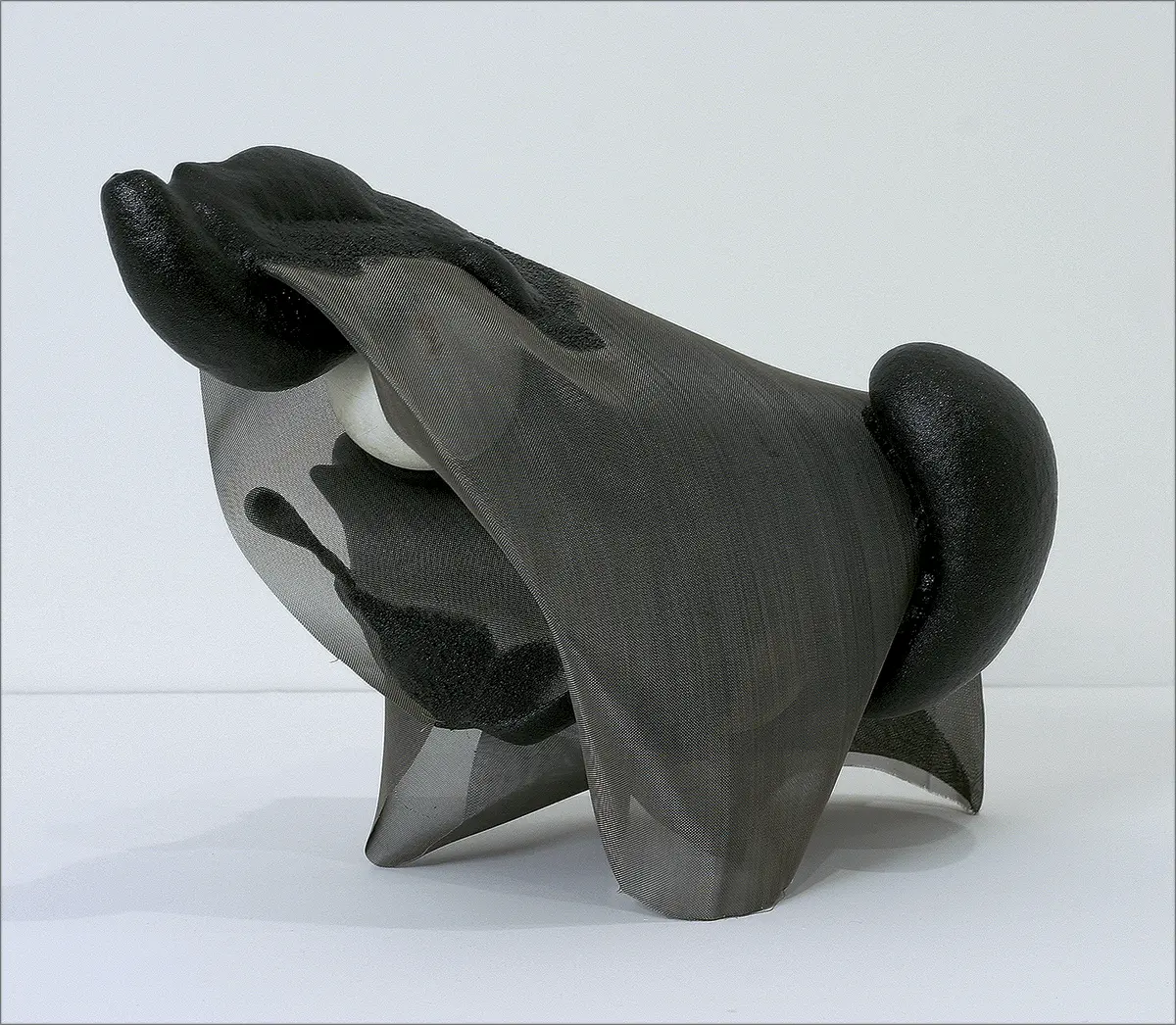
This time around, Orozco’s presentation was less singular. Although the works seemed to be thematically or even conceptually disparate and included pieces from an earlier period, amounting to a kind of survey, there were some formal links that gave this show a semblance of coherence. It consisted of numerous works in various media including painting, drawing, video, sculpture, and photography. In the north gallery were a series of paintings based on early formal structures derived from the Atomists works of 1993. In this new incarnation, Orozco resuscitated the very recognizable motifs that he painted on newspapers but these were reformatted onto large paintings collectively titled Samurai Tree. The palette of these works was seductive: shimmering metallic backgrounds offset by opaque color schemes. The forms themselves were not unlike a kaleidoscopic effect that shifts between the synthetic and the organic, the micro-and the macroscopic, that played visual havoc with figure/ground dynamics. In the next gallery were a series of drawings that were slightly too ephemeral for their own good. They did have an affinity with his sculptures in the south gallery; the saving grace of the sculptures, however, is that they were constituted from quotidian detritus and vernacular flotsam and jetsam and were consequently inscribed with meaning. With the absence of such signifying signposts, the drawings became too amorphous and seemed to be formal meanderings with insufficient narrative or even conceptual anchoring. The video was equally formalistic and there was a propensity to read it as decorative. Yet it was such a visually compelling work that to only take it for face value would be an act of visual illiteracy: its razzle-dazzle verged on the ironic and this optical phantasmagoria was a commentary about the sublimation of painting to video, and vice versa, via the delicate morphing of shapes against a monochromatic background. This, in turn, enriched the paintings in the front of the gallery and gave them a context beyond that of operating on formal registers.
This aesthetic and conceptual conundrum strikes at the very nature of Orozco’s multipartite artistic strategy: what at first may seem as aesthetic or even the antithesis of the beautiful, as is the case with some of his works that ostensibly border on the banal, are in fact rich with meaning and are analogous to a visual koan. The koan is a Zen conceptual and perceptual riddle that encapsulates the innate philosophical contradictions of the world of the living and is used by the aspiring Buddhist adherent as part of meditation toward reaching enlightenment. Orozco’s art has a protean complexity that at first viewing may not be apparent and that can be demanding of the viewer. But his work is more than just visual puns and koan-like exercises that question the nature of art’s ontology. When Orozco is at his best, his work achieves a philosophical dimension that is seamlessly coupled with a refined and poetic aesthetic. Ultimately, then, while this recent exhibition may have seemed akin to old wine in new bottles, it nonetheless reaffirmed Orozco’s stature as one of the contemporary artists most challenging artists living today.
RAÚL ZAMUDIO