
There can be no doubt that the architectural profession has marked deeply Héctor Medici’s pictorial praxis.
Projecting, building, using models and plans trained him in handling and analysis of the means we use to apprehend reality that, while always present, as a set of problems, in his work, seems now to become paroxistic.
The rationalization of the environment, which Man has attempted with greater or lesser emphasis throughout time, with its conventionalities of perception and representation, has already been reflected upon and de-structured in previous periods, but in the show, the artist presented at the Centro Cultural Recoleta it acquired superlative proportions.
The fragmented, the divided, the reiterated, the precise and the fluid, the underlined, and that which is submerged in anonymity provoke an explosion or a counterpoint that haunts the viewer and leaves every possible question unanswered from the start.
This is an image-index of the real in flight, to quote Ch. Bucci-Glucksmann.
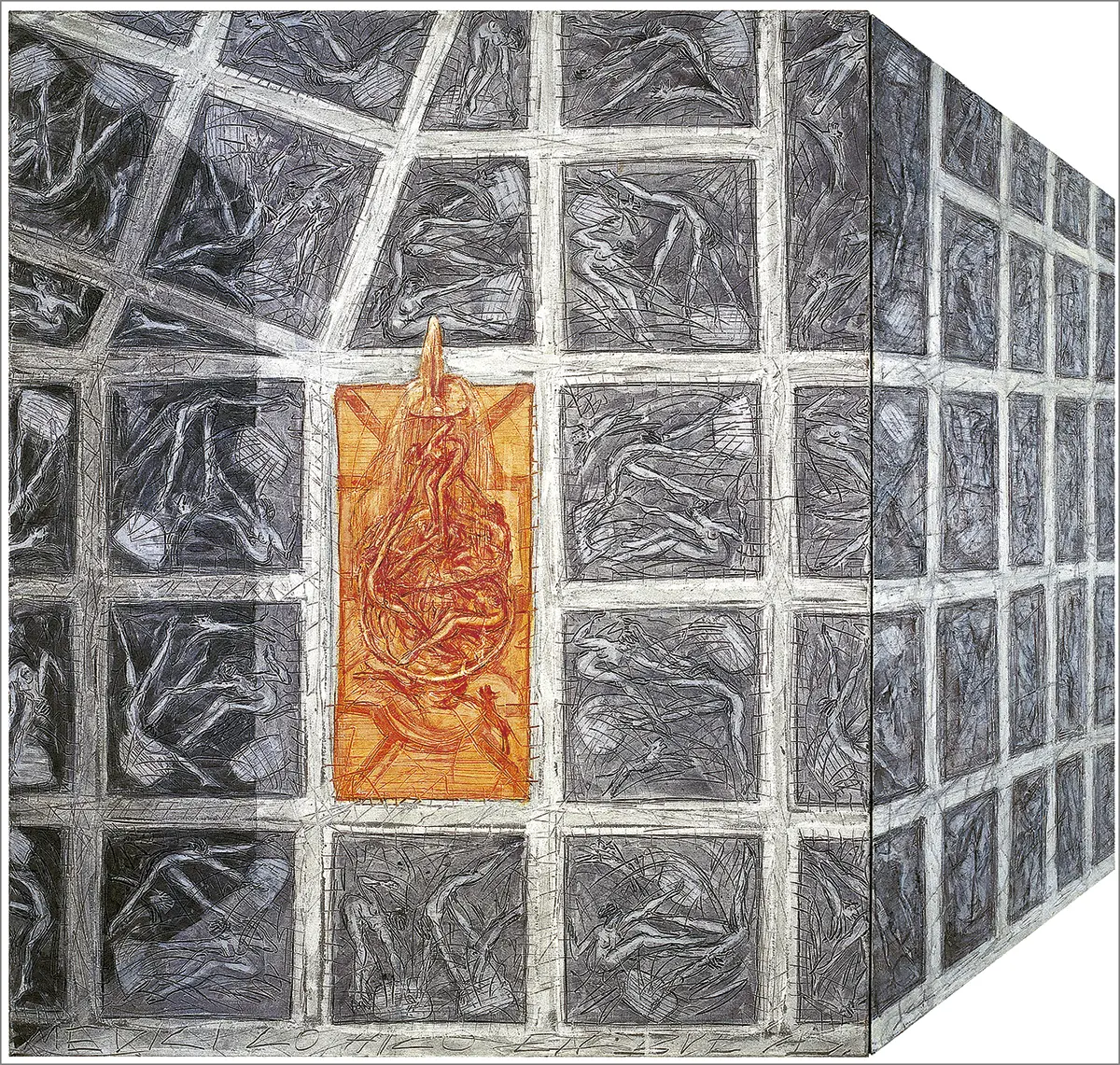
Because this painting recurs continually to quotes: on the one hand, to the representation of three-dimensional space from the most rigorous forms of the Quattrocento, to the boldest distortions of the Mannerists; on the other, to the flatness of geometric painting and the austerity of its eloquence. But these we can describe as self-quotes since they return to aspects of the author’s own oeuvre.
Thus the title of this show: Op-cit.
Also, these quotes are superimposed and disorganized, with the explicit purpose of perturbing the viewer.
One wonders whether the intention is to provoke the viewer into reflection, or whether the artist’s gnoseological eagerness installs a negation in order to posit possible new articulations of meaning or language.
The pictor is often present, witness ad narrator, subjugated but never in complete despair, despite the torturing enigmas that have taken the place of former utopias.
Ultimately, there is always in the act of painting an affirmation, due to the search for a valid interlocutor. And this interlocutor’s gaze seems unable now to find a point of support; rather, it finds a more or less chaotic set of heterogeneous surfaces from which a coherent image of the word only dissolves.
In this show, nature appears always in a heightened fictional key, as in the four three-dimensional models in different colors indicating the cyclical passage of the seasons, which establish the sequence of trajectories and tensors.
Water appears, too, as in the space of the swimmer, with rhythmic undulations that nevertheless abandon their placidity in the intricate labyrinth of the shaped canvas and the flat or sketched geometric figures.
And there is the source water, as in Fuente citada (Quoted source), in turn, a witty wordplay, which can be hypothetically located in gardens or in urban spaces but here is enclosed, repeated, always involved in the ordered disorder Medici made the protagonist of this show.
He has taken lost images like the two characters (who first appeared in his work in 1996) and they become repetition modules, used in all positions, at times sewn-in, in a harried plot in which they have to compete with flat shapes or shapes that are figuratively three-dimensional; allusive to the cube of traditional perspective or of the habitat or of the window or of the TV...
Everything becomes a question in this show where the author has used complex transference techniques.
Myth, which at some point was in Medici’s work a metaphor for the search for the impossible, is no longer enough for him.
Neither is the investigation of the image and meaning enough now.
At a time when art seems to either move away from or come too close to its viewers, Medici finds a way to slide through the interstices.
With eagerness and persistence, he explores that place that Deleuze has called the point of undecidability between the real and the imaginary.
The show’s companion catalog includes an excellent prologue by Lucas Fragasso.
NELLY PERAZZO