
João Loureiro’s career began in 1997, and even since he has been accumulating a solid body of work based mainly on the construction of objects and sculptures as well as an extensive graphic art production. The large majority of his pieces and drawings explore the domestic realm as the subject’s formative space and the relationships established in it, be it between its different inhabitants; between the latter and their furnishings; or between both and the architecture that contains them.
João Loureiro developed his “project for the occupation of a house” on the basis of this interest in the domestic universe. With the support of the recently dismantled Bolsa Vitae, a foundation devoted to subsidizing artistic production, Loureiro rented a house in a residential São Paulo Neighborhood and built a series of pieces to populate it. The project lasted a year, from the earliest studies and sketches for the different rooms, to the last month, when the house was open to the public.
The building seems to have been selected not for any remarkable feature it possessed, but for its mundane characteristics: a small garden and a garage out front; a front door that opens directly to a not-too-large living room; the kitchen towards the back with half –walls in decorative majolica, 1950s style; a staircase to the second floor, with to bedrooms, an annex, and the bathroom. Nothing to distinguish it from the neighboring buildings, dating from the same time.
The front part was left untouched. On the living room, a white metallic structure drew, interlinked, the fixed seats of a reddened social conviviality. The same metallic outlines that served as feet for the white-upholstered chairs tied them to one another and supported the center table, also white, a white painting, and three lamps illuminating the room from the ceiling. The line continued around the floor and drew a fence that demarcated the space under the window, with a view to the front garden. The parquet there was covered by a black sheep’s wool rug.
The kitchen, the site par excellence of family relationships, was occupied by a round table linked by an axis to a chair that turned around it at an stable distance. Built in metal and painted brown, both presented a design that memory relates to wooden furniture. A mirror served as display platform for a clock —on time—, and reflected the viewers inside the room. A key piece, it inscribes observers in the site created by Loureiro’s work, and makes them aware of the passage of time, of the continuity between inside and outside. At all times, the project is structured by the tension between the reality of the street or of he building and the fiction that is constructed there.
The staircase was covered by a green carpet that slowly gains volume in the upper steps, as if this well-behaved sign of comfort and warmth were getting out of control, becoming vegetal little by little until it disappears through the left-side door, closed and without a doorknob. To the other side, a hallway takes us straight to the bathroom, where the sole interference by the artist, the only thing that seems out of place in the known reality of decorative tiles, are two common bars of soap with encrusted tree trunks.
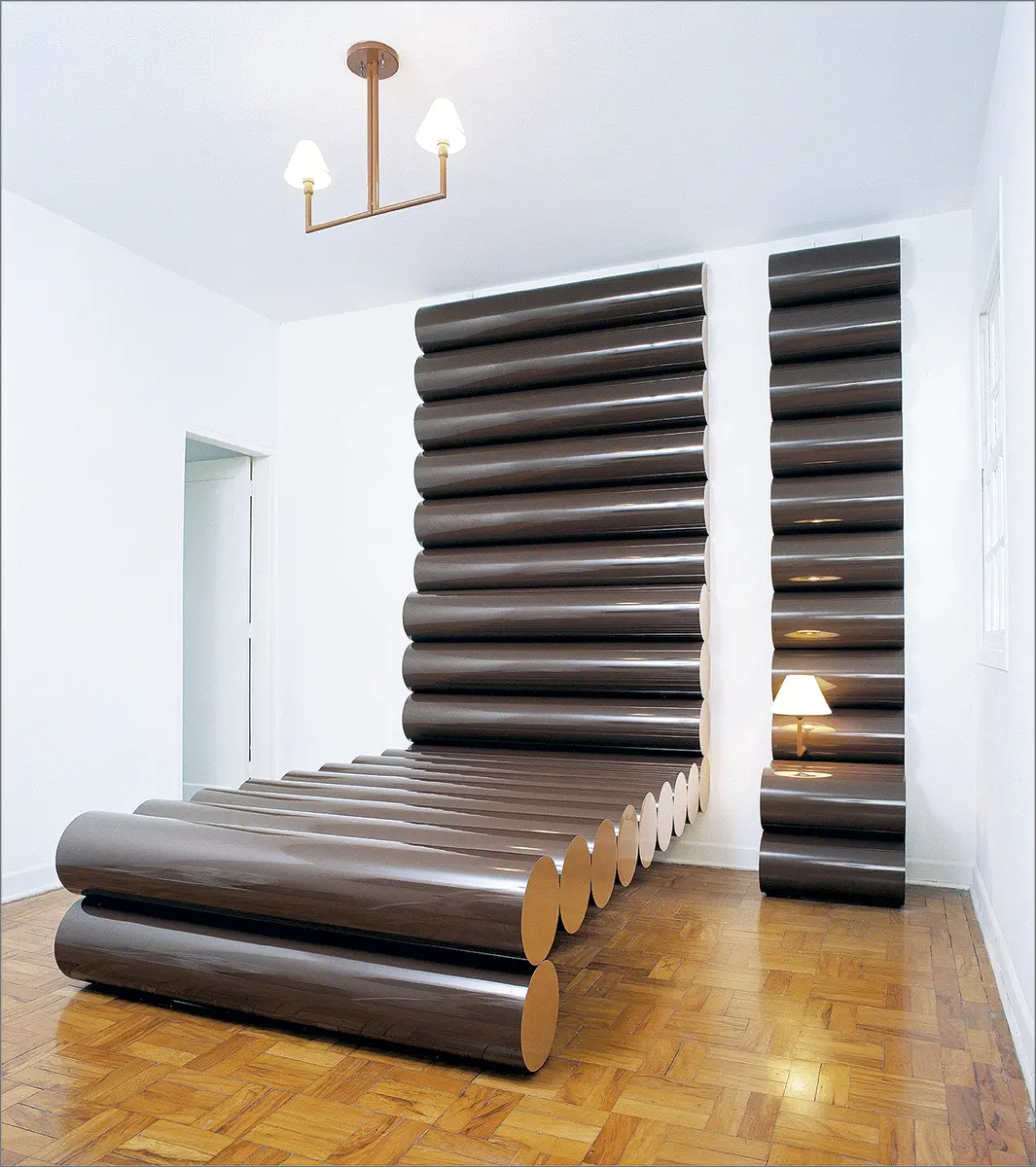
In the open bedroom, a sculpture begins in parallel to the wall and becomes horizontal, with the proportions of a matrimonial bed. To one side, a similar structure occupies the place of a nightstand, with its lamp. Made using Formica-covered plywood cylinders in two shades of brown, the pieces bring to memory the log cabins one sees in book illustrations or TV cartoons, or the images of lumberjacks transporting rows of cut trees down a river.
The next room contains a wooden chair upholstered in green, next to the window that opens to the street. On the walls, shelves and books reveal some of the literary references of a fictive inhabitant or of the artist himself: an incomplete collection of Julio Verne’s works; three science books devoted to zoology, mineralogy, and botany; a shelf with real tree trunks, with spaces for absent publications; Daniel Defoe’s Robinson Crusoe and its companion Friday, by Michel Tournier.
We go back to the mirror and its clock. Sitting on the chair, the books in sight contain discourses that build this space, while the window takes us closer to the street, where the everyday contents that did not abandon us inside this space are manifested without tricks or perversions.
CARLA ZACCAGNINI