
Among other things, the Museo de Arte de Ponce’s ample overview of the career of José Antonio Torres Martino shows how much the artist is revered in his hometown. He is a native son who brought honor to that once-great southern coastal city as an artist, teacher, radio and newspaper commentator, and labor organizer. The fact that Martino has spent almost none of his working life in Ponce did not faze the exhibition’s organizers in the least, although this seems to be less a case of wishful myopia than an indication of the artist’s monumental statue in the island’s modern and contemporary artistic traditions.
In the closing episode of his career, Martino has decided to revisit the Ponceñan landscape—in his art, at any rate—painting bright, semi-abstract memorials to flora, mountains, the sea, and a clear, almost fragrant light. These works celebrate, as much as did his earlier iconic tableaux of street urchins and bootblacks, his inextricable connection to a Puerto Rico of the spirit and imagination. It does not require many tours of the ruined, dejected Ponce of today to understand how a restless young artist, hungry to embark on a timely and profound project, might abandon forever this provincial remoteness for more lively, cosmopolitan surroundings.
After trips to Europe, Martino did return to Puerto Rico but only to the capital city, San Juan, and to promising projects with other energetic young Turks of his day who had also gone abroad: Rafael Tufiño, Lorenzo Homar, and Antonio Maldonado, among several others. These artists banded together in the late 1940s and early 50s to form first the gallery Estudio 17 and then the pioneering workshop, Centro de Arte Puertorriqueño (CAP), which produced a body of work that was considered essentially and significantly Puerto Rican, assuming a creative role much like that of the Taller Gráfico Popular in Mexico.
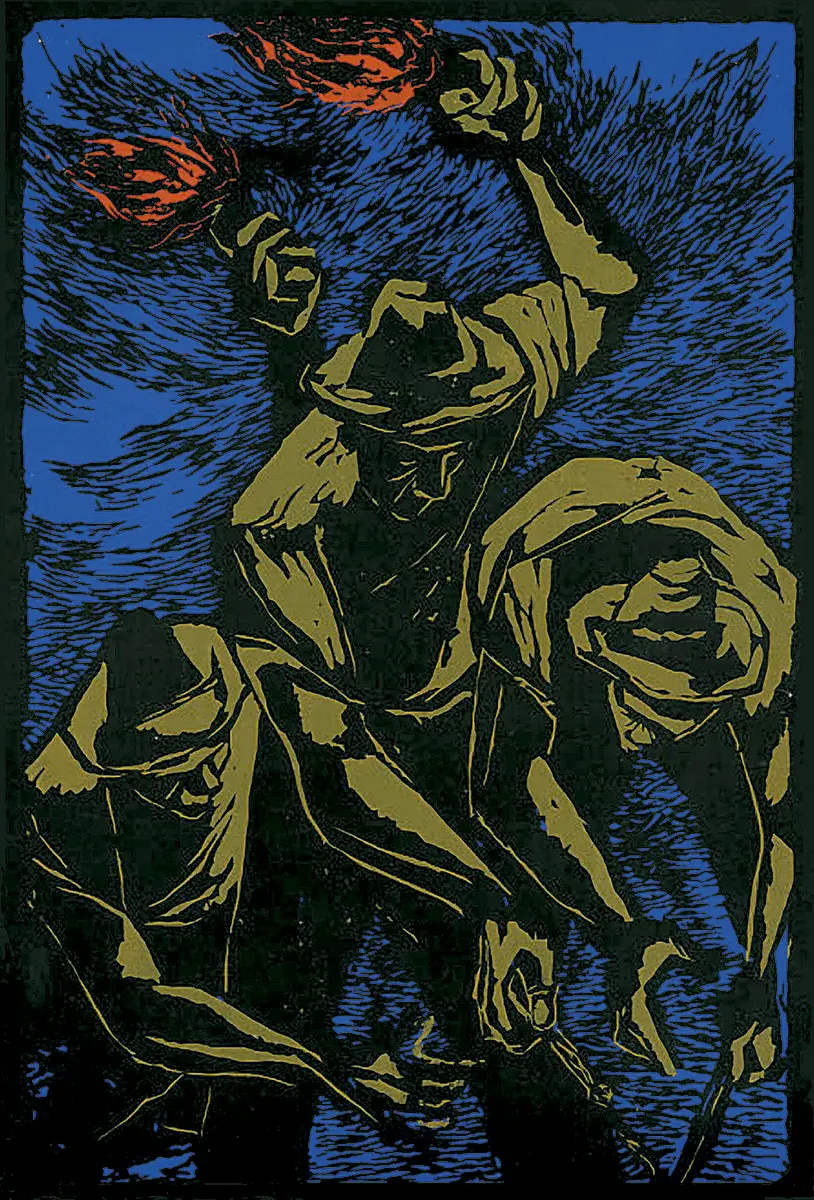
With his assiduous teaching and his radio shows and newspaper columns, Martino became a popular, influential figure both for the art world and the population at large, and the graphic works in Voz de varios registros vividly demonstrated the artist’s populist fire. The first portfolio issued by Martino and his associates at CAP, La estampa puertorriqueña (1951), features scenes of a determined nativist symbolism: Tufiño’s cane cutter, Rubén Ribera Aponte’s house carpenters, Martino’s own intent, torch-bearing crabbers in the impossibly effervescent blue of a nighttime sea. The great accomplishment of this work is not that it tied the artists to “authentic” society, as they wished it to, but that its compositional beauty lent a stirring dynamism to daily life and work.
Even after Martino’s attention turned inward, toward more purely formal concerns, he never really stepped away from graphic works or from the cultural and political life around him. In addition to the seminal La estampa puertorriqueña, the exhibition contained a number of later print portfolios which Martino created for poem series and long poems, as well as several books of poetry on which he collaborated as an illustrator. A print series based on the book of poems by José Emilio González, Profecía de Puerto Rico, is filled with forms of land, sun, and stars, but its human political drama is unmistakable: Un pueblo de macanas iracundas (1979–80) has a central image of a crowd of upraised arms-bearing machetes or clubs, like a forest inexplicably in motion.
Many of the books on display were by the activist poet, Juan Antonio Corretjer. Corretjer was not without a sense of humor, subtitling his book of poems, El Cumplido: Narraciones arbitrarias. Another of Martino’s portfolios provided visual accompaniments for Corretjer’s revered Yerba Bruja in a 1970 edition published by the Instituto Cultural Puertorriqueño (ICP).
Without knowing much about Corretjer, you might find in these Martino prints a pronounced mysticism: landforms melding with womanly shapes and markings reminiscent of pre-Columbian symbols. You can see that Martino is in love with a color as always but is growing more sophisticated in his formal tastes, more appreciative of contrasts and the other simple pleasures that printmaking allows, and dictates. In another series, a portfolio for the poem, Por los caminos del día (1969) by Manuel Joglar Cacho. Martino really hits his stride, and the almost hallucinatory play of abstraction and figure, symbol and object, color and form—as austere as they are in these incisive graphics—foreshadows the luxuriant play of these same elements in the paintings that bring him back to Ponce.
Even in this latest work, so meditative about the exigencies of canvas and paint, the land and its people are as much its true subject, and their exaltation is no less apparent and satisfying as when Martino was a social dreamer and a young man eager to meet the future beyond his hometown.
JOEL WEINSTEIN