
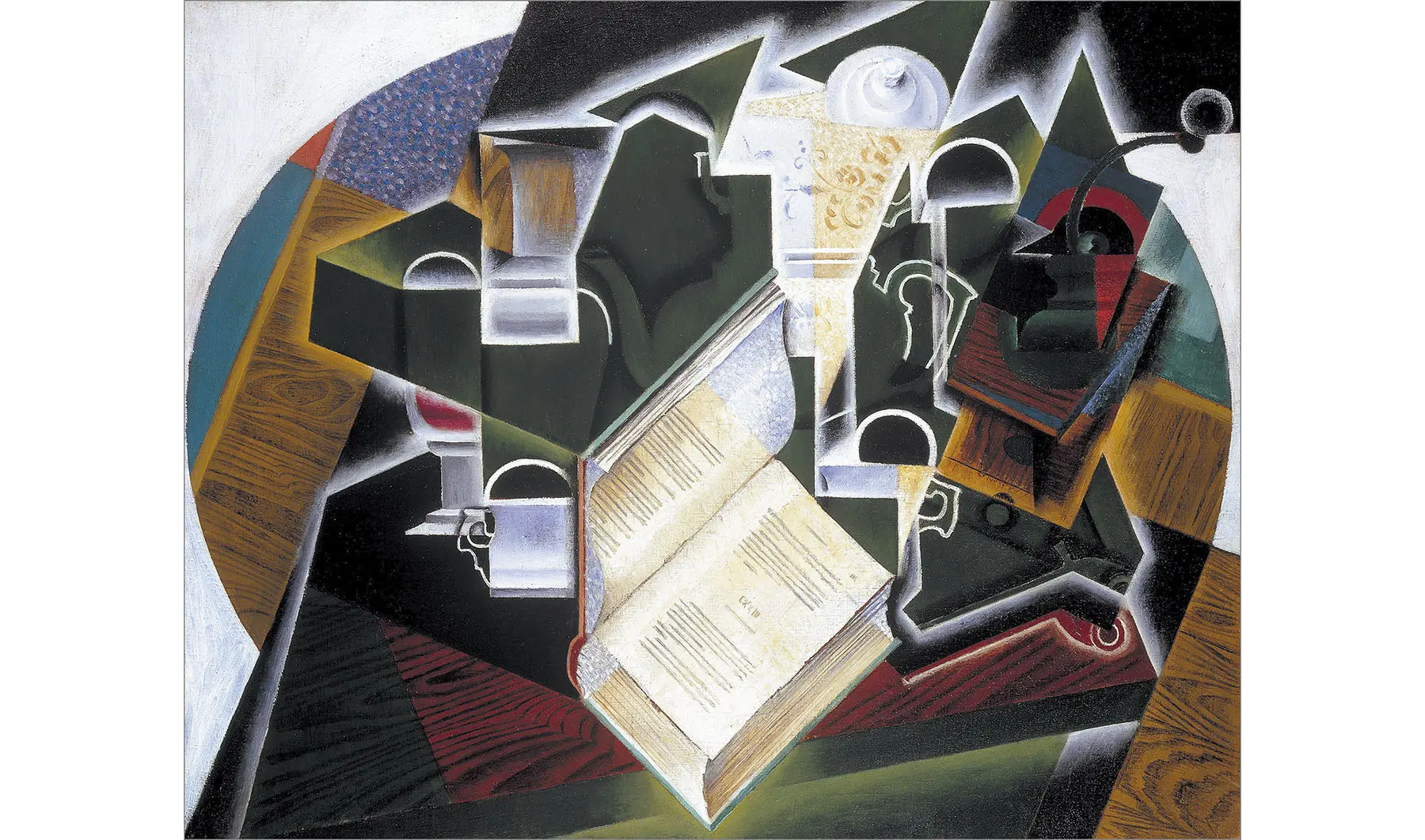
The Museo Reina Sofía presents an exhibition of 247 pieces by Juan Gris, probably the most exhaustive show of his work ever organized.1 Gris was born in 1887 as José Victoriano Carmelo Carlos González Pérez as the thirteenth child of fourteen. He died forty years later, in 1927, vaguely diagnosed since 1920 as having uraemia, high blood pressure, asthma, emphysema, and pleurisy. In 1906 he went to Paris, which became his mainstay, and there he mercifully changed his name to Juan Gris.
The exhibition is clearly a scholarly display, sometimes excessively tiring for the average visitor, and designed to make up for Spain’s relative neglect of Gris. It was not until 1978 that an official institution acquired a piece by him, and the only major retrospective in Spain took place in 1985.2 A big production surrounded the two-volume catalog that accompanied the exhibition. For all its ambition (the second tome is a catalog raisonné of all the exhibited pieces), the poor quality of the color reproductions sadly renders it useless as a visual record of Gris’s work.
Gris has always been seen in mainstream art history as the “third” cubist, a ranking for which he competes with Ferdinand Léger. The first and second places are alternatively occupied by Picasso and Braque, depending on who is making the ranking. In this context, Gris’s work has tended to appear more often as padding to add prestige to anthological shows than on its own.
Gris was a bit late in his movement into cubism. When he arrived in Paris, Picasso had already begun his studies for the Demoiselles d’Avignon. Gris started painting four years later, but it was in the footsteps of Cezanne. Nevertheless, in spite of being a late-comer to cubism, Gris is credited with shifting the grounds of cubism sufficiently to earn his own label as a synthetic cubist, to be distinguished from the analytic cubism of Braque and Picasso. It seems to be the combination of his late arrival to cubism and then his idiosyncratic departure from its signature style that has persuaded some commentators to place Gris in what can be described as the ground floor of the cubist hierarchy—above secondary figures like Gleizes and Metzinger but below the absolute masters in the penthouse.
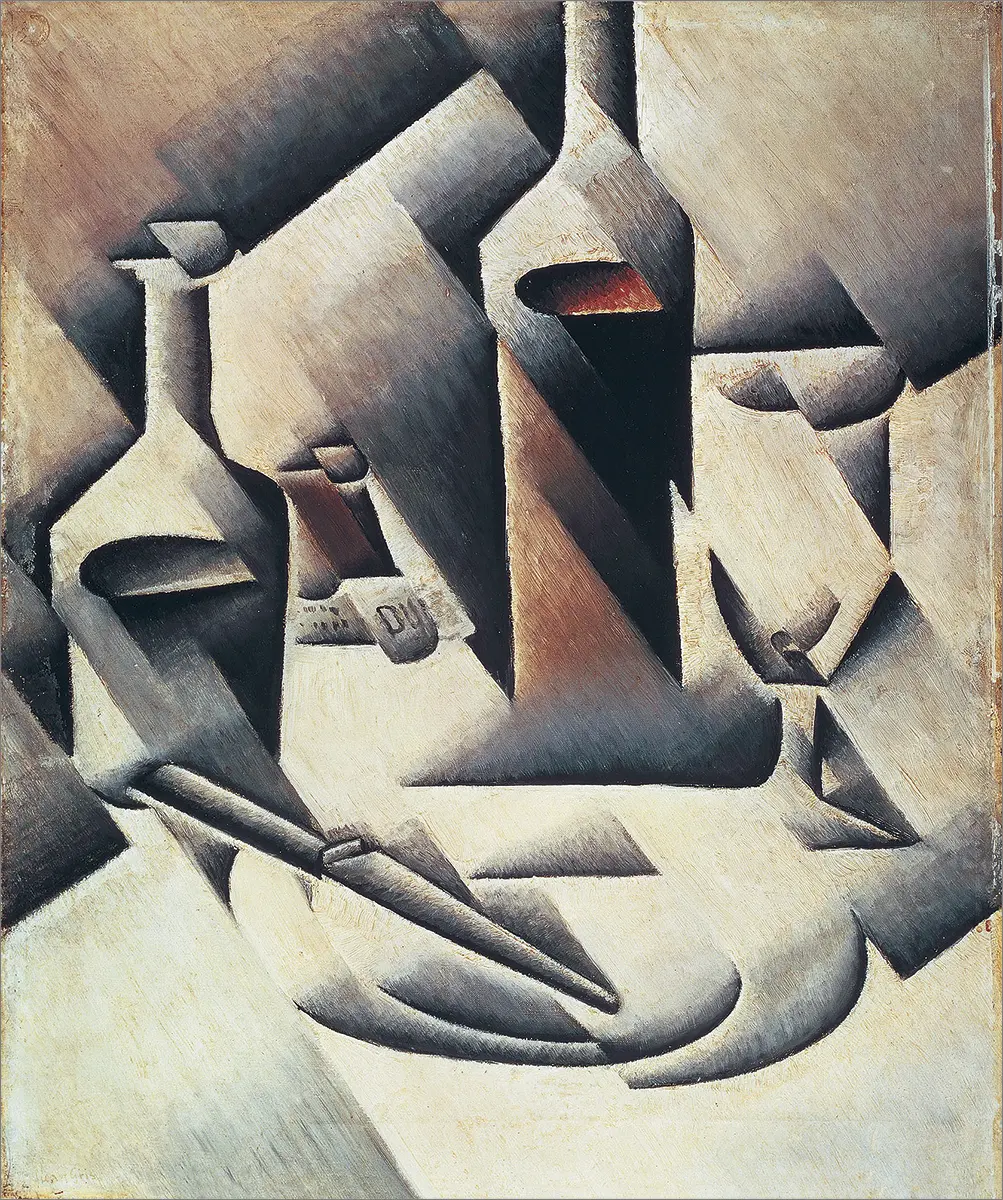
The Gris show in Madrid should, and most probably will generate enough scholarly attention to make this particular essay a bit superfluous. This has the advantage, however, of giving me some room for subjectivity. Gris was a mythical figure for my generation of Uruguayan artists (1950s and 60s). There was no clear reason for this, no explicit rational argument, and it can probably only be explained by the fact that we lived under the shadow of Torres García, whose thought and taste deeply affected our education and who saw Gris as absolutely the greatest artist of his time. For Gris, Picasso’s art was too based on reality, and Braque was too lyrical. As Torres saw it, “Juan Gris is the perfect ‘geometrist.’ That is why he is the purest of cubists."3 For me, then, visiting this exhibition was like paying a debt incurred half a century ago, one to be paid with pleasure. The Gris memory drawers in my mind had up to that moment been filled with rigorously formalized still lifes, free of the brown shoe-polish palette of early cubism. My memory was not wrong, but it turned out to be excessively selective—to his advantage, as I came to realize.
In his time Gris was a relatively controversial painter. He had strong support where it mattered for his survival (Gertrude Stein, dealers Daniel-Henry Kahnweiler and Leonce Rosenberg, etc.), but the admiration was not universal among his colleagues. Guillaume Apollinaire, for example, described him rather dismissively (though early in his career and before he had developed his signature paintings) in The Cubist Painters:
“[His] is an art of ornament, driven to respectfully combine the last vestiges of classical art, the drawings by Ingres and David’s portraits, to then animate them. He arrives at a style as Seurat did, but lacking his theoretical innovation... The art of Juan Gris is an excessively rigorous expression of the scientific cubism born by Picasso; a profound intellectualist art where color only has a symbolic meaning. However, while Picasso’s art is conceived in light (impressionism), Juan Gris contents himself with a scientifically conceived purity."4
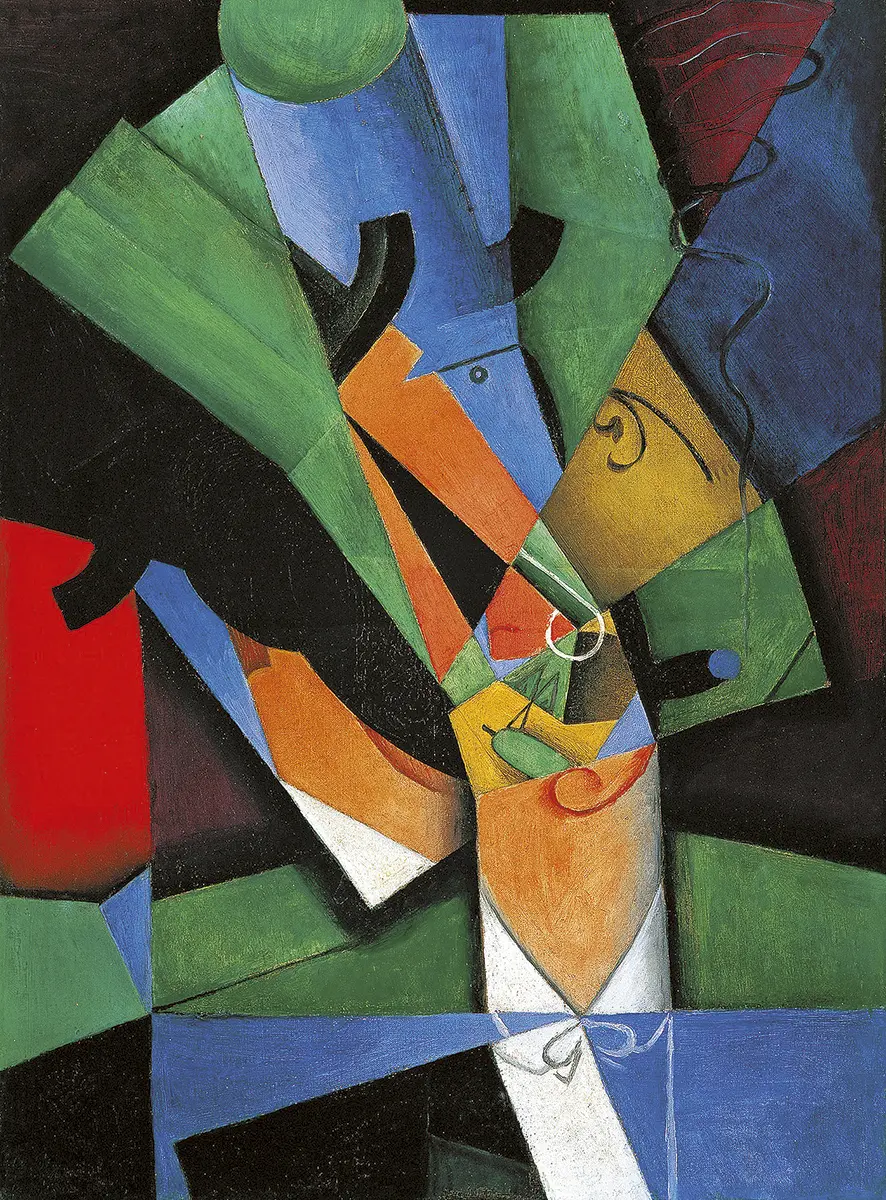
Torres García and Apollinaire were opposite in the value they placed on Gris’s work, but they agreed in their description of what he was doing. What I found, though, is that the work in this exhibition deviates from their description. The formally rigorous paintings they speak of and that I expected are certainly there. But a lot of the work presented in the Reina Sofía deviates sharply from his signature style: unexpected and disconcerting pieces characterized by very sentimental uses of color and stylized illustrations.
Gris emerges as a deeply conflicted artist who often succumbs to kitsch, yet valiantly tries repeatedly to escape it, with different degrees of success. Some periods in his career are worse than others, notably from 1922 to 1924, a period generally viewed as weak, but also generally excused because of the overall decline in the quality of European art in these years. One cannot, however, divide Gris’s production neatly into good and bad periods. Discounting the first years, 1910–1912, when he was searching for his language with understandable hesitations, there is sufficient inconsistency in every period to leave one with the feeling that Gris has a sentimentality that occasionally explodes and contaminates the gallery.
Both Picasso and Braque used harlequins and other stereotypical images without compunction. But when they did, they managed to either break them up into what today can be described as fractally organized spaces—subdivisions that carry the tension of the whole— or imbued them with some form of interesting painterly aura. Contrary to the assumptions of Gris made by Apollinaire and Torres, Gris often fails to do this. The stereotypes appear, but without originality of expression; they offer predictable simplifications in which a vague aura of abstraction is present but undermined and contradicted by a schematic portrayal reminiscent of basic caricature. At his worst, Gris uses sweet and sour colors that actually seem alien to the composition. As if distracted, he produces a softly painterly texture, combining in a heavy soupy atmosphere shapes that in other canvases fought and conversed powerfully. The wavering between rigor and sentimentality, formalism and soup, could possibly testify to a wish to experiment; unfortunately, it does not read that way.
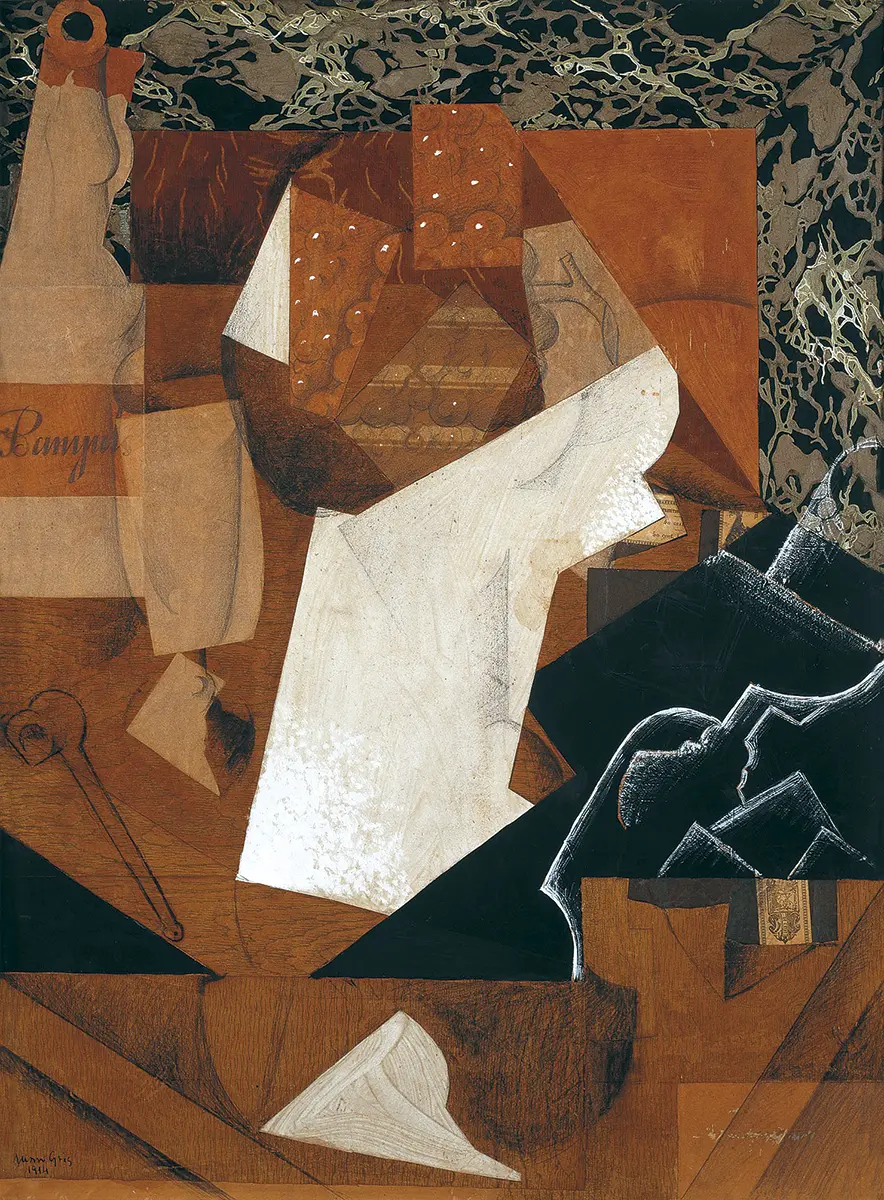
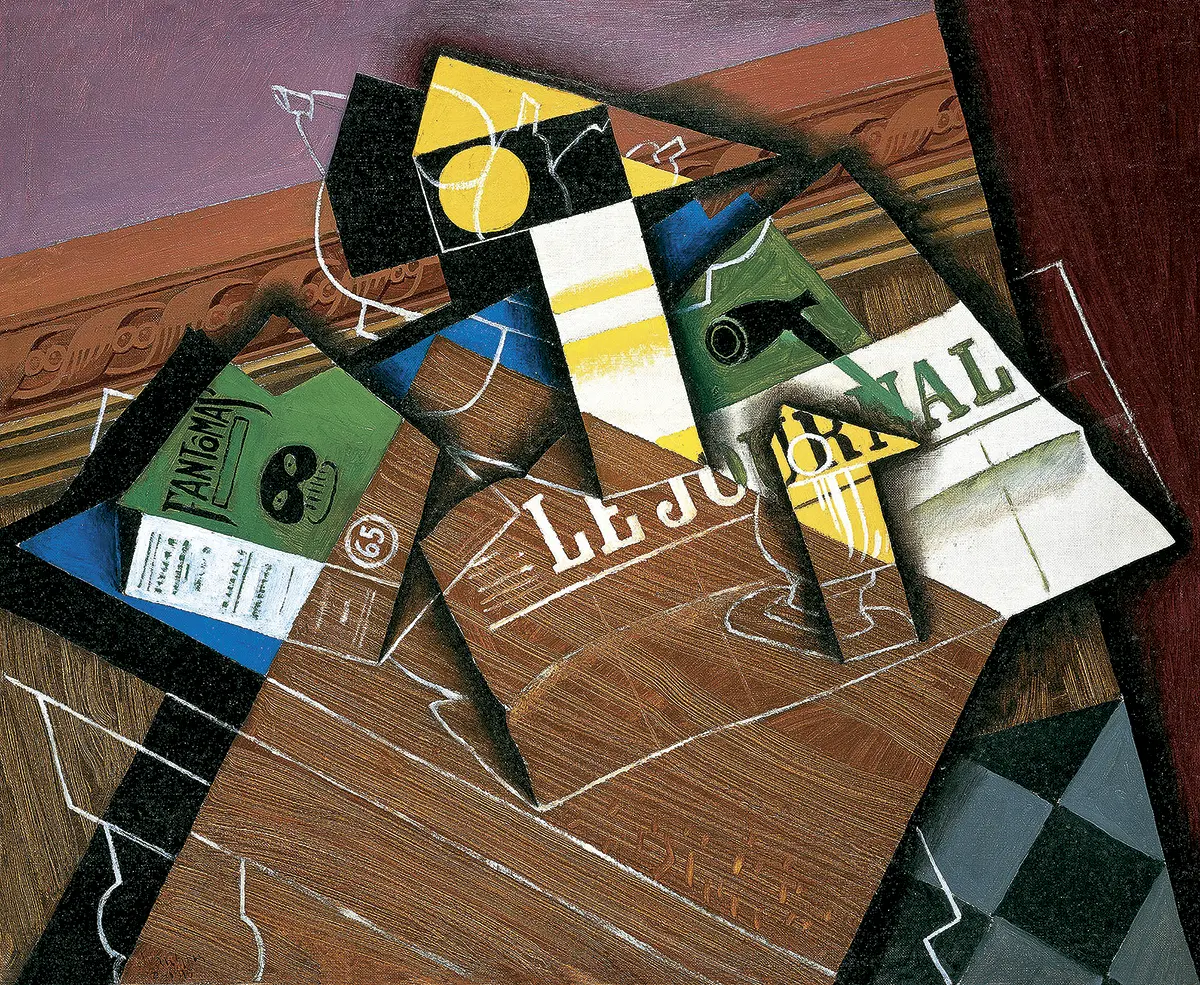
Gris began his career as an illustrator. His first paintings (1910) are nice but not stunning Cezanne-like pieces. The first painting in this show is Sifón y botellas (1910), a peaceful and beautiful still life. Afterward, until 1912, Gris gets involved in breaking up the surfaces into somewhat ornamental patterns. Apollinaire’s description, which was written in 1912, seems quite appropriate to Gris’s work at this time. But 1912 is an important year for cubism. Picasso glued a printed wax cloth on his “caned chair” (Nature morte à la chaise cannée) sometime in May. In September, Braque glued industrially painted paper on a drawing (Compotier et verre). And that same month, Gris also collages onto his canvas La montre. The painting is not great, certainly much weaker than those of his colleagues, but it inaugurates a series of interesting works and makes some interesting points. In one series continued until 1915, collage seems to function as a brake or a check on Gris’s sentimentality. Colors seem to integrate much more effectively when a piece of paper is stuck in there somewhere. In Le livre (1913), there are pieces of actual book pages forming the book. The composition, however, is not one of cubist fragmentation but organized in vertical stripes with different rules operating for each of them. The reality here is not a four-dimensional centrifugal puzzle anymore but an entity flattened into a folding screen; Gris is starting to assert himself. In subsequent works, he focuses more on iconic shapes as containers for his compositions, sometimes with surprising and, for me, unexpected success (as in Fleurs, May-June 1914), but sometimes too sweetly and easily.
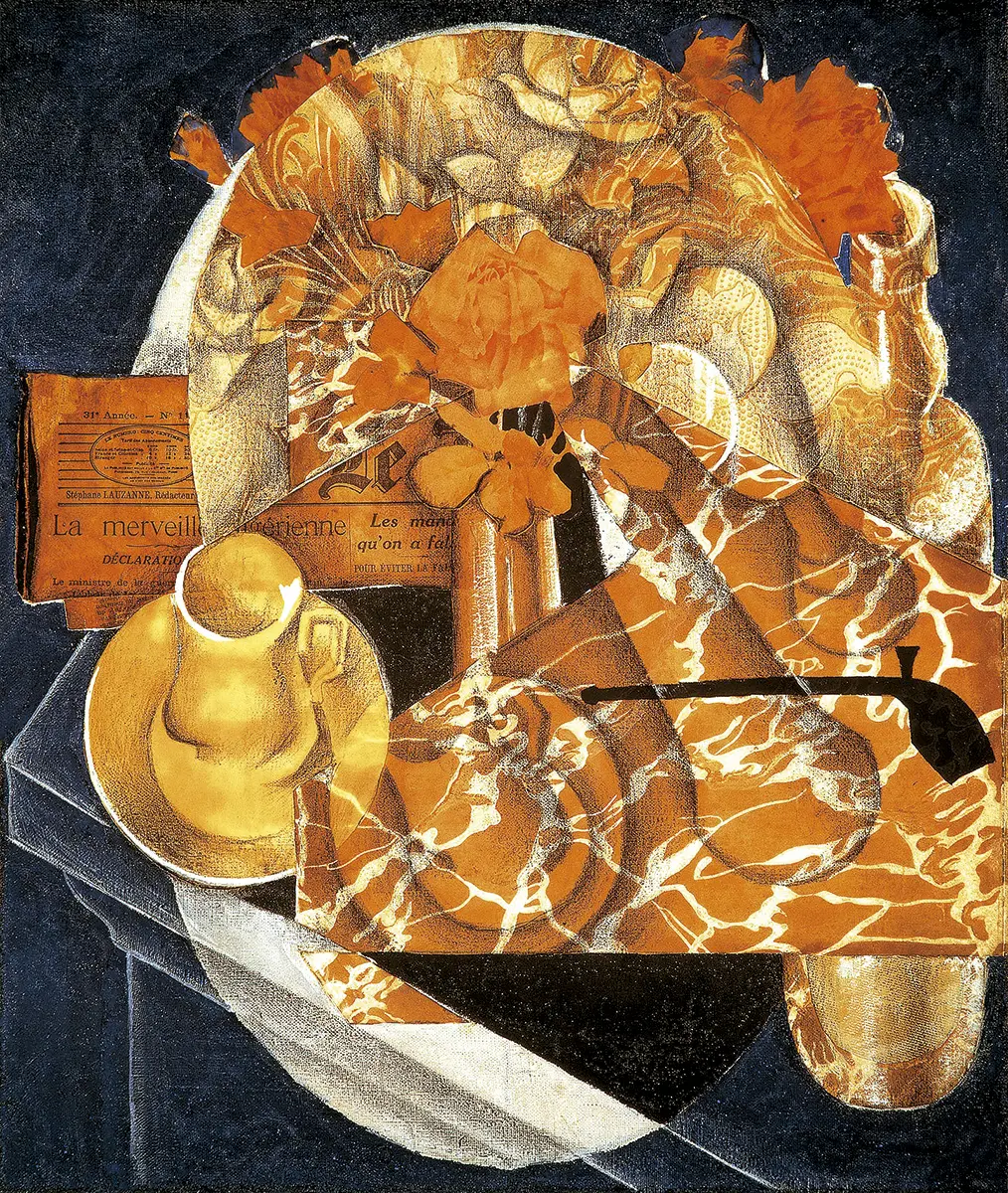
Tomas Llorens, in one of the essays for the catalog, analyses this period and the role of collage. More than the content of the collaged elements, it is their shapes that matter. The glued pieces, as Llorens sees it, give structure to the work. Llorens cites two examples, which unfortunately are not included in the exhibition. One is Le lavabo (1912), an image of a sink with fragments of mirrors attached to the canvas. The point here is that the changing reflections on the mirror, which in terms of traditional painting would have an enormous visual impact, become irrelevant in his piece. What becomes predominant is the shape of the fragments and their reflective quality. The other example is Violon et gravure accrochée (1913), with an etching glued on the canvas. Speaking of this work, Gris said that it didn’t matter what etching is stuck on the painting, that the purchaser of the work was free to exchange it at will.5
Paloma Esteban in her essay also stresses the use of the shapes of the collage over the content or image. The collage suggests possibilities for abstract composition; from them, Gris derives his images by deduction. One could say that Gris uses graphic layout as a primary tool.
Toward 1916, Gris went through a period in which, influenced by a fashionable revival of pointillism, he textured surfaces with dot patterns. Although they are praised in the catalog, these pieces have a purely documentary role in the show. Afterward, he seemed to pick up again and produced some of his strongest works (Les raisins, Compotier er journal, and Bouteille et compotier), all between June and July of 1916. My interest was also piqued with some of the last pieces he painted, in 1926 and 1927. The show ends with two small and seemingly humble paintings: Nature morte au journal (made December 1926–January 1927) and Le gobelet (February–April 1927). Sometimes excused as the product of a painter weakened by illness, they are to be quite impressive, seemingly synthesizing wisdom and experience gathered from the highpoints of his career. Here his demons seem tamed, and he is at peace with a trembling line, which becomes an unassuming and direct tool for rendering. In an act both powerful and moving, Gris finally allowed his biology to merge with his mind.
In 1921 Gris wrote: “I work with the elements of the spirit, with the imagination, I try to concretize what is abstract, I go from the general to the particular, which means that I start from abstraction to arrive at a real fact."6 For Gris this was a humanizing factor, rather than a sign of scientific detachment. In the same text, he continues: “I consider that the architectural aspect of painting is mathematics, its abstract side; I wish to humanize it. Cezanne makes a cylinder out of a bottle; as for me, I start from that cylinder to create a special kind of individual; from a cylinder, I make a bottle, a specific bottle. Cezanne goes toward architecture, I start from it.” It is in this context that his description of his paintings as “flat colored architecture” acquires a particular meaning.7
Apollinaire saw four kinds of cubism: scientific cubism, physical cubism, orphic cubism, and instinctive cubism. He dismissed the last category as lacking in lucidity and artistic faith. However, scientific cubism as “the art of painting new compositions with elements not taken from visual reality but from the reality of knowledge."8 In it, he includes Picasso, Braque, Metzinger, Gleizes, Laurencin, and (lastly) Gris. Physical cubism, whose only example is Le Fauconnier, is a composition device to deal with visual reality. Apollinaire wrongly predicted a future for this tendency in historical painting. Orphic cubism deals with a reality purely created and made powerful by the artist. “Orphic artists are to simultaneously show a pure aesthetic divertimento, a construction where the sense is obvious, and meaning; in other words a sublime theme. It is pure art.” Here Picasso appears again on top, followed by Robert Delaunay and with the help of Léger, Picabia, and Duchamp.
Apollinaire’s theory of cubism is instructive for all that it reveals about the limitations of personal taste and the play of private attachments on scholarly judgment. As it turned out, the greatest impact on the art history of Léger, Delaunay, Picabia, and Duchamp did not come from work that was cubist in any meaningful sense. Metzinger and Gleizes slipped somewhat from ranking and faded from memory. And Laurencin’s place on Apollinaire’s list was due more to the fact that she was his lover until 1913—at her request, in 1956 she was buried holding Apollinaire’s love letters to her breast. So, we are really back to Picasso, Braque, and Gris.
It may have been difficult to see this clearly in Apollinaire’s time, but with hindsight, one might argue that Gris, at his best, fits into both scientific and orphic cubism as defined by Apollinaire. Gris certainly would have had no problem being classified in this way, as his writings make apparent. It seems, too, that it is precisely this combination that was so attractive to Torres García.
Gris’s show, like many other comprehensive or retrospective exhibitions, presents us with conundrum curators often face. Should the focus be placed on the artist’s contributions or on the artist’s whole body of work over a lifetime? If, as viewers, we follow the first course, we are an audience for the art historical narrative as it currently exists and more particularly the selective choices of the curator. If the focus is on the entire body of work, we have as viewers the opportunity to draw conclusions of our own. When I went to this exhibition, I had a very selfish motive: to confirm the art historical myth of Gris from my childhood. Instead, because the show offered me an opportunity to move past that one-dimensional view, I found instead a complicated (rather than complex) individual who painted. Juan Gris said that he experienced satisfaction in seeing weak paintings by Braque (a close friend) because Braque’s good paintings always intimidated him. Seeing Gris’s secondary, less successful work was rewarding to me in a similar way.
Still, a question remains for me: what if the show had presented only those paintings by Gris that I certainly expected to see and already knew that I liked (which definitely is not the same question as asking what would happen if I curated the exhibition)? The surprising answer I would have to give to myself is that I like Gris when he is most consistently a formalist when he is most remote from any project focussed on meaning. This is really what his process of “deduction” is about. It is what allows him to absorb formal devices irrespective of the subject matter he treated. It is the pleasure of layout that holds him steady and that makes him so relevant for the subsequent development of modernist formalism.
The Spanish-Mexican writer Max Aub didn’t spare his criticism of Gris. Aub wrote a biography of a fictional painter named Jusep Torres Campalans, a Catalan painter who invited a young Picasso to visit a whorehouse called Viño, which later would become Avignon for the sake of the Demoiselles. Torres Campalans hates Juan Gris, whom he describes as “a little orderly man who only went into cubism when he saw an open and easy road.” Accordingly, Gris is depicted as interested only in his own material well-being and chose painting over his previous illustration work because it brought in easier money. Gris is fictionally quoted as saying: “We have to see things like painters. Exclusively like painters.” To which Torres Campalans answers: “Sure as if we were angels. Don’t you see, you dumbass, that we can’t stop being men?"9 Aub summed up my problem. I had gone looking for a myth that was larger than life and instead found real life.
(edited by Selby Hickey)
NOTES
1.Juan Gris: Pinturas y dibujos 1910–1927, Museo Nacional Centro de Arte Reina Sofía, June 22–September 19, 2005. Curated by Paloma Esteban Leal.
2. Juan Gris (1887–1927), Salas Pablo Ruiz Picasso del Ministerio de Cultura, Madrid.
3. Agustín Sánchez Vidal, “Eminencia Gris,” Juan Gris: Pinturas y dibujos 1910–1927, Vol. I, p. 142
4. Guillaume Apollinaire, Meditaciones estéticas, Los pintores cubistas, Madrid: A. Machado Libros, 2001, pp. 63–64.
5. Tomás Llorens, “Juan Gris y la vision interior,” Juan Gris: Pinturas y dibujos 1910–1927, Vol. I, p. 72.
6. L’Esprit Nouveau, 02.1921, cited by Paloma Esteban, “Una pasion contenida,” Juan Gris: Pinturas y dibujos 1910–1927, Vol. I, p. 45.
7. Cited by Paloma Esteban, p. 18.
8. Apollinaire, p. 31.
9. Max Aub, Jusep Torres Campalans, Madrid: Plaza & Janes, 1984. Published in English by Doubleday in 1962.
LUIS CAMNITZER
Uruguayan artist and emeritus professor at the SUNY College, Old Westbury.