
It would be very risky to try to classify or label the work of Julio Villani (Marilia, São Paulo, 1956.) Indeed, it, fortunately, escapes the determinations of identity, the constraints of a catalog, whatever the genre, style, or aesthetic family. At best, one could find felicitous connections for him. Because his work, unique and multiple at the same time, is contemporary. Prolix and proteic (painting, photography, collage, assemblages, objects,) uses a variety of materials (wood, iron, cardboard, zinc, lacquer, metro tickets, kitchen utensils, invitations to art shows) and dialogues incessantly with the word, with the history of art, with its symbols or emblematic figures. His work feeds on references; it trusts chance; its poetry emanates from its inalienable freedom. Villani’s humor is a form of meaning, not to mention that the impact of the form and its surprising developments partake of a playful spirit in permanent renewal. Nothing stops the artist’s linguistic creativity or his imaginative veneer, born in ironic mismatches and knowing tenderness; with great spontaneity, without artifice or imposition, Villani juggles ideas and materials, forms, and objects.
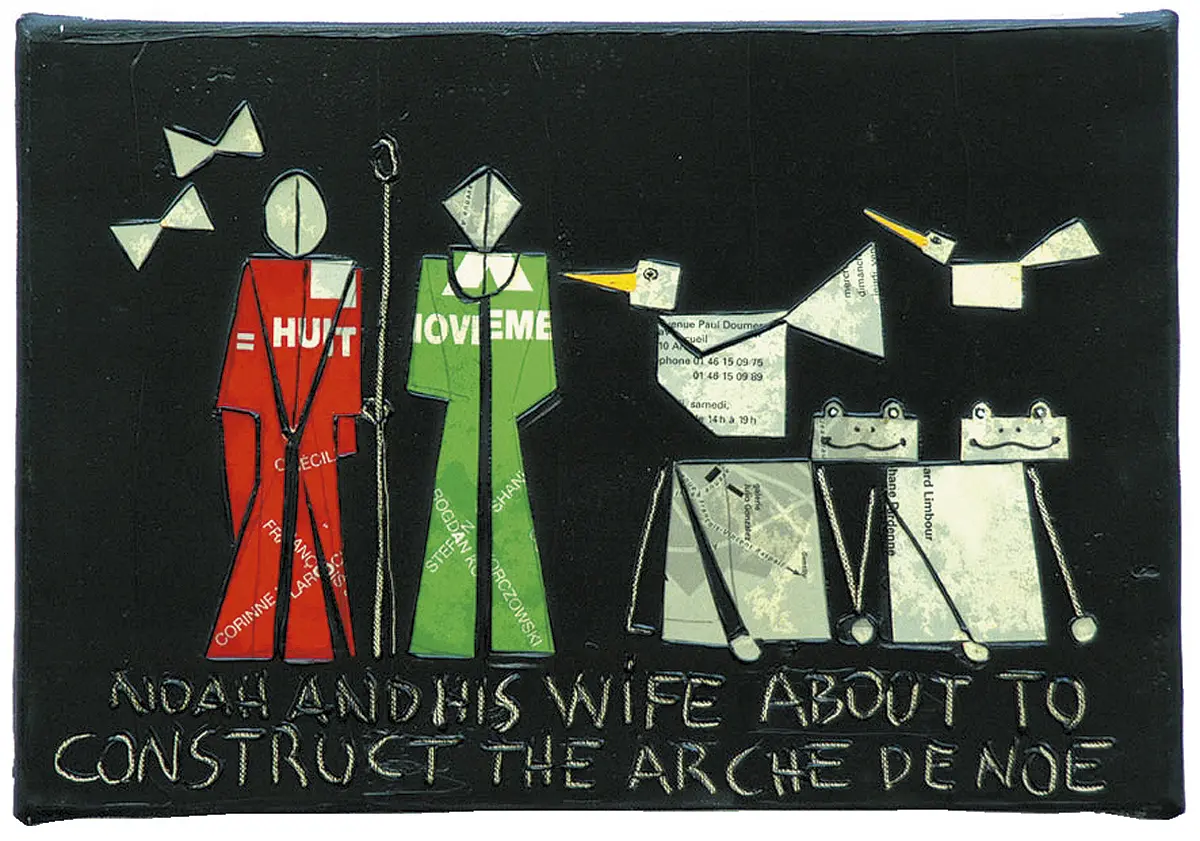
The show at the Latin American House, titled Yo no soy de aquí, is built on countless metaforms around topics related to movement, instability, the infinite and borderless worlds that life and imagination have to offer. It refers to places through words, paintings, and objects that give meaning to the image or disturb one's already present. It speaks of journeys, of distance, of feelings; it adopts the instruments of childhood; it likes Duchamp, and it has at the same time something of oulipo and of oupinpo1. Based on six chapters that establish a course that interweaves geography, the cosmos, art history, and everyday life, this exhibition is a metaphor, construction, space, encounter, saudade/ Here we discover the artist’s most recent creations, some staggered over time, like the animals in his El Arca de Noé, some —most— created for the show, comprising the remaining six chapters: paintings against a black backdrop that sketch a different cosmos; videos, collages, and small formats accompanying El lamento del loro; the Arquitecturas migratorias (objects created using Metro tickets and lacquered zinc) constitute the outline of a universe driven forward by Villani’s “bachelor” machines.
As they enter the building, visitors are greeted by two previously unseen works that parade in the manner of advertising development, from which they borrow the system of supports lit from inside. These unveil bodily cartography where São Paulo’s red heart (where Villani was born) is “linked” to Paris’ red heart (where he has lived since 1982) through a series of “arteries” and “veins” that go from Lima Lyon and Rome, passing through Lisbon, Hong Kong, and Rio, and which inevitably take us to Duchamp, transformed, thanks t a neologism, into a grower of corn and sunflowers. Our entry into the topic of the endless journey is strongly emphasized here, the movement is the key both physical and conceptual for the personal worlds whose doors Villani cracks open for us.
The first machine (Paseante en teoría,) perpetuates the poetic absurd of Duchamp’s bachelor machines; the bicycle wheel rotates incessantly for an individual whose steps leave no imprint since he remains immobile. Villani’s twelve Estudios para otro mundo (paper and oil on canvas, varied dimensions, 2005) invites us to penetrate a dark galaxy; these are cosmogonies of an everyday hobo, waking dreams of the destination-less traveler. In the more intimate spaces of the basement, Villani installed the animals of his Arca de Noé2 and the video of a parrot that, enraged and with premeditation shreds a Picasso and the Gioconda, as though the entire history of art ought to disappear.
In the main room, the artist installed a traveling meditation around time and space, with a series of light sculptures (his Arquitecturas Migratorias) ingenuously manufactured by assembling Metro tickets facing their alter egos in zinc and tin, built in a variety of forms: nest, chimney, water lilies, water tank, dome. Our course through the show could come to an end in front of the installation titled Los siete continentes (2005): seven small houses lit from inside, with the words “hell” and “madness” inscribed on them, come to close, in the contrast between the reference to childhood and the violence of the evocations, the reality of his eternal trashumancy. Away from it, in a second bachelor machine, Domicilio fijo, 2005, is the ground/world on which he moves while the house remains static. Villani, a migratory, ocean-crossing artist, achieves a difficult balance between constant mutation and permanent stability.
NOTES
1. Names of the French movements Oulipo (born in 1962 for literature) and Oupinpo (born in 1981 for painting.) Excentric and extravagant propositions that drive artists to establish rules or demands with formalistic ambitions in the execution of a given work.
2. We can find other animals in the show presented in parallel, around the topic of Noah’s Ark, the 1900-2000 gallery in Paris, September 4 thru October 15, 2005.
CHRISTINE FRÈROT