
“One is best punished by one´s virtues”.
Friedrich Nietzsche
With an assortment of works in different media, Kcho’s exhibition Every Man is an Island opened at the New World Museum in Houston. The starkly modern exhibition space, one of Houston’s newest, is ideally suited to Kcho’s poetic debris-based installations. Its sunset orange façade titillates the visitor and compensates for the white-box experience that almost every museum and gallery proposes. The NWM is a fitting background for an artist whose ideas first emerge as drawings or titles and often evolve into works with a carefully calculated, albeit chaotic, carpentry. The proverbial title reflects the fact that most of Kcho’s oeuvre is about insularity and its consequences: isolation, emigration, migration, navigation, etc. Moreover, when the island in question is Cuba, Kcho’s works become imbued with an ambiguity that renders them poetic.
The welcoming piece in the exhibit is Kayak from the Dangerous Objects series, a wooden sculpture shaped like the vessel. Although kayaks are not exactly part of the Cuban experience, to use the rhetoric of the islanders, they bear all the traits that usually engage Kcho’s poetic sensibility. First of all, it is a vessel and, like all possible sea-worthy crafts in Cuba, it is, therefore, a suspicious and dangerous object. It is dangerous for the regime as a potential means of invasion or escape from the island; dangerous for the U.S. Coast Guard that tries to prevent Cubans from reaching Florida; and dangerous for the kayaker who may succumb to the unsafe waters of the Caribbean Sea. Secondly, Kayak is symmetrical, and therefore it is not possible to determine in which direction it is going until it starts moving. Finally, the symmetry of the kayak is deliciously mimicked by the palindrome of its name, and Kcho is a fisherman of poetic ideas that set his works against his titles. The spiky nails where the kayaker would sit simply repeat how dangerous this object really is.
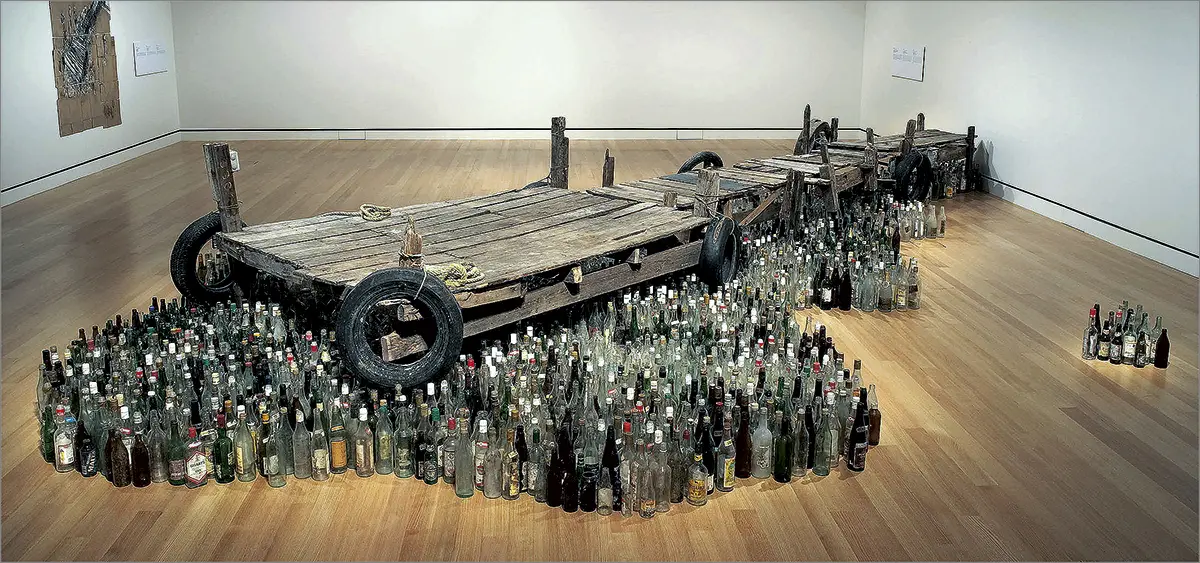
Para olvidar (In order to forget) is the main installation of the exhibit. Kcho first showed it at the Kwangju Biennial as a wooden boat floating on bottles. In this more recent work from 2000, the boat was replaced by an actual dock appropriated and reconstructed by Kcho. Old tires cushion the impact of boats that might dock there and empty bottles stand where one might expect water. This dock or one like it without the bottles is part of yet another work called El Camino de la Nostalgia (The Road to Nostalgia) (1996). The similarities between different works are an indication of Kcho’s creative process. Suddenly, the same objects, slightly altered, are instances of different concepts. Once the boat is replaced by the dock, we are no longer in transit but waiting for arrival or a departure. The dock is the last thing one remembers as one leaf, or the first thing one may step onto when one leaves behind what one will forget, or the familiarity of a place to which we constantly return.
Binoculars are a series of drawings grouped in five panels. Each drawing resembles what one would see through binoculars, observing people aboard boats. In these drawings, the visual field of the right eye is different from that of the left eye. In one case, the left eye sees an armed man aboard the boat that the right eye does not see. The viewer may ask himself: who observes? Is it the Cuban Coast Guard or the U.S. Coast Guard? Or is it a neutral observer? Who is observed? Are they coming or going and where?
Kcho’s works are usually constructed with second-hand materials and found objects: “I like working with used materials because of the concentrated energy that emanates from them.” Not surprisingly, Kcho has great admiration for Pablo Picasso’s Cubist collages and of Marcel Duchamp’s readymades. Some have read into Kcho’s poetics a reference to recycling as a way of life for Cubans during the “Special Period” of scarcity that followed the collapse of the Soviet block. It is always possible to discover in his works a critical subtext about the Cuban political situation, and Kcho does little to prevent it, but if there is one, it is not a partisan critique, but a reflective and even an existential one. The existential tone comes out explicitly when he says, “I have never understood why in Cuba, being an island, the sea is considered dangerous when it should be something very close and loved. It is certainly risky and beautiful, but everything that defines what Cuba is has arrived by sea.”
FERNANDO CASTRO R.