
The work of Uruguayan artist Marco Maggi was on display last September and October in the exhibition spaces of the two locales of Bogotá’s Centro Colombo Americano. For this project, Maggi focused his attention on a material that has constituted the main support of what seemed to be the quintessential artistic activity in the modern era (drawing), none other than paper. However, far from a conventional approach to this material, in artistic terms, Maggi moved towards an investigation of the linkages between its uses within and outside the artistic field, made explicit in his utilization of industrially processed paper sheets. In using letter size Bond paper sheets, exactly like the ones people use to print texts from their computers, Maggi produced a relationship between those references and his particular artistic project.
The link between writing and drawing has been suggested historically by all those analysts who have seen in it traces of primarily cognitive activity. Both writing and drawing seem to retain the evidence of a short trajectory between the mind that produced it and the mind that perceived it. It was from that point of view that the idea developed, at the beginning of the modern era, that drawing worked as the conscience of an artist. Later, the analysis of drawing was articulated to the task of projecting a certain path for an artist’s ideas, anticipating the reach of later stages. Towards the end of the Twentieth Century, a conception of drawing in a similar direction served to reinforce one of the most deeply rooted notions among artists, the construing of their work as an intellectual process.
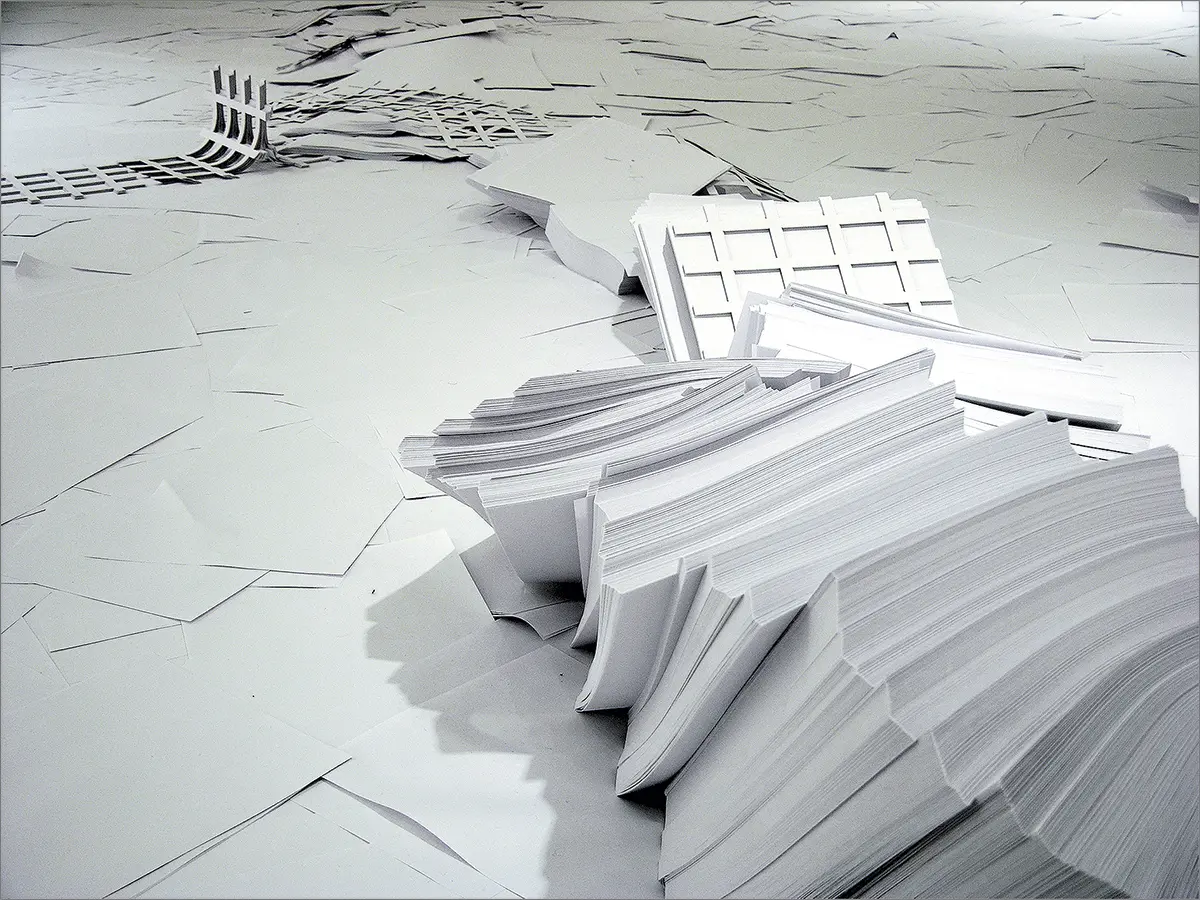
When Marco Maggi places his work, comprised of large amounts of paper, inside an architectural space, he displaces the use and the scale of both, generating demand for intimacy and miniaturization of the architectural experience and re-signifying each sheet of paper in a corporeal and material sense. Instead of centering the viewer's attention exclusively on the incidents that occur on the surfaces of those sheets, Maggi confronts us first with a contingent situation involving the weight and size of each sheet and its relation to the axiomatic structure of the architectural space in which they are collected. For that reason, the weight and size of the observer’s body become significant and a demand is made from it or a certain cognitive performance in the established course through the space.
When a subject assumes the function of the viewer, it plays a conventional role, supported by a cultural tradition and an ideological structure, since art seems to be understood as a structure on the service of visuality. As we have been told, visuality is both the base of the social experience of vision and of the visual experience of the social. Thus, the simple act of seeing (or the fact that we believe it possible or legitimate to do so) introduces an adherence to a conception of art as vertical, atemporal, formal, or sublime. The unsettling duplicity of the project El papel del papel is based on its requiring a sharpened visual perception, and on its having demanded an active physical role that dismantles the persistence of the viewer’s traditional role. Entering this work implies a recognition of the global duality that surrounds the body and transforms the work into a substitute for the building. It also involves the subtle recognition of miniature incidents that originate in the vast array of shades that are discovered in the color white or in the discovery of slight interventions by way of incisions on the surface of each sheet. The slits in some of them tend to replicate the idea of construction inside a construction, as suggested by the work inside the space, and the corporeal evidence of this material that becomes susceptible and vulnerable, revealing all its fragility, is reinforced.
In provoking a transformation of the experience provided by architecture, this work posits a horizontal intervention, supported exclusively by the gravitational force that opposes modernity’s characteristic formality, verticality, and transcendence. Pointing out the contingency and transitory character of the experience of the body, it unveils different temporalities, situations, or allusions that are not satisfied in the simple fact of seeing the work. El papel del papel is a challenge to the conventional order of the visuality of the visual arts, and it posits channels of communication capable of overturning those conventions.
JAIME CERÓN