
On September 10th, the exhibition Lies of works by the photographer María Martínez-Cañas opened at the Fredric Snitzer Gallery. The exhibition consists of twelve pigment prints on archival watercolor paper. The smallest piece was 25 x 31 inches while the largest was 34 x 29 inches.
Martínez-Cañas’s work is in the middle of a transitional process, not the first and hopefully not the last one in her career. According to her statement for this exhibition, she is challenging the traditional function of photography, which is often associated with documentation. These twelve works are the result of her recent photographic experimentations.
In a completely new approach to her work, Martínez-Cañas is distancing herself from her previously detailed photographs. She was known for photographic collages and innovative botanical works; now she devotes all her attention to the human figure and cityscapes. She moved from intimate and personal themes to more universal and general topics and changed from precise and defined forms to ghostly images that are very painterly. Many photographers when deciding on a technical change manipulate their work with current technology, creating juxtapositions of images and montages, for example. Martínez-Cañas instead chooses an approach closer to the original technique of photography. This action indicates that she will continue exploring this path and that this exhibition is only the beginning of many other changes in her work.
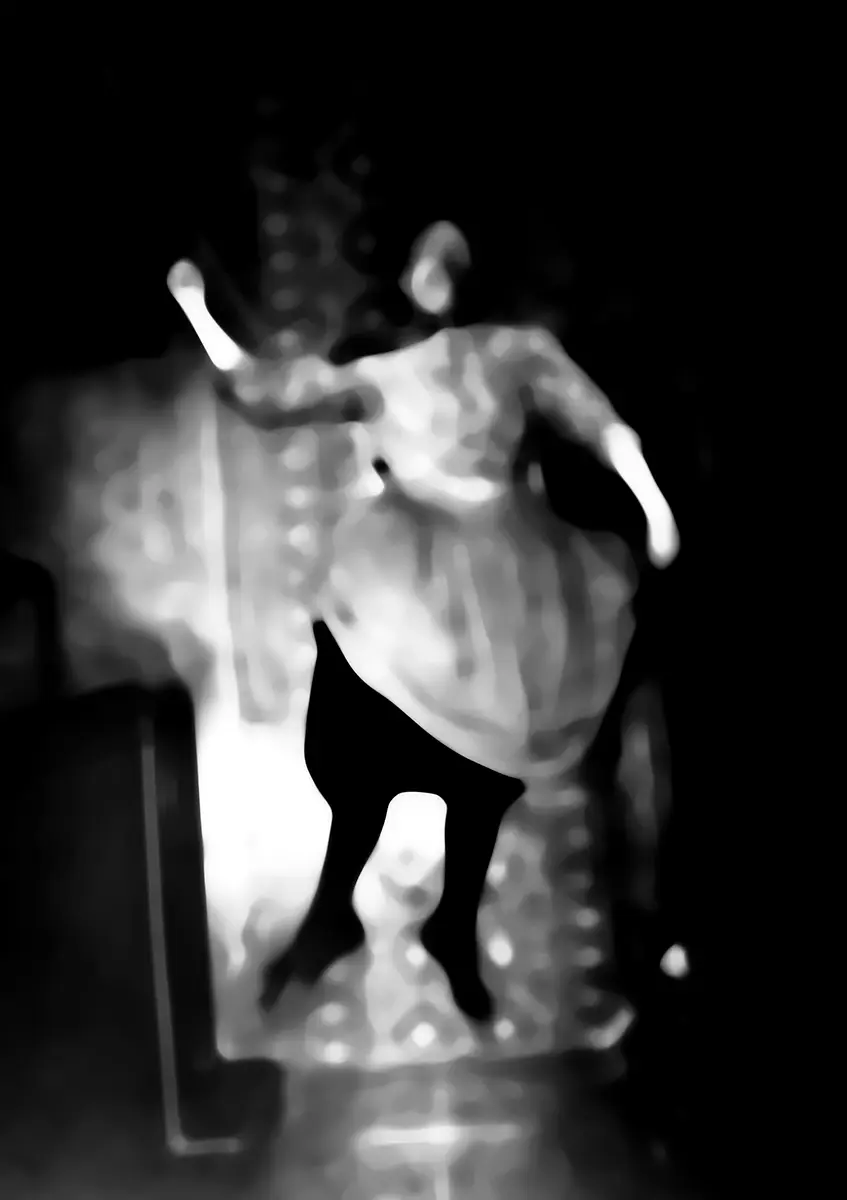
Her color palette has changed as well. Although black and white are not new to her work, the new work is exclusively monochromatic, in contrast to her earlier work’s inclusion of blues and browns. The work is an abstraction and dissection of her reality. Her perception has shifted from what was her usual themes and focuses on different aspects of her surroundings.
Martínez-Cañas plays with the idea of the impure image in a very conscious act of manipulation. She uses photographs that initially were linked to the crime. By isolating the image from its original context, she creates a new environment and a new story for the image. Hence the title Lies for the exhibition. She lies to our eyes, she gives us an image in a fragment of abstraction in the sterile and safe environment of a gallery; later we learn that these images originally had a violent past. Yet we see a peaceful instant in most of them. She questions the acceptance and judgment of images received from a predetermined context. She questions the fact that photography, something trusted as being loyal to reality, can be so manipulated that an image can end up at the other end of the spectrum of meaning and assessment. And ultimately, Martínez-Cañas proves her point. If we don’t read her statement, we would never guess the origin of her images.
Constructed from what appear to be shadows, her photographs become a testimony of her reality. Before your eyes, cityscapes, objects, and people start to take shape. This is a new way for her to address perception. Is she fooling the eye? Perhaps. But Martínez-Cañas shows that these images are also part of reality but from another point of view or a different interpretation.
These images possess a haunting beauty, an attractive quality that forces us to look again and again, trying to learn the story behind each of them. They seem to be part of the past, like virtually frozen snapshots of dark corners. This fascination is based perhaps on the fact that the interpretation of the image itself varies from viewer to viewer and the conjectures can be infinite.
Martínez-Cañas chooses for her work to be blurry, an intention to disguise reality and at the same time a way of forcing the viewer to consider alternate spaces. It is as if she has transported herself to a different dimension and is looking at her surroundings through a thick glass.
IRINA LEYVA