
For some forty years, French-Argentinean artist Marie Orensanz (Mar del Plata, 1936) has assumed a challenge that provides a foundation not only for the essence of her art but also for her individuality as a woman and her position in society. It is the ambitious option for the value of freedom, on which the truthfulness, sensitivity, and deep meaning of her work are inscribed. Her work is observed and analyzed on the basis of the tirelessly evoked postulate—to be free—where two symbolic dimensions cross paths and join each other in order to define both her existential search and the integrity of her creative work. The artist manifests the desire to remain free beyond life’s circumstances or difficulties. Her loyalty to this desire allows her to situate herself at a conscious creative distance, from which she faces the avatars and artifices of supposedly international art. The dominant aspects of her aesthetic identity are symbolized by continuity, coherence, and artistic and intellectual reflection.
The essential foundations of Marie Orensanz’s work are based on a mobilizing conceptual axis: the relationship between thought and matter. This “place” of fundamental interrogation, where reflection confronts the real, has impregnated every material, technical, and formal investigation in the different periods or phases of her visual arts history, where the most recent signs are witnesses to their incessant vitality. The spirit of her work transcends both the formal and intellectual, in the coherence of the permanent. What first captures our attention is the harmonious development of a plastic thought and its materialization in each attempt, according to each risk, in the selection of each matter, and the invention of each form. On the other hand, the articulation of the social—a fundamental preoccupation that the artist seeks to channel, and in consequence materialize—is achieved through the questioning of new materials and their critical, rational, and sensitive mise-en-scène.
The evolution of Marie Orensanz’s oeuvre can be surprising, not only from form to informalism, white to black, and linen to marble to the canvas but also from linear to organic, weight to lightness, the path followed by this artist adapts to the same conceptual and formal dialectic that establishes the essence of the work’s plurality and causes its transformation in the deepest recesses of the creative process. As she has said, “in order to find what is essential—which is thought—go beyond matter, do not be limited by it.” Her search is demanding. Matter, idea, space, meaning—everything is joined, and nothing can be separated. From the formal objection to the object whose function has been subverted, the work of the artist resides in the path opened by the “constructive impulse” which so many Latin American artists have interpreted at a point in the region’s history. Joaquín Torres-García, Carmelo Arden Quin, Lygia Clark, or Jesús Soto anchored a vigorous abstract and constructive tradition in Latin America. In the traces and the personal interpretation of a humanized geometry that becomes “warm” (Torres-García) and where architecture is “emotional” (Mathias Goeritz), Marie Orensanz finds her own way, questioning the world and society in a permanent renovation of forms in order to be and remain free. The artist’s Latin American-ness is both identity and cultural commitment as an indispensable, constant source of inspiration.
Training and craftsmanship
After a foray into the practice of the law, Marie Orensanz decided to devote herself to art and followed a five-year course of study in Emilio Pettoruti’s workshop. In that analytical-abstract Argentinean school, she learned rigor and technique, but above all the value of craftsmanship. Still, in Buenos Aires, she frequented the workshop of figurative painter Antonio Seguí and reinforced her “need to know techniques to express herself freely.” While she was learning painting, the artist took classes in theatrical research, since the social dimension of the theater is essential for her. To have a social conscience, and to project herself toward the world are her most basic drives. Marie Orensanz decided what she was able to say by abandoning image, and she delineated that essential, unique, invisible dimension that is at the center of everything. Following Duchamp, she sought to “materialize” the very idea of the image, and like him, she attempted to carry out a mise-en-scène of thought itself. “Trying to keep what is essential, eliminating everything superfluous to retain just the idea. This drives me to work on ideas and matter at the same time.”
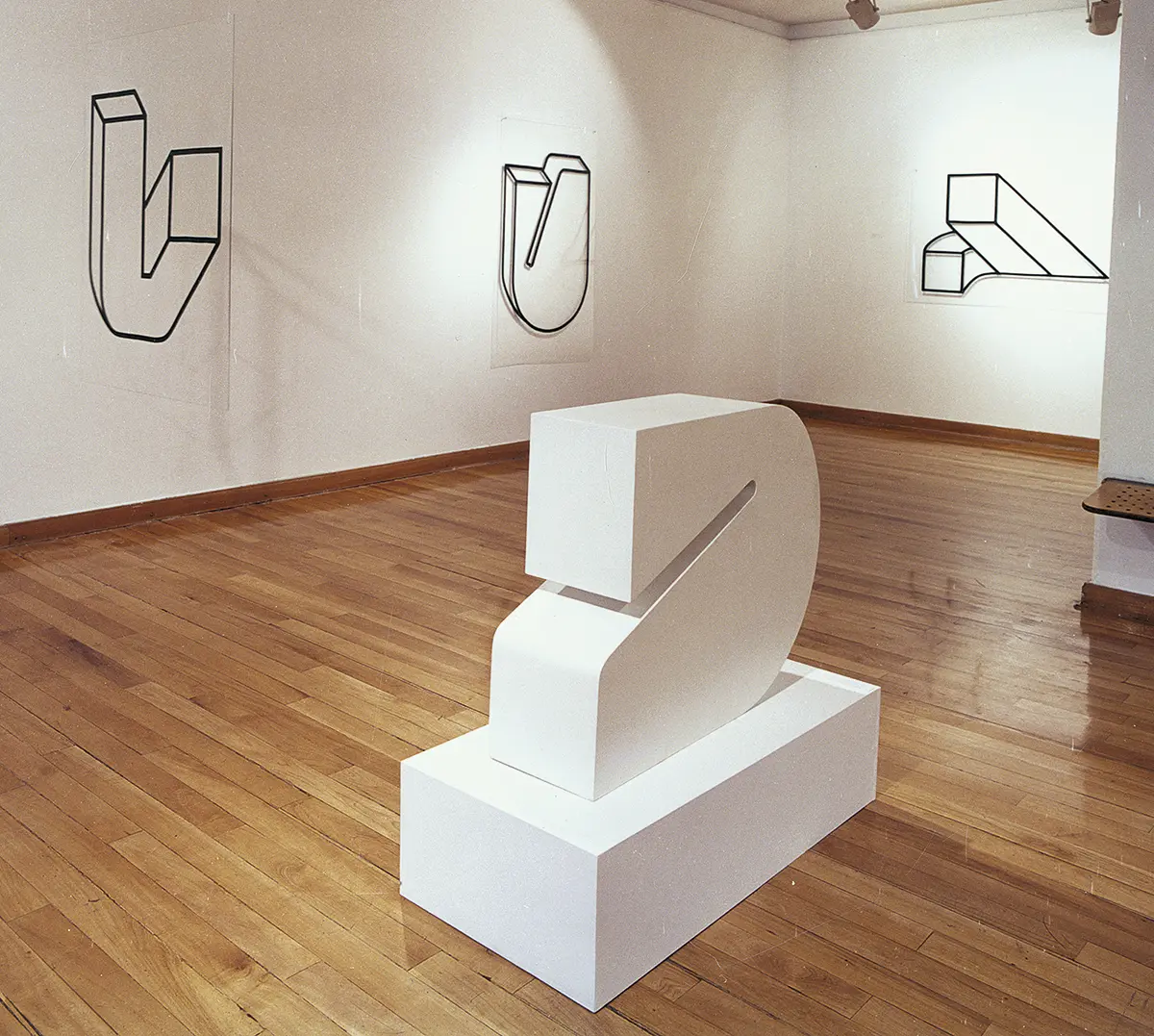
Starting in 1962, Orensanz developed an interest in a new way of integrating space, using the abstract form in volume, bare forms close to Minimalism. She also experimented with transparent acrylic sheets on which she “drew” using black adhesive tape; this opened up a dynamic and relative space for her, which provided that “spatial sensation” she sought so insistently in her creative work, and which we reencounter in all of her form-matter experiences. Her Estructuras primarias (white wooden sculptures from 1967) and her Formas-de-formas (transparent acrylics with black tape from 1969) attest to this period of radical change, of a break with figurative images and with painting in order to move toward sculpture, geometry, and abstraction. However, in her new abstract works, those curves, clefts, and snaking shapes that evoke the constant desire to translate the organic, and announce, in a way, future changes.
“To work thought and matter together”
Marie Orensanz’s exploration is not only linked to social thought, geometry, and to philosophy. It is above all an artistic matter. The color white, privileged first with her marbles and later with her reliefs on canvas, is not a purely aesthetic option. In the commanding intention of the concepts of “fragmentism” and “of the incomplete” that articulates the meaning of her work, the color is chosen for its neutrality and variation; in fact, it changes under light more than any other color. The color white, and later black, is what makes possible her transmissions, her limits, her progressive slides. This is how the artist is able to remain in a perpetual state of mutation, with which she seeks both to “commune” and to “communicate” through matter. The artist shapes her relationship with space and with the world, drawing, painting (on marble and cardboard,) modeling a canvas impregnated with a mixture that will give it, upon drying, its definitive rigidity, or more recently by bringing together materials and different objects. What interests her is “to motivate thought and to find an aesthetic way of transmitting those thoughts.”
In the summer of 1969, an external event provoked a change in her art and allowed her to discover the strength of that “inner thought” she is compelled to express through matter. Having witnessed a worker’s rally against the cancellation of rail service in a village called La Gallareta, in the province of Santa Fe, she decided to present in her next show the document drafted by the protesters: “The village of La Gallareta fights for its sole source of jobs.” She created several posters with that caption and lined them up on the gallery walls. For the first time, she appropriated the meaning of a text and transformed it into the act of exhibiting it in an art gallery. Argentinean censors, noticing the double meaning of her action, closed down the show, which had lasted for only a day. Yet by confronting the museographic space and transforming it into a space for reflection, the artist developed an awareness of the location’s power and its lack of neutrality.
After this experience, which reinforced her desire not to remain indifferent to the problems of the world, Marie Orensanz went back to the canvas and began a series of works about the chaos of the city. We see broken cars and felled trees, later joined by symbols, dots, arrows, and symbolic equations (for example, 1+1=0). In a text written in Milan in 1875, she says: “Some times I give symbols, or numbers, a precise meaning. For me, the number 1 represents the human being in society. The addition 1+1=0 symbolizes our lack of communication. A dot can preserve its main meaning as a dot, but a dotted line means time. An arrow can indicate a direction, strength, or love.”
Later she would incorporate text (phrases and words). The topographies of the city refer to the geometric plan of Buenos Aires. The artist draws on a new space, conceived as a kind of grid that she calls “pathways of memory.” These new iconographic codes announce a fragmentation of space thought of by the artist as a metaphor for diverse ideas, which was to be continued and confirmed later on. Marie Orensanz is simultaneously located in the matter and in theoretical and/or utopian reflection, and she incessantly seeks different materials since it is those materials that incite ideas. When she chooses a given material at a precise moment, it means that such material serves her thoughts. The state “of permanent evolution, of interrogation” that she defends is the foundation of the idea that the material is the support of a basic thought-matter dialectic.
Fragmentation and white marble
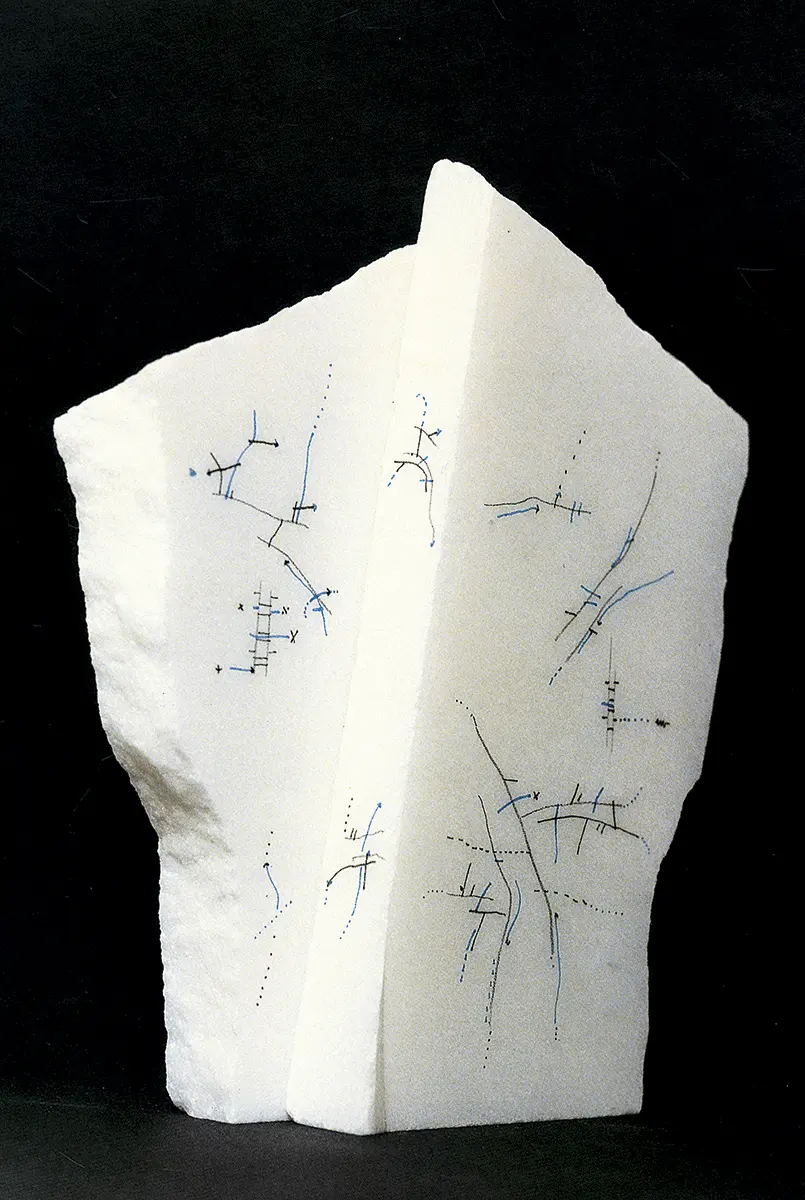
Marie Orensanz traveled to Italy in 1972 and lived for three years between Rome and Milan. Her desire to abandon the canvas became more and more evident. It was in Carrara that she found the solution. She decided, rather than uprooting marble from its natural environment, the quarry, to let herself be guided by chance encounters, collecting fragments and unarticulated pieces, blocs aged by time and fractured, parts of the whole, abandoned remains of an unconquerable immensity. She is attracted by “the beauty of the broken” and its imperfection subjected to the rigor, the exigency of the color white, and the density and hardness of the material.
The idea of fragmentation becomes more precise. Using pieces of marble is not only a way of leaving the canvas behind but also of rekindling an interest in the matter. For Marie Orensanz, it is a “true encounter,” a kind of chance recuperation of that which is palpable. In that attempt to give life back to the erased and the dislocated, she reconstructs, in idea and not in form, the order in space. She does not seek to reconstruct the original object, as the latter is nothing but a part of a whole. First, Marie Orensanz draws on the marble, and then she introduces painting. The text written and drawn on marble must temper the laws of geometry; it is a whole unfinished graphics of punctuation that leaves the discourse hanging in an ellipsis. The numbers, Orensanz’s mathematical and physical science notations, evoke the constructivist’s rulers and calipers. But the rigorous purity of the graphics is counterbalanced (humanized) by the marble’s fragile, wounded skin, the fruit of its haphazard irregularities.
In order to better frame its incomplete, unfinished qualities, in order to exorcise its element of infinitude, the marble fragment recovered from the Carrara quarry, chosen for its transitory existence, makes way for the fragmented work of art. From this practice of recuperation and written and drawn intervention on white marble, on which she worked for more than twenty years, Marie Orensanz was to develop a theory named Fragmentism, which she often followed in practice. In this text manifesto, enriched between 1978 and 1982, she writes: “Fragmentism seeks to integrate the part to the whole, becoming, in its multiple readings, an unfinished and unlimited object through time and space… Incompleteness is a constant in my work because I believe we are fragments of the past and the future… I am interested in establishing a dialog with the person looking at the marble, producing an intellectual or emotional relationship in each one of our phantasmatic projections. It is at that moment that the symbol’s polysemia begins to work.”
White constructions or “sensible geometry”
Cut up, the glued cloth was to replace white marble. First, the artist chose the color white to create structures, reliefs, and geometrical constructions that continued to incorporate certain graphics and complete sentences, such as for example Las raíces son femeninas (Roots are feminine), as well as fragments of sentences and loose words, such as elevación (“elevation”) or camino (“path”), the latter a concept she is particularly appreciative of and around which she wrote her text "A donde va el camino" (Where does the path lead) for two exhibitions. These reliefs stuck to a white background, these hand-modeled canvases can seem somewhat distanced from the idea of Fragmentism as previously developed by the artist. However, for Marie Orensanz, a given shape can be structured without being closed, since, according to her, “thought can also be fragmented.” As previously explained, she is not interested in the material for its own sake, in its technical and plastic dimension, but in “the material as a support for thought.”
The black canvas: a relationship with the body and nature
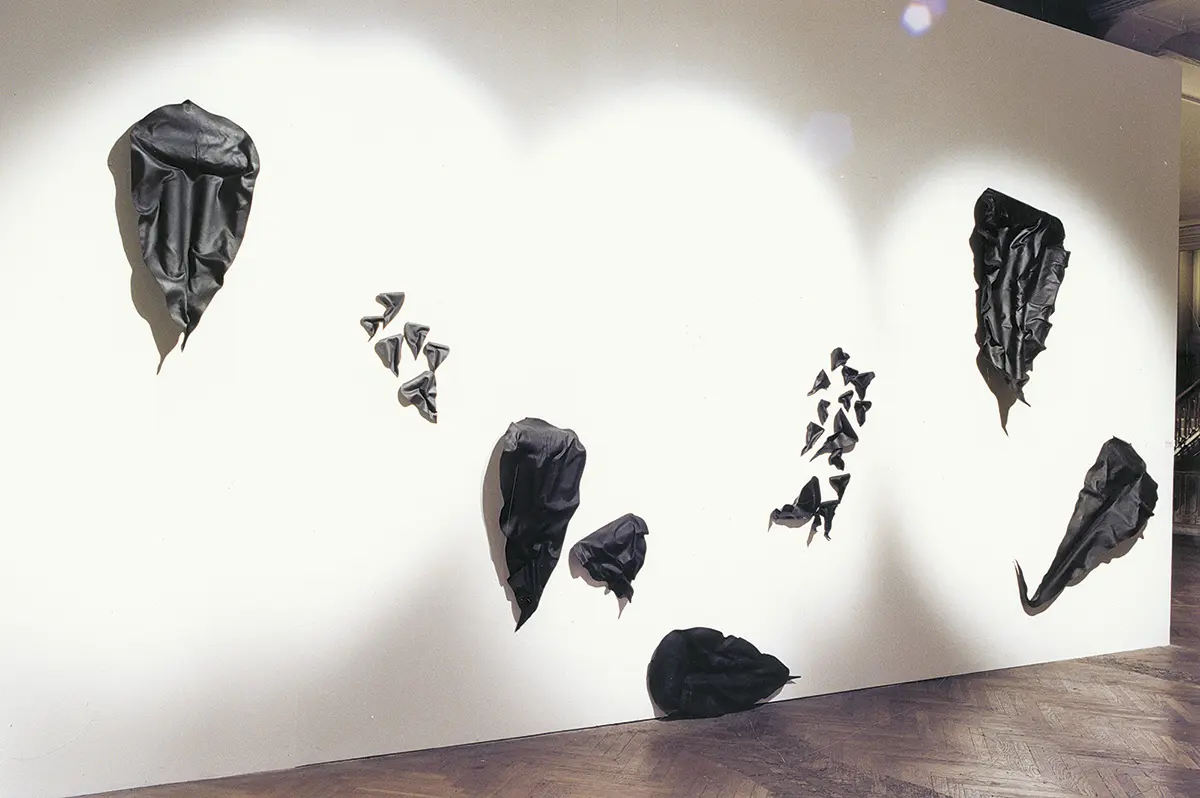
With this new material that the artist, as we have just seen, first paints in white, later in black, two elements are basic: time and manual labor. Marie Orensanz confirms it: “It is a slow process. I mold the canvas, already soaked in acetone, to give it shape; after it hardens, I sand it; and finally, I paint it. Since the process in the workshop is slow, all that time helps me to transfer the energy of my thoughts to the piece I’m working on.” More than ever, Marie Orensanz establishes a bodily, sensual relationship crushing this “mass” she gives shapes to that she calls “leaves,” painting them in black. However, with those identified, metaphorized images (Leaves of life), we are both in the body—an evocation of female sex, of hands—and in nature. The artist transforms nature into architecture and invents a space-landscape-time. Since she had her abstract totems “bloom,” Marie Orensanz has been experimenting with geometry in movement that corroborates her attitude towards life. The three periods in her work (veins/earth; roots/woman; leaves/life) are expressions of an interior path that mix her reflection on form and its meaning with that of life in the process of being lived. Her video Camino de artista (An artist’s path, 1999, five minutes) is an aspect of that love of life that unfolds in a preoccupation with and a permanent interrogation about the freedom to think, to act, to be.
The text becomes artwork: aphorisms, a game of Q and A
The relationship between text and image, writing and form, has been practiced by all cultures, throughout history. In the twentieth century, the role and place of writing in the space of the visual arts were systematized by the Dada movement and the Futurists, in order to later blend, ad infinitum, the creations of poets and painters. Starting in the 1960s French artist Ben Vautier imposed his manual typography as a provocative double-meaning work, while, later, Jenny Holzer’s texts, parading in the manner of advertising billboards, occupy the public space and intervene to motivate reflection and mobilization. With Conceptual Art, the use of words, phrases, and texts becomes banal, evacuating the image.
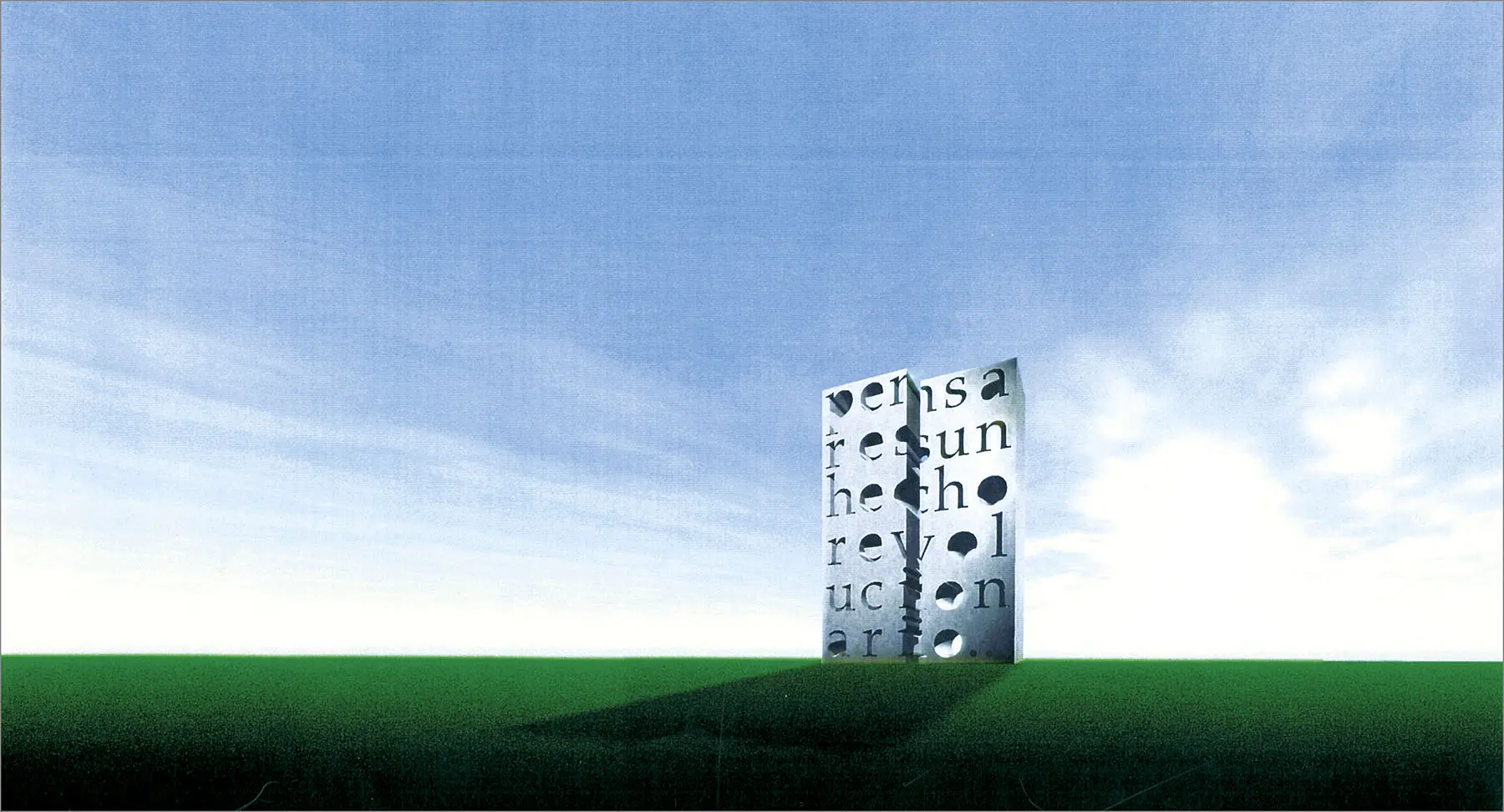
With a purpose that is at once aesthetic and conceptual, Marie Orensanz’s work introduces a relationship between text and object in which the metaphor is inverted. The text-work coheres with her public art projects proposed in 1999. She won a competition (out of 663 projects submitted from 44 countries) to create a monument to the Victims of state terror with her project Pensar es un hecho revolucionario (Thinking is a revolutionary fact) to be erected in 2004 at the Parque de la Memoria in Buenos Aires. It is a structure in concrete comprised of two equal parts separated by a small distance, which forces the viewer to reflect in order to read the phrase. The text “Pensar es un hecho revolucionario” is carved on both parts.
What is interesting in Orensanz’s work, unlike the use of text by other contemporary artists, is that the evidence of the relationship between the chosen object and the text is the nucleus of the work’s meaning. Text and object fuse into an inseparable unit. With Orensanz, what provokes reflection and achieves great coherence in the trajectory of her inquiry—which is not only personal but also about matter and space—is the fact that her intellectual discourse is profoundly linked to the object while forming a cohesive whole.
After Pensar es un hecho revolucionario, the artist created several installations in public spaces. In the spirit of letting text assume matter and become embodied in it, and with the idea of that “graphism of thought” that motivates her, Orensanz won the Banco Ciudad 2001 prize in Buenos Aires with her installation De qué lado? sopla el viento (From what side? does the wind blow). The work is a propeller based on a drawing by the artist. It hangs on a wall on which the text is written in a semicircle to give the idea of the propeller’s movement while it remains still. Marie Orensanz explains this piece and its text as a metaphor for a necessary reflection and insists on its ethical aspect, emphasizing “objects must be aesthetically excellent because emotion is very important for me, even if my work seems overly intellectual.”
In 2001, the Arteba foundation and the Puerto Madero corporation called for entries in a competition for sculptures to be installed on the Azucena Villaflor Boulevard, in Puerto Madero. Marie Orensanz’s project, Para quién? suenan las campanas (For whom the bells toll) was selected. The piece comprises six aluminum bells suspended at different heights from a thin pillar. The next question is printed on the floor, and each bell tongue offers a different answer: “For those who doubt; for those who judge; for those who wait; for those who remain silent; for those who accept; for those who help.” The viewer looks downward to read a question and upward to read an answer; in this way, the artist attempts to provoke surprise and reflection.
The object’s detour and the return of the idea
In the late 1980s, Marie Orensanz began to investigate a different medium, that of functional objects. She collected old utensils, pieces of old wood, and steel rings from old casks, and executed them according to her drawings. These objects linked her once again to her own desire that traverses and irrigates her hand-made works: to give creative value back to the human hand, the working hand so splendidly photographed by Sebastião Salgado in the exhibition that, under that very name, he presented some years back in Paris. These new works by Orensanz bring us face to face with a new dialogue between two temporalities. In this act of gestation, she creates a different time, that of being in her own time taking past and future into account simultaneously in order to form a single, contemporary time. She wants to “create a different dialogue” in her permanent desire to reach the other, to communicate with the other.
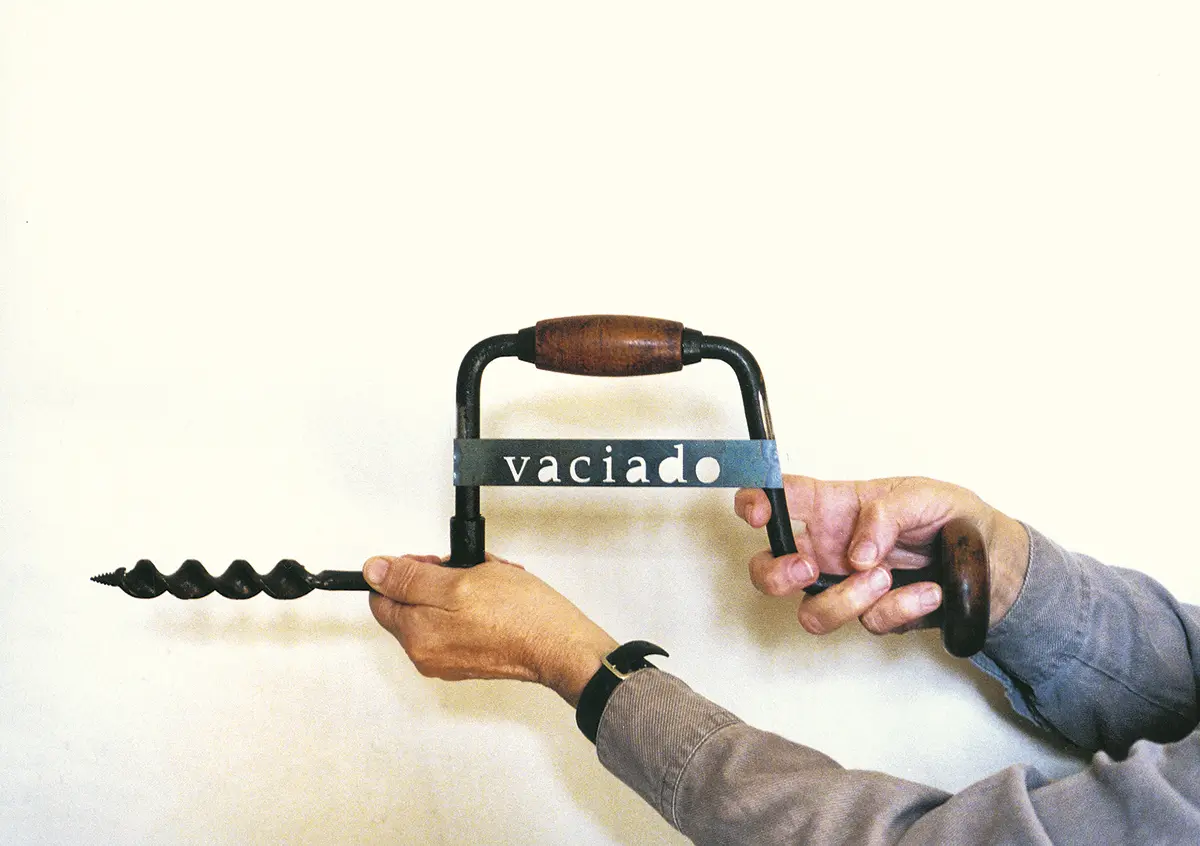
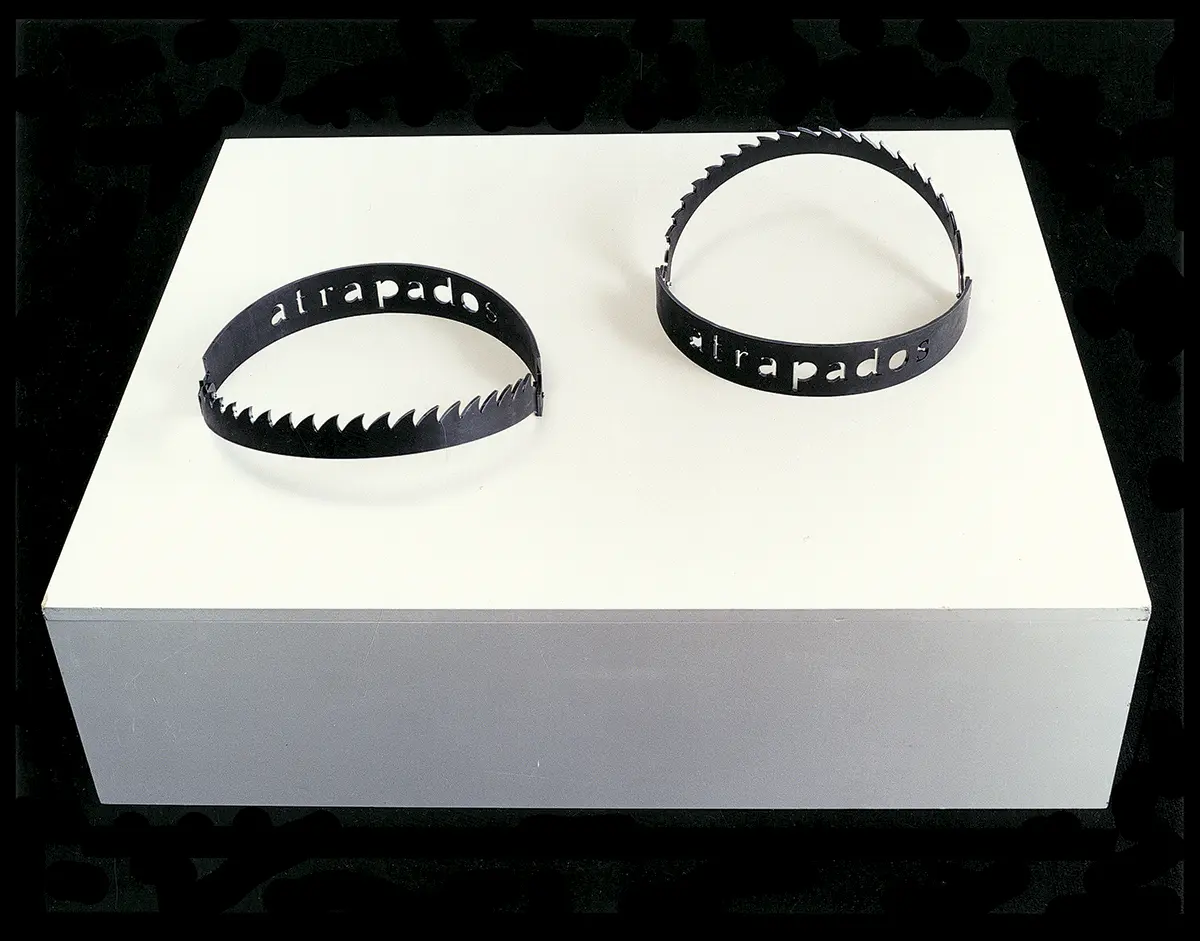
Always present in Orensanz’s work is that desire to have the public participate, to have them commit to her proposal, raising for themselves questions about society and reflecting on the dominant all-pervasive alienation, in the spirit of that “relational aesthetics” theorized by French critic Nicolas Bourriaud. For this purpose, she chooses an object that deviates from its function. The singularity of the operation consists in giving back to the detoured object its original meaning through a provocative conceptual redundancy. In the traps she draws, she achieves her goal. The same goes for the old wood and steel drill on which she inscribed the word vaciado (“emptied”), alluding to our personality, which has been perverted or emptied by an obsessive alienation of consumerism or information. Marie Orensanz is especially sensitive to our indifference to each other, and our individualism. She believes in the “power to choose” that allows us to be free, and in her own demanding standards, because “nothing is given, everything must be earned through reflection, sensitivity, and emotion.”
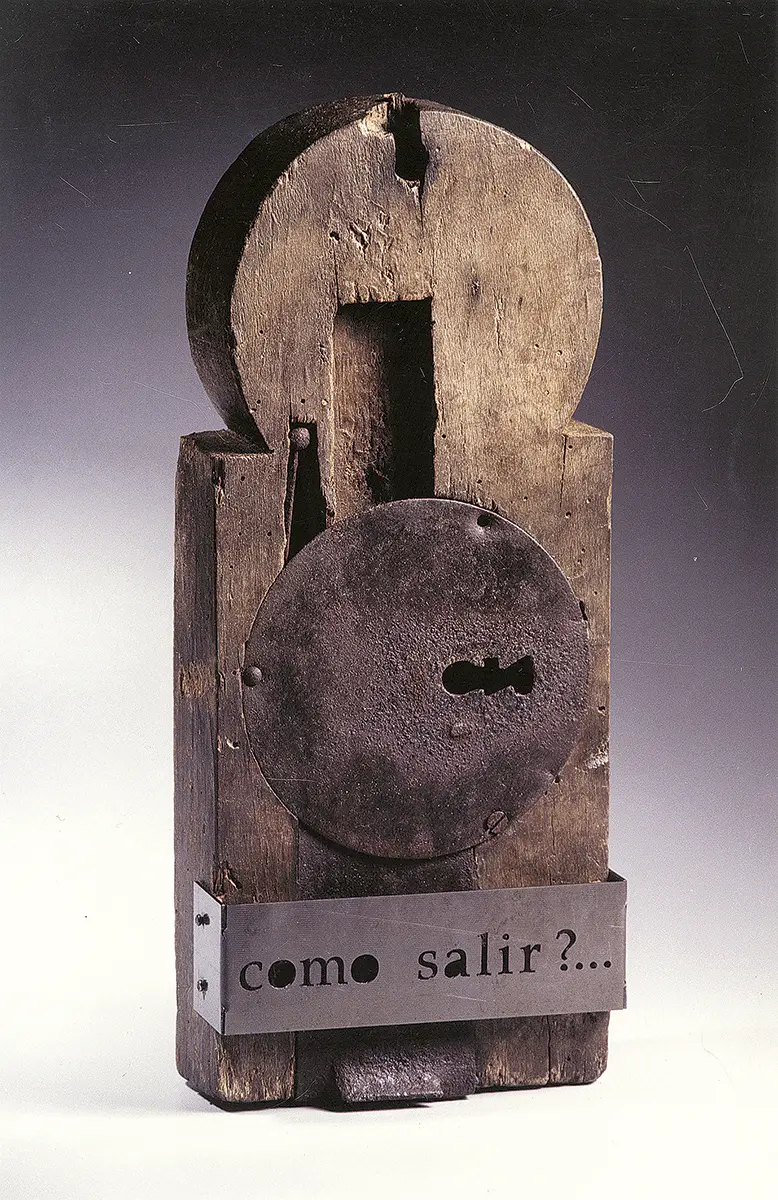
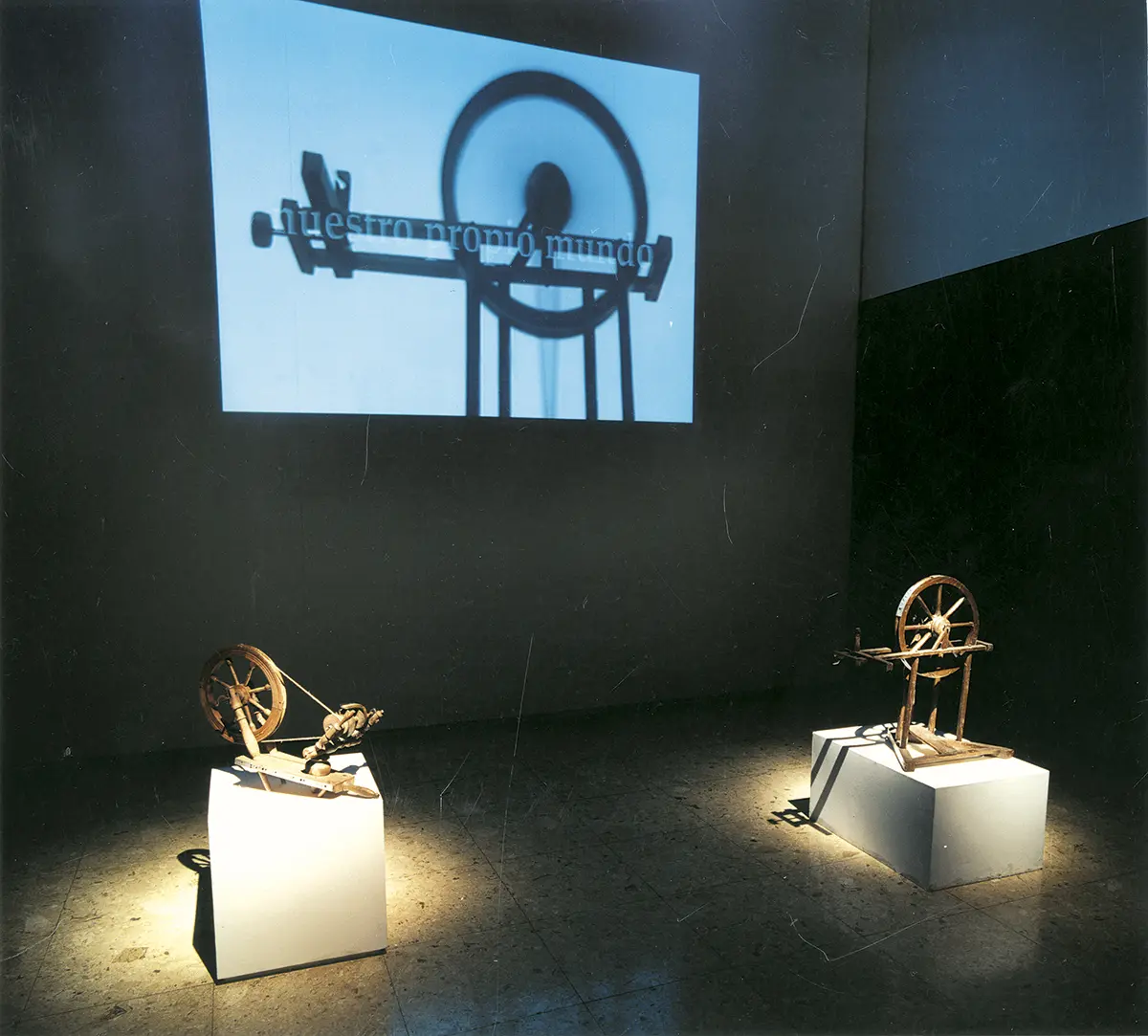
Following was another example of the superposition of one discourse (conceptual) on another (visual and functional), not à la Magritte—for whom the painted pipe was not a pipe but the representation of a pipe—but to emphasize initial meaning and to play with redoubled meaning. In 2002, Marie Orensanz was invited to participate in an exhibition on the subject of the Neo-Object and exhibited her work at Galería Filo in Buenos Aires. She presented an old wooden lock without a key on which she had engraved the phrase cómo salir (How to escape). For the second Buenos Aires Biennial, in December of 2002, she presented an installation titled Querer, poder, hacer girar nuestro propio mundo (To want, to be able to, to make our own world turn). The piece consisted of two wooden distaffs on which she wrote two texts: “El grande se sirve del chico” (The large one uses the small one), and “El chico depende del grande” (The small one depends on the large one), and a minute-long video. In her most recent exhibition at the Castagnino Museum in Rosario, Argentina (September 2003,) she presented an overview of her latest work under the title Variaciones sobre un mismo tema (Variations on a theme).
Knowledge and pleasure, or the interplay of opposites
The use of a new material perpetuates the work’s aesthetic value, and each experiment allows Orensanz to renew her conceptual and visual discourse according to contemporary artistic demands. The interplay of opposites, intelligently and effectively orchestrated by her, both concerns the alternation of white and black, marble and canvas, and indices a blast, the expansion, and contraction of form. With the color white, we are in the realm of meditation, of silence, a somewhat monastic space where folded paper and marble build an always-unfinished order, incomprehensible stability in the polysemic chain of knowledge and sensitivity. With the color black, space becomes dynamic. Gesture, trace, flight, scream. Action. Alchemy of mutation. A communicating thread guides the artist’s mental and physical gaze, from matter/earth to art/reflection/life, following the continuity-discontinuity of symbols that are almost morphogenic. Today, the incursions of sculpture on marble have disappeared, the fragment of matter has exploded, and words and text have imposed themselves over matter and attached themselves to the object. With writing, Marie Orensanz deals with problems of meaning related to the issue of content and container, visible and hidden, truth and false. It is not only a game around signifier and signified; it is also the revaluation of memory that, in the recuperation of utensils and functional objects revisited by a dialectic of forms and meanings, communicates and consecrates the universality and eternity of fundamental ideas: those of life, of thought, and the conscience of time.
* The first Marie Orensanz retrospective will be presented in December 2005 by the Buenos Aires Museum of Modern Art.
CHRISTINE FRÈROT
Art historian and critic at École des Hautes en Sciences Sociales, Paris, whose work involves both research and teaching.