
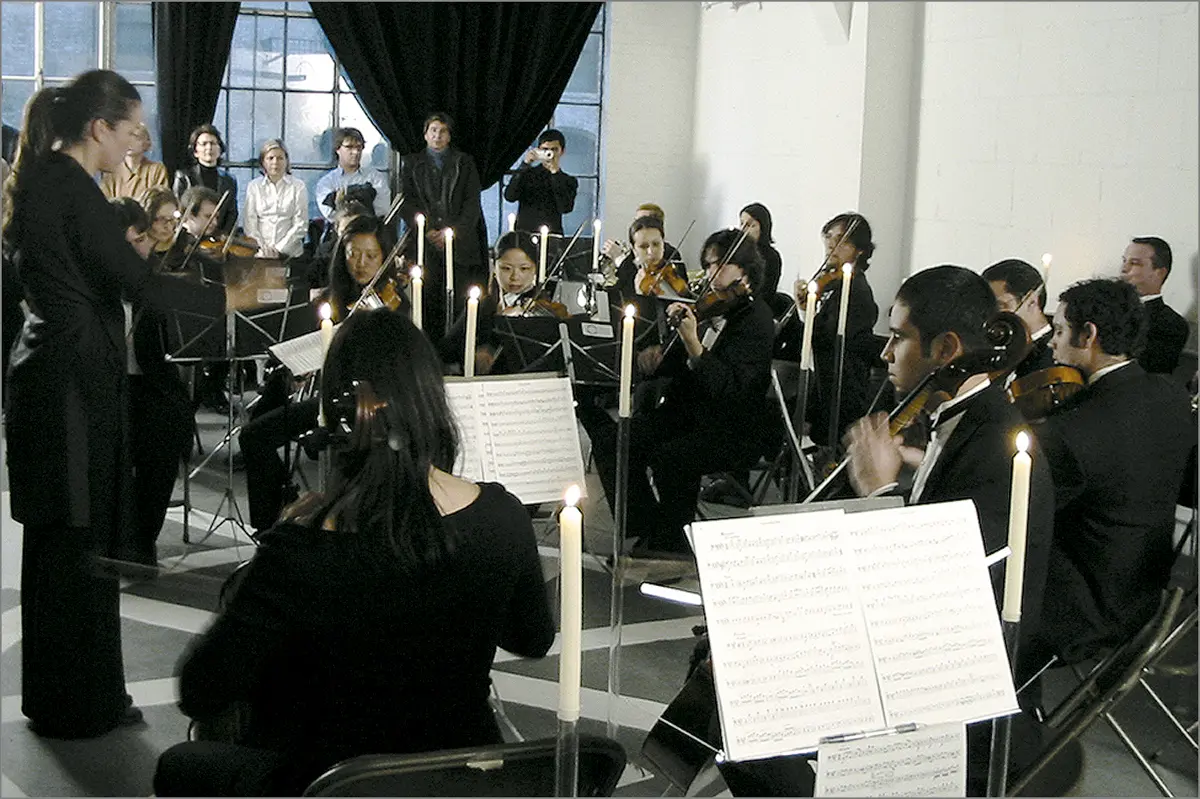
To consider only the elements exhibited on the walls, in a monitor, on the floor, and on the ceiling of the gallery would be too narrow a view of Pablo Helguera in his show “Swang Song.” To have the complete idea of this exhibition, viewers need to recreate the concurrence of these works with the performance, presented four blocks away on the opening day of the exhibition by the Mexican-American Orchestra, conducted by Alondra de la Para and composed almost in its entirety by the artist. As a visual artist, Helguera weaves together the territories of the object, performance, and music, with his focus on the concept of extinction. The author has been developing presentations on the subject of the extinction of languages and cultures, and on the tools to execute, or register sound production and reutilization. Finitude is a concern upon entry of the tunnel of his creations and it reaches the remains of various cultures, the media, and certain characters, while at the same time allowing the introduction of a fin-de-siècle romanticism into the general climate of his exhibitions.
Helguera is both individual and generational, which we will analyze presently. Today’s artists—at least a good portion of them—do not remain within the boundaries of a single expression. Rather, they create hybrids (of several components simultaneously or not) like the description of Swang Song in the previous paragraph. Those attentive to a conceptual framework avoid linear narrative: some offer their viewers aspects of the process of creation of the work, others (like Helguera in this show) don’t. Elegance is generational and individual—we are no longer in the 1970s—and as a consequence, each element is carefully executed and presented. Visual arts viewers are exposed to experiences like any person who goes out on the streets today. The narrative of some neo-conceptual artists is sublimated in diversity. The viewer has to take all of this into account with regards to Pablo Helguera’s work, including the fact that he locates himself in his heritage and in investigation and reveals both. He likes to explain, publish, and sublimate them in objects like Conservatorio de Lenguas Muertas, a series of thirty wax cylinders, among the few that survive this kind of recording device, every one of which registers one language in danger of extinction. Lined up in their warm color and their paleness—like something still alive, but dying—they were placed on shelves inside a display window. While this presentation could not but evoke the marketing of beauty products, it also paid attention to the duality between the real and the synthetic that abounds in a variety of topics, be it the creation of artists or commercial products. Conservatorio de Lenguas Muertas is well-lit and it was strangely attractive; the word conservatorio in the title allows several interpretations, both in English and Spanish, which remain open for the reader’s play. The artist’s concerns could be situated as aspects of cultural anthropology. Focused on the visual nature of music—not on music sheets of epochal registers—and occasionally on certain instruments, Helguera exposes us to the knowledge of certain aspects of the past through Helguerian recoveries. By 1942, Henrietta Yurchenko already had made her first research trip to rescue original indigenous languages and music in Mexico and Guatemala. Helguera’s intention is not to do that precisely; he is a twenty-first-century vision—ambitious, encyclopedic, and ironic.
Upon entering the gallery, the display window and Acolman, the installation in the ceiling, exerted a powerful attraction. The suspended composition—resolved in wood and wax—thin and with a molecular contour, also provoked perceptions of classical order. It could be either a beehive or a renaissance encasing; the same motif was traced on the floor where the orchestra was located using masking tape. If Acolman derives from one of Mexico’s beautiful monasteries, Endigness, the musical composition that is our topic today reveals the hybrid nature of contemporary aesthetics. A natural reference emerges: John Cage, music, text, object, performance—although with very different sources and motivations. Cage faces rupture; Helguera, with his attention on finitude, seeks and avoids it, fears, and pays tribute to it in an ancestral echo of Mexicanness. At the opening/concert/performance, there was a lit candle next to each player. After Endingness they played Haydn’s Farewell. The musicians blew out their candles and left the room one by one, carrying with them the already mentioned integration of performance into the work of this author.
GRACIELA KARTOFEL