
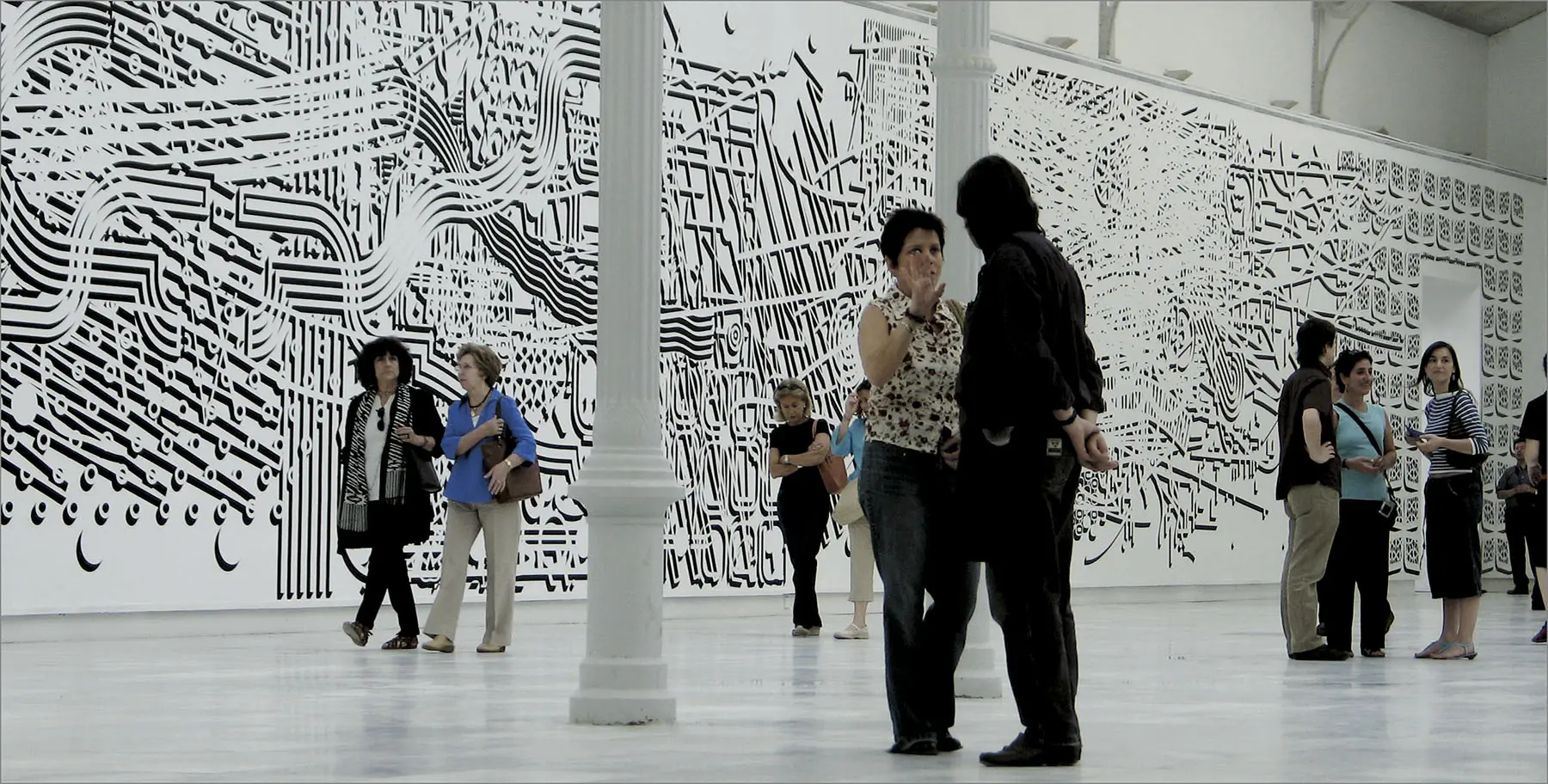
I chose the title for these notes on Pablo Siquier’s most recent exhibition advisedly because I think that the most intense and accomplished works were the murals he painted on the walls of the Palacio de Velázquez, the dependency of Museo Reina Sofía. The title “Siquier at the Velázquez” situates his painting and does so with a strong sense of implicating and even contaminating it with the attributes and the traces of the place on which it was painted, more than being on exhibit. Or might it be better to say that his painting was the place. We could even go further in our attempt to highlight the links between painting and place established by Siquier, giving another turn to the phrase and stating that the place was, thanks to the painting that provoked, illuminated, and interpreted it, freed from the flatness of its anomie or the indistinction of a state that, following Roger Callois, we could call “legendary psychasteny.”
Such links would also have important precedents in the career of this notable Argentinean painter if we are to credit the essays included in the catalog of this excellent retrospective. The three authors—Ivo Mesquita, Arturo Carrera, and Juan Manuel Bonet—insist, despite the evident differences in their approach and their conceptualization, on the thesis that there is a link at once necessary and revealing between Siquier’s work and Buenos Aires, his city. This is a surprising thesis, to say the least, if we note that Siquier’s painting has never been figurative, framed as it always has been within the abstract tradition, be it concrete in the sense of Concrete art, ornamental in the sense assigned by Worringer, or textual in the philological sense of “weaving,” or in the purely calligraphic sense.
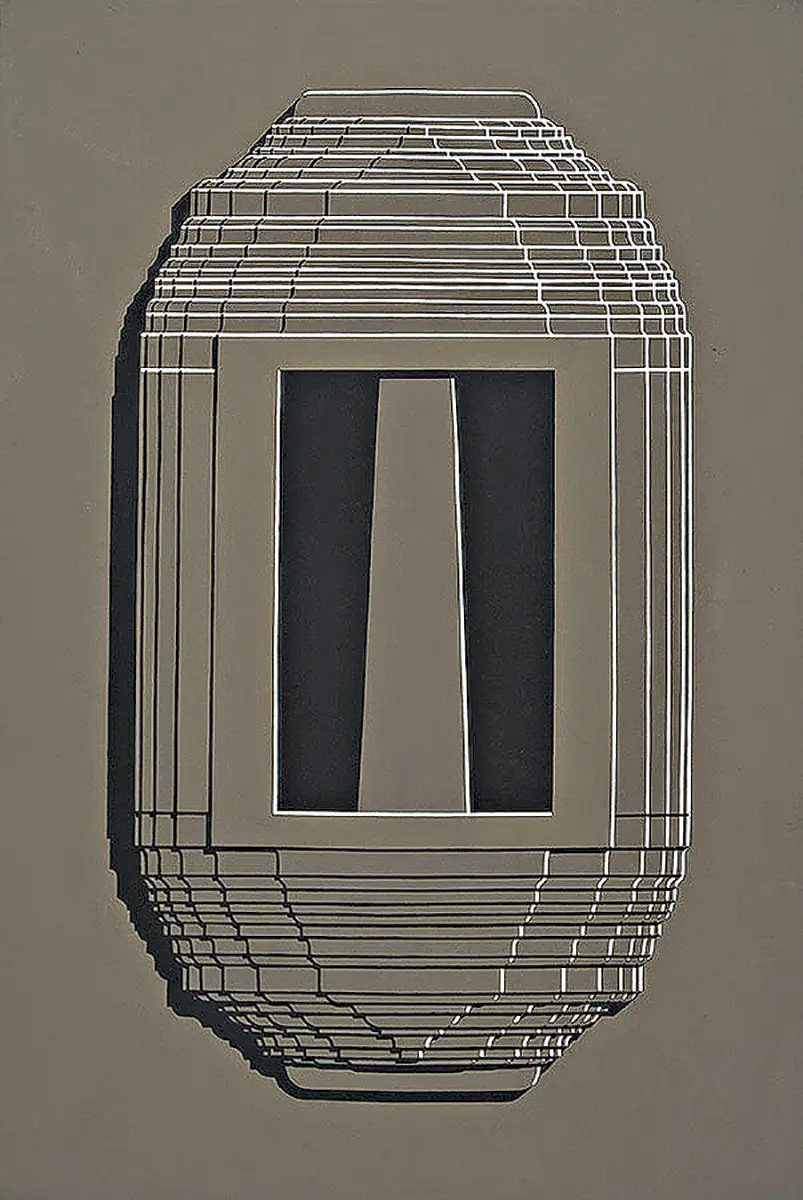
Nothing in Siquier’s work, not one of the paintings Siquier has created since he started creating paintings in the late 1980s—much less his current production—has included naturalistic or photographic references to Buenos Aires. The arguments wielded by Bonet, Carrera, and Mesquita are certainly brilliant and evoke by themselves the splendor and the horror of a metropolis that remains intact in my memory. But they are not convincing. Most of Siquier’s works are clearly inscribed in the strategy of painting for painting’s sake, that is, the investigation of the always open but not inexhaustible possibilities that result from the decision to make painting itself the definitive theme or topic of painting. I am aware that this thesis can be offensive to an entire generation of critics and theoreticians educated in postmodern criticism and in the tautologies launched by the venerable Clement Greenberg in his analysis of his favored New York School painters. This Modernist paradigm, as they say, seems to them entirely in shambles, and it is at any rate entirely alien to Siquier’s work, where they find complexity and/or hybridity that both Mesquita and Carrera unhesitatingly identify as Baroque or neo-Baroque.
They are mistaken. I say this with full knowledge that Siquier’s entire oeuvre is radically marked by the spirit, or if you prefer the traditions and the intellectual and cultural climate that dominate the institutions in Buenos Aires, keen on abstraction and universalism. But these two ideas, whose presence can be traced easily in Siquier’s paintings, share a common characteristic: they leave no place for place. What they do, if at all, is to offer clues for those anxious to find meaningful associations between the shapes in his works and visual details or fragments from the artist’s city.
A very different thing is what has occurred with Siquier’s murals at the Velázquez, an eclectic nineteenth-century palace recovered as a space for contemporary art exhibitions with all the implications of abolishing or neutralizing its distinctive features. With a territory-claiming painting, however, Siquier has interrupted Velázquez’s drift toward spatial anomie, transforming it even if temporarily, into a place. It is precisely the place of his painting.
CARLOS JIMÉNEZ
Writer and critic, independent curator. Author of Extraños en el paraíso: una Mirada al arte de los 80 (1993) and Los rostros de Medusa: estudios sobre la retórica fotográfica (2003).