
Long recognized for his serial depictions, the Havana-born Cuban painter Paul Sierra’s most recent series of eight paintings portray vehicular accidents. Motor-vehicle accidents are among the leading causes of death in the United States, and worldwide, it has been reported, someone dies in a vehicular crash every minute. Sierra gives vibrant visual form and presence to these alarming statistics. He stated to this reviewer that “cars are a second home” and vehicular accidents are a “sudden, brutal, violent way to die.” Ironically, or perhaps due to its horrific nature, the subject of death itself is absent from the work. Fittingly titled, Kaddish (2005) invokes the Jewish prayer recited by prescribed mourners during the first eleven months following the death of a loved one and on each anniversary of the death. Notably, there is no literal reference to death itself in the prayer. Correspondingly, the viewer sees no victim(s) in the painting, only the aftermath of what was a tragic collision. An overturned and badly damaged blue-violet car appears in the foreground and a still-smoking red car rests in a ditch across the expanse of a country road, betraying reckless driving. Nothing is divulged about the drivers. Who lived or who died is a mystery left to the viewer’s imagination. Mourning for somebody, however, remains an irrefutable activity associated with the mishap. An avowed atheist, Sierra nevertheless recognizes his paternal Jewish faith through his naming of the work. An anonymous church in the background further echoes the muted religious tone.
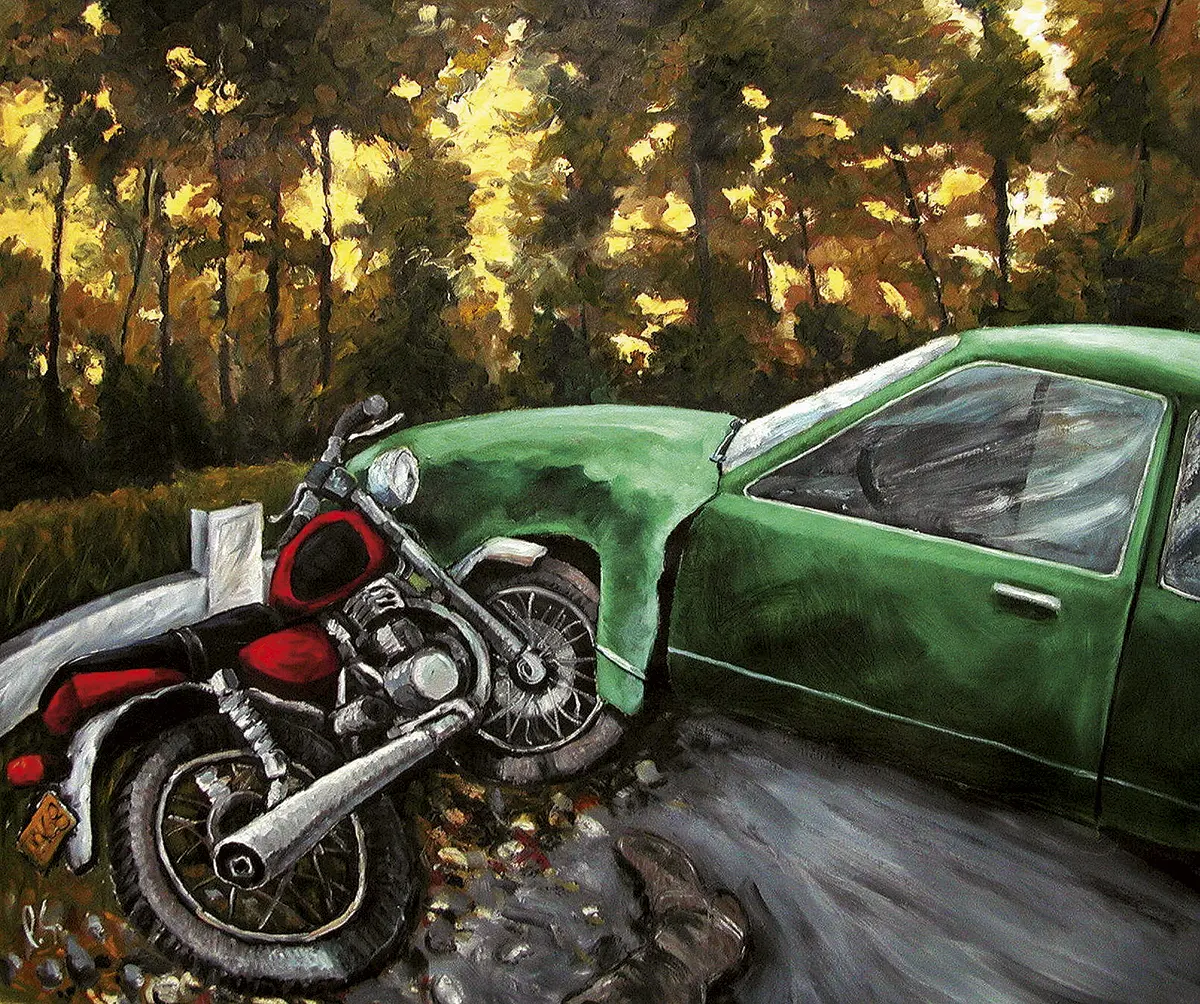
Similarly unknown and unseen, but for the disembodied lone boot in the immediate foreground, is the Donor who lends another canvas its title, and who apparently perished in the fatal crash involving a green car and a red motorcycle on a rural road, captured photo-realistically. A verdant and shimmering tree-filled background infuses this brooding portrait of an accident scene with an eerie quietude. Oddly, Sierra’s rendering of the car’s hood is highly suggestive of skin or fabric. Mangled (2005) features a disemboweled blue car whose shorn metallic skin also takes on the appearance of soft shredded cloth. A Red Toyota (2005) is laid to rest in a lush fertile landscape of resplendent Monet-like yellows and greens. The car’s fractured metal parts call to mind a human body’s broken bones. In the absence of people in the images, Paul Sierra arguably imbues his vehicles with human-like attributes. So considered, Truck vs. Chevy (2005) becomes a parable for combat between the David and Goliath of motor vehicles. This unstretched canvas also lacks any explicit human subjects. Two more paintings, Pile Up and Rush Hour from this 2005 series, recall the car crash paintings from the 1980s by the late Chicano L.A.-based artist Carlos Almaraz, a painter whom Sierra praises. The former painting resonates with the palette and drama, albeit not the majesty, of the English painter Joseph Mallord William Turner’s canonical work, The Burning of the Houses of Parliament (1834). Five vehicles are discernible in Sierra’s Pile-Up. Upon closer scrutiny, the luminescent foreground yields a car tire and other fragments from the impact. The consuming fire in both of these latter paintings and the rising plumes of smoke, in Pile-Up, in particular, haunts the viewer with anthropomorphic aspects.
Paul Sierra gives his viewers snapshots of the aftermath of motor vehicle collisions. Nearly all of the pieces have black frames that enclose their once highly kinetic subjects, turn them into strangely animated memento mori testimonials, and underscore the banality of roadside deaths as captured by the camera lens and reported in the media.
Two paintings exhibited in the company of the moving vehicle subjects are Prometheus (1991) and Icarus (1993), two mythological figures associated with fire and tragic outcomes. Icarus, of course, flew too close to the sun god Helios and fell/crashed to his death when the wax holding his wings melted from the heat. Stealing fire from the gods and giving it to mankind, Prometheus would suffer the painful wrath of Zeus. Employing a Siqueiros-like baroque verve and heavy impasto, Sierra transforms his human embodiment of Icarus into a more ethereal life force that blends into the picture’s prominent landscape setting. Prometheus is rendered somewhat tentatively, devoid of his usual commanding physicality. In the larger context of the vehicle series, one is left wondering to what extent the human figure is an ephemeral subject for Paul Sierra. Happily, in another work on display, two teams of diminutive rowers compete with the surrounding cityscape for attention in a stunning, luminous oil painting entitled From the Fullerton Bridge (2004). A running man subject—reminiscent of the installation artist Jonathan Borofsky’s Running Man painting on the Berlin Wall—is depicted in In the Blink of an Eye (1994), also shown in the company of the new series.
VÍCTOR ALEJANDRO SORELL