
As part of its cycle devoted to Latin American artists, the Museo de Bellas Artes de Santiago presents a selection of recent works by Peruvian painter Ramiro Llona. Sixteen large-format works are exhibited inside the very large Sala Matta —almost 800 square meters in the building’s underground level—. These are oil-on-canvas works, the smallest of which measure 2.40 x 2.60 m. It is rare to see this exhibition space in such an open state, without panels subdividing its majestic layout; there is only one panel that on one end receives visitors as they descend the access stairs, and on the other maintains the visual continuity of the gallery’s perimeter. Llona’s works light up the gallery’s interior, giving it a unified harmony that is truly difficult to achieve: inert space comes to an extraordinary life. In echo and counterpoint to this show is the exhibit at the Isabel Aninat Gallery (also in its underground space,) with another group of almost twenty works in formats somewhat smaller than those at the Museum. Despite a less-attentive arrangement and display, especially in terms of lighting, this is another excellent opportunity to gain a wide view of Llona’s current work. Both shows had the valuable support of Peruvian gallery owner Lucía de la Puente.
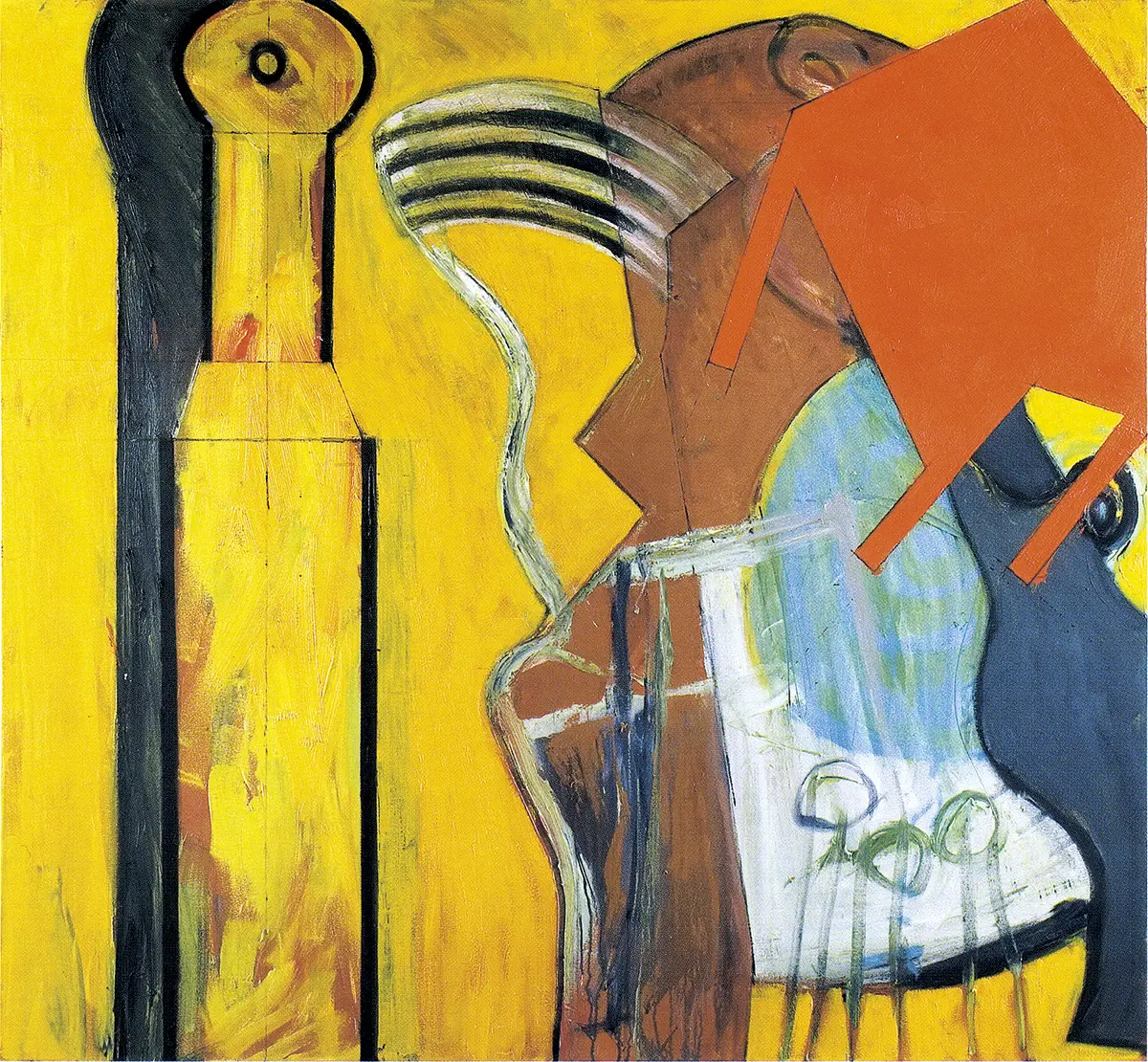
Many of these works are diptychs or triptychs. It could be argued that this resource simplifies the handling of paintings that can reach up to seven meters in length. But what is interesting is that the artist involves the partition of each work as an essential element in its composition; in this way, technique and language come together in perfectly adjusted solutions. This way of composing, both pictorial and material, is not new for Llona. He has been using it with great skill for over twenty years. While the tools of his work —oil on canvas— are rather conventional, the way he breaks the painted surfaces is not.
The series of paintings shown in Santiago, dated between 1998 and 2004, are dominated by warm colors. Reds, yellows, oranges, pinks mix skillfully with neutral “mediators”, from black to white, and, eventually, some notes of green and blue. The visual structure that organizes color is marked by black or white graphics. There are chessboard patterns, grids, regular lines, and strong brushstrokes that delineate irregular shapes. There are in Llona distant echoes of Matisse and some themes of Hockney.
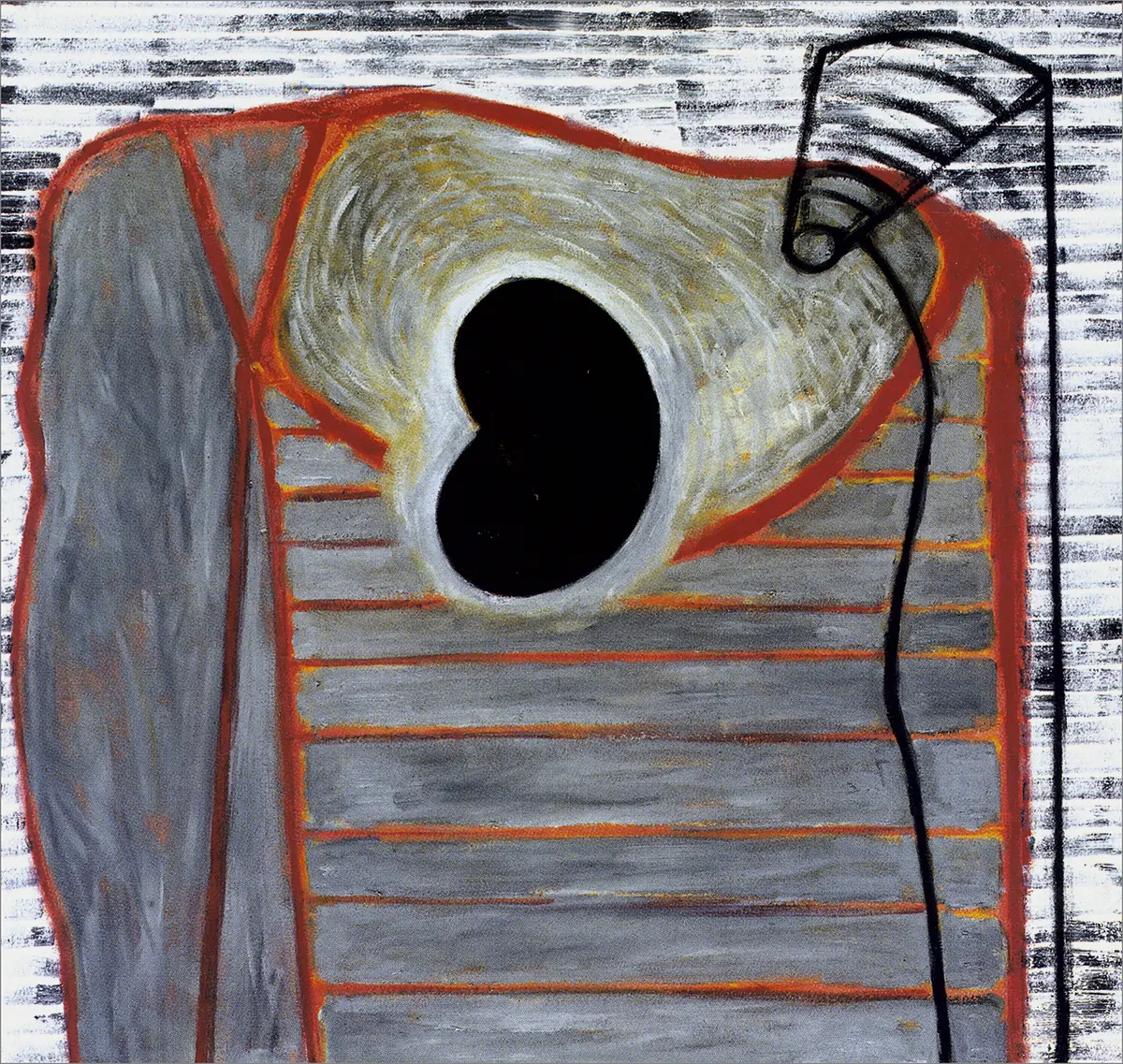
This Peruvian artist’s complex abstraction is populated by shapes with organic characteristics and by elements that seem extracted from mechanics. There often appears a sort of cone at which base we can see a spiral or a series of concentric circles deformed by the perspective of representation. There also appear graphic marks or color planes that allude to the artist’s education as an architect. The viewer could very well wonder whether this is abstract painting, and such an undefined state brings Llona’s work closer to Surrealism.
The processes followed by Llona are legible on the painted surfaces. His canvases present energetic brushstrokes that slowly weave the final texture. There are layers and layers of paint with a gestural appearance, but ultimately they are all entirely controlled. In these canvases, there are very few accidents. Llona’s saturated colors are not achieved through impasto but through veritable chromatic palimpsests, although an impasto here and there adequately showcases the structure of each work.
“I think of my work… as an interior landscape, as an unintentional order of my mental landscape,” says painter1. His discreet geometry limits itself to organizing the surfaces of the painted spaces. More than vast extensions, like those of a landscape, and despite the proportions of each canvas they resemble intimate, interior spaces, like dreamed rooms populated by shapes that suggest without ever becoming explicit. An unconscious associative process leads us to find architectures, furnishings, objects, scaffoldings, screens, besides the organic entities and kinds of machines already mentioned. A current of questions is thus generated, and we try to answer them, but there is a narrative here whose codes remain hidden. It is not by chance that the show at the Museo de Bellas Artes is titled Tiempo de Simbolización. Llona’s shapes build a suggestive and unsettling etymology all of their own.
NOTE
1. Quoted by Donald Kuspit, in Ramiro Llona: El Terreno Íntimo del Tiempo. Frances Wu ediciones, 1990.
MARÍA ELVIRA IRIARTE
Ph.D. in Art History and MFA. Art hidtory professor at the Art School of Universidad Finis Terrae in Santiago de Chile.