
When Émile Zola wrote Joie de Vivre he could not have imagined that his expository naturalism centered on social phenomena in Nineteenth-Century Paris was to find a counterpart, with different coordinates, in today’s visual arts, and in today’s Havana. Specifically, in the work of Cuban artist Roberto Diago (1971,) whose self-titled show had at Galería Havana, between August and September 2005, its first confrontation with viewers.
Black and white gigantographies; illuminated photographs in lightboxes, framed in rough wood; moving photographs on a monitor of projected onto a wall, coming out of a pair of small houses resolved in wooden planks, allowed the public to verify the organic articulation of “the benefits of high-tech with the povera rusticity and visuality of the wood and the environments,” as expressed in the catalog by the show’s curator Elvira Rosa Castro. “The joy of living,” she continued, “is not only a privilege but a resistance mechanism in the day-to-day.” But the same could be said of Aquí lo que no hay es que morirse (“What we can’t do here is die”), the slogan of the black slaves who arrived in Cuba in colonial times, which Roberto Diago used for the title of a previous show.
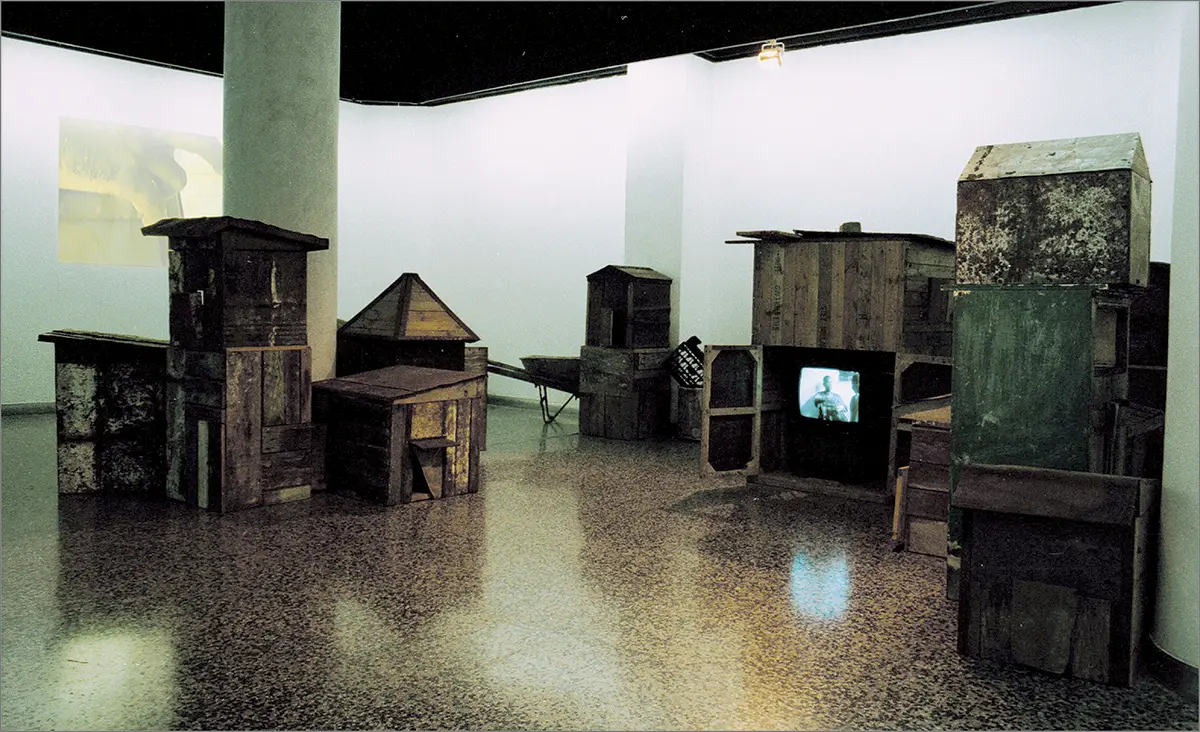
This is why, according to also to Elvira Rosa Castro, the title of the new show expressed the old conviction of a poetics or artistic discourse. But, notice that in this show euphoric expressions mingled with attitudes of dejection or resignation, the festive percussion of drums and the activity of several children mixing with the sordid habitat and a man grinning painfully in the photographic tableaux titled La alegría de Vivir, viewers could have realized that the show oscillated between irony and sincerity. All of this on the basis of registers later decanted by the artist in a documentalism that, while seeking out the things of reality and/or the reality of things, did so through a lens that logically expressed its truth.
Diago deployed for this purpose several modus operandi. As a live photographer, he went out to trace expressions that he captured in situations that were not necessarily chosen with premeditation. As an artist who documents his actions, he photographed or recorded in the video the social interventions in which he has taken part. There are the visual arts workshops with children in the Havana tenement of La California, which Diago helped repair and the portraits of its smiling inhabitants. It was here that, during the last edition of the Havana Biennial (2003), the collective project titled Isaroko took place.
Diago also operated as a creator. He reinterpreted his referents and projected them to a hyperbolic scale, for greater impact. In this construction of meaning, exaggeration was not the result of augmentation, but of its reverse. It was thus manifested in the environment included here, which became the show’s most interesting focal point. More than the lightboxes, this rustic village amplified the discourse of poor materials, which not only alluded to economic precariousness. Their very provisionality as a habitat is connected with the assumptions of any ephemeral work of art. And, on the other hand, the rudimentary housing and the chaotic “urban organization” were related to an improvisation that takes root as time goes by, dissolving the notion of the provisional, of the “in the meantime.” And they became, just like the kerosene stove included in the show, “objects of necessity”: those utilitarian artifacts that spring from a popular, spontaneous ingenuity, their creation prompted by the need to survive, whose functional values prevail overall aesthetic considerations, as Cuban designer and researcher Ernesto Oroza has defined them.
All of this could lead us to think that Diago’s art is anthropological or sociological. However, he also does the anthropology of art, because as an insider he works on the basis of his own experiences, contacts, and concerns, which he metabolizes and exhibits. Diago is still interested in the phenomenon of marginality (which includes the marginal, the marginalized, and the self-marginalized) and continues to prioritize within it his “race” (he is black,) a fact that inscribes him within a long Cuban tradition. Perhaps Diago’s vision hasn’t been entirely joyful. Neither is life. And, like life, Diago’s formulation isn’t entirely apocalyptic. Perhaps this has been also the impression of those who have seen La alegría de vivir at the Brownstone Foundation, in post-Zola Paris, where this show by a variously award-winning artist who has shown his work at the Venice Biennale (1997) and at many international art fairs and has received the National Culture Distinction, is on exhibit from October through December 2005.
ISRAEL CASTELLANOS LEÓN