
The most exciting aspect of Darkroom, the most dangerous and attractive one, is perhaps the sensation of deep helplessness that envelops the receiver of the work from the moment he or she accepts to participate. Conceived technically as a “video installation and performance for infrared rays and single viewer,” Roberto Jacoby’s work was first presented in 2002 at the Belleza y Felicidad Gallery, and in an atypical case of remixing, so infrequent in the visual arts, appears now in a new version at Malba, with slight modifications. Jacoby, a pioneer of 1960s conceptual art and an intelligent observer of present-day social relationships, creates with this work a highly singular option of the personal journey where participants are encouraged to traverse a situation of incapacitation and discovery that will hardly leave them indifferent.
The space of this proposal opens with a waiting room that serves an orientation function: three closed booths allow us to visualize, through a monitor and several channels, videos supposedly showing the deployments of the scenes that the viewer is to encounter later inside the darkroom. This area, apparently informative or anticipatory, became in the Malba staging of the work a veritable solution to the unexpected affluence of public that exhausted the reserves of turns to get into the darkroom: not everybody was able to move on to the second part, the room proper, but access to the screens and to a small installation of objects and photographs remained open.
Once past this preparatory phase —which, it needs to be said, clarifies some hypothetical questions but installs new ones—, visitors are introduced, by a woman who acts as their guide, into the entirely dark room where the actions of the performers take place. ‘If you have a problem you must say out loud the word Marcel,” the guide says, “and immediately someone will come for you.” The only way to see inside the black room is through an infrared video camera; the woman shows people how to operate it. Jacoby is quoting here the rhetoric of terror: once the guest is received, the guide disappears, the door is closed, and the loneliness of the visitor becomes akin to, for instance, that of Jonathan in Dracula’s castle. Anything can happen in there.
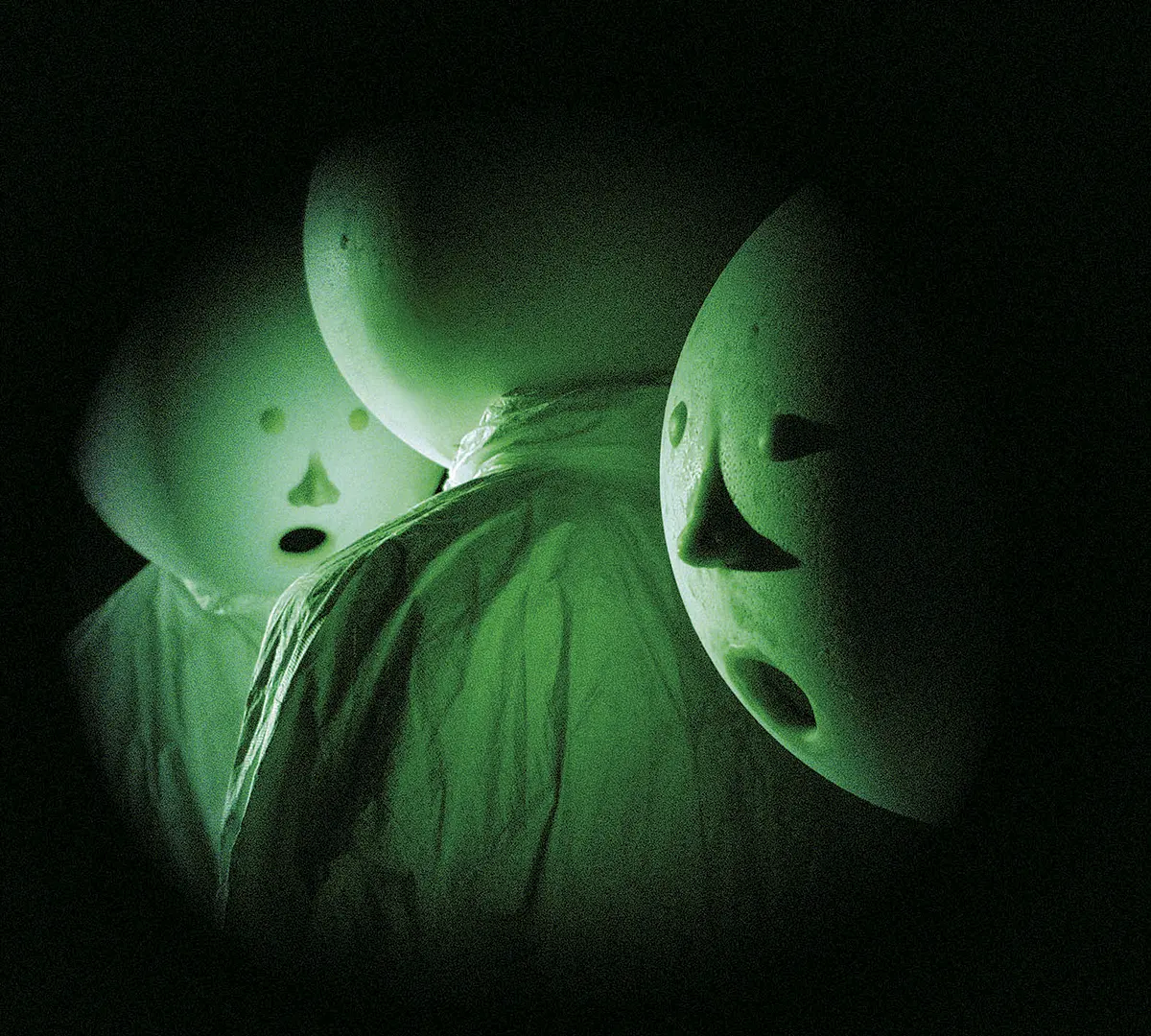
Viewers can only see what they capture with their cameras. One of the indications given them result essential: they must follow with the camera a dotted line painted on the floor, their sole compass in a context that speculates with disorientation. The walk begins slowly; the absolute lack of light and the “help” of the camera distort our perception of the surrounding space and, above all, take apart our perception of our own bodies, which become hesitant and clumsy. Once the visitor is able to trust that dotted line that does not disappear and remains there even if out of sight, he musters the courage to raise the camera and see what is there. Then he sees them: impossible, neutral beings, dressed as nothing, that move a few or many meters away, impossible to tall, recreating some of the situations glimpsed in the waiting room monitors, or perhaps generating new, different ones. They do not interact with the visitor, limiting themselves to communicating with each other through vaguely recognizable codes. They can’t see anything, and the visitor can barely spy on them. Suddenly, and after one has discovered some scenes, there appears the mark that signals the end of the path, and all that is left is to return to the starting point retracing one’s steps, perhaps more boldly, as we are close to the end.
Jacoby’s experiment just a few minutes long generates a surprising emotional intensity. It is in darkness, Jacoby seems to be saying, that art in its more phenomenological sense can today find refuge. Art/sensation, the art of intimate fears and certitudes. It is in the trajectory of individual fantasies where the work is activated, where it is charged with anxious suspense or with unbelief, it doesn’t matter which. Some viewers express later, once outside, their fear of being touched by those beings that seem to orbit around them. Others confess that, amid the desolation induced by blindness, nothing but be more natural than to rub against someone else, a person, an actor, a white figure. In any case —in the sum of all these minimal, unrepeatable experiences, translated into narratives and testimonies— Darkroom is a landmark in the history of Argentinean experiential conceptualism.
EVA GRINSTEIN