
Sculpture and landscape are two seemingly anachronistic problems. To again think about them is what some have come to call “reflexivity.” Thus the question ¿What do we talk about when we talk about...? sculpture and landscape appears as the necessary critical “turn.” Rosario López reflects on these two problems: landscape and sculpture. Landscape as experience and sculpture as minimal strategies that invite viewers to relive the inexplicable feeling of sensing oneself at a limit and overwhelmed by monumental structures. Both experiences border on despair and the feeling of breathlessness.
The show attempts to recover a journey to Machu Picchu, a monumental landscape where one is close to the walls, and Paracas, with its godforsaken straw houses in the middle of the desert. Landscapes that are very different from each other, weariness and emptiness at the same time. Rosario López explores the sculptoric power of these two vital sensations.
The show demonstrates that besides experiences, the artist brings to bear her research into the works of others who preceded her and who obsessed over the landscape. The German Romantics, for example, and Rosario López puts in play a horizon line for the viewer to confront directly the abyss and vacuum as a visceral sensation. But also present are the more contemporary reflections of the “landscape artists” of the 1970s, who, aware of the feeling in the middle of “a whole,” expanded the notion of sculpture.
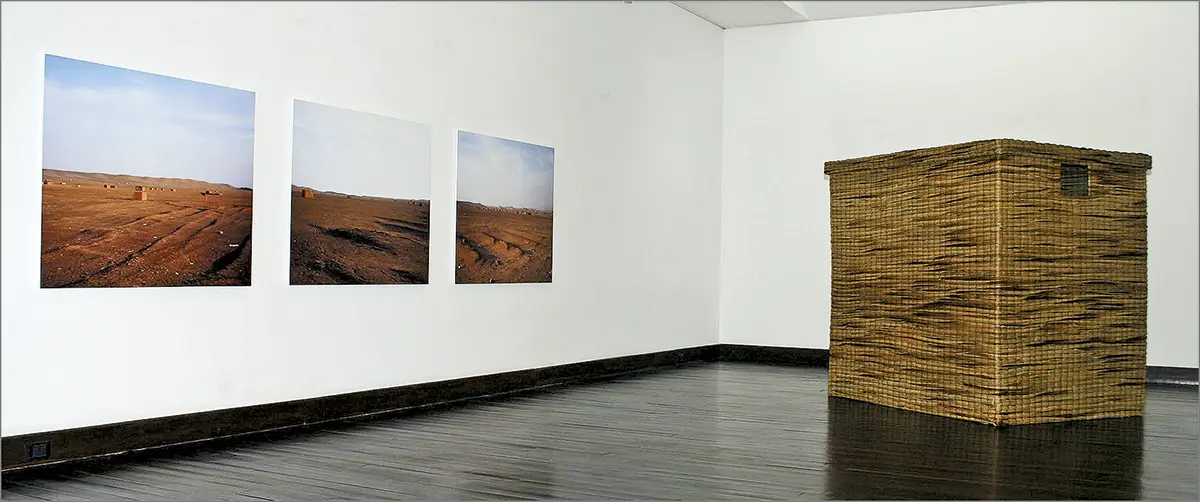
The objects in this exhibition are thus affected by geography, by emotion, and by the behavior of materials and images, because this exhibition combines photography and organic materials and subjects them to very simple strategic operations.
For example, it inverts the photograph of a blue-sky-and-horizon landscape, and the emptiness of that sky, now in the “wrong” position, comes to us with an intense sculptoric power. The stones of Machu Picchu, in two large-format photographs that lean against the wall, bring into the gallery the power of the assembled-stone walls, and the strength of the pressure they put on one another becomes the protagonist of the image. Because in this exhibition, photography has the power of inviting us to see things beyond the anecdote; it invites us to sense the power of the sculptoric forces that determine the shape and the emptiness of the landscape.
With her organic materials, Rosario López invents highly creative borders to make visible the vacuum. Thus, she built a techito (small roof) —nevertheless taking over a large room in the gallery— that bends under the weight of air. She covered the space between the stones with a material that, subjected to pressure, makes visible the sculptoric power of the emptiness between them. And she built a straw house, following the model of the houses in Paracas, scaled to life. The mental operations aroused in the viewer by that house are incredible. First of all, it evidently protects an empty space, and also dereliction and absence; we mustn’t forget that many houses like this in the Latin American countryside are abandoned by peasants because of violence and poverty. And it is equally incredible how uncomfortable that little house “feels” in the gallery space; so much so, that it seems to demand more real presence in the exhibition spaces.
What do we talk about when we talk about space? We talk about a space that takes into account the sensations and experiences of the place we are in or the place we live. We are not talking about the evasive space of modernity, represented by the straight line or blank space between two points, which erased all interest in remaining or even observe what occurred “in-between,” since what mattered was to arrive, almost always harried, “somewhere” or “some other place.” This is a reinvigorating exhibition by a very young artist highly focused on her work, who demonstrates maturity and commitment. An artist who believes in sculpture and in her materials, but “disorganizes” them by filling them with vital experiences and by running great risks.
NATALIA GUTIÉRREZ