
Alma Ruiz: Where did the idea of the trilogy originate?
Damián Ortega: I am interested in the notion of trilogies and triptychs. I realized that my thought process was not dualistic, that there was always a third view of work—it could be a “perhaps,” or a “maybe,” something better, and afterward—a third perspective that was more ambiguous.
AR: Is The Beetle Trilogy a single work?
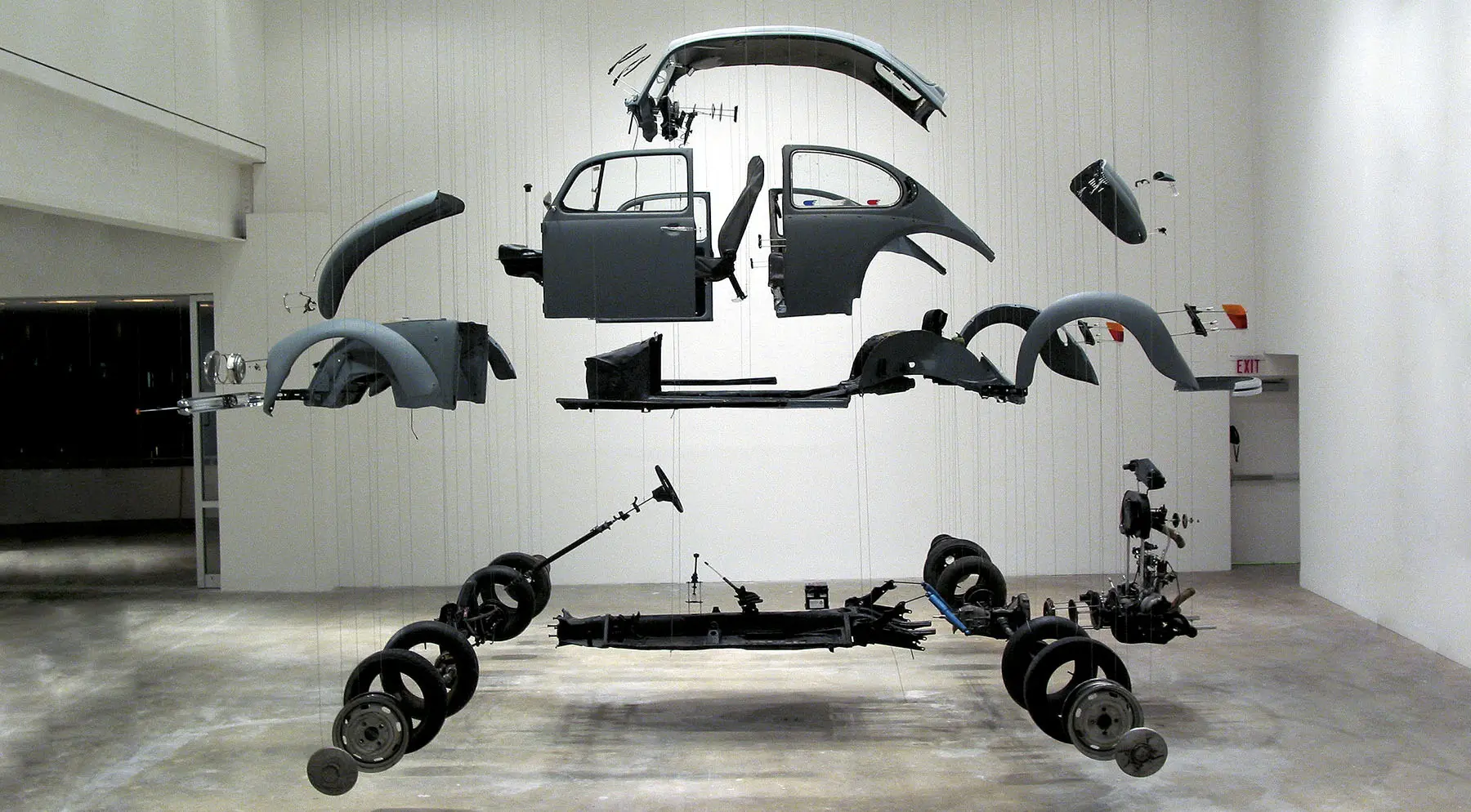
DO: It is really three independent works. Cosmic Thing was the first one. It’s a piece that I had floating around in my head for years. It’s a Volkswagen (VW) sedan, one of the more common cars in Mexico City. For many people, it offers the only possibility to have their own car and get around town. There are even taxis using that model. I drive one of them too.
I liked the notion of creating something like a dinosaur displayed in a natural history museum. It’s also a kind of assembly plan. You can see all of the elements that form the fragmented car, with its parts suspended, on display.
AR: What year is your car?
DO: It’s an ’83. A while ago I found some paintings I had made in 1991 using the same system of fragmenting the car into a diagram, but they were just pictorial representations. The idea of the object wasn’t clear, nor was the physical relationship with the space; they were paintings on a white canvas. The project was to have the whole car taken apart in the paintings.
AR: Were you hoping to exhibit all of them together?
DO: When I started the project, my idea was to commission the painting from a professional sign painter, a common profession in Mexico, a craftsman who can be contracted to paint a landscape or a text to advertise any kind of store. Some are very accomplished painters. At the time, the idea was to bring a photo of a VW car and have the sign painter execute it to scale life-size, and then I would reproduce each of the different parts in various paintings. It would be a process of appropriation and subjective exploration. Each part would be broken down and, in the end, offer a general outline of the whole car. Clearly, it related to this, but the notion of the blueprint was very much a part of it. I hadn’t managed to get rid of the concept of representation in order to enter the notion of reality, yet. It was an interesting process that helped me to understand the final concept. The medium changed from canvas to sheet metal and from acrylic to automotive lacquer. I think I began to understand the importance of the relationship between technique and form, and how the totality of the working process brings the final work together.
AR: So the notion of the deconstruction of the object predates the creation of Cosmic Thing?
DO: I think so. I’m not sure of what the exact reference might have been, but I think it began with the relationship I developed with Gabriel Orozco in his studio, trying to understand the notion of how to show an object, not just represent it, and also of technique, or the working process, as something fundamental, not neutral or insignificant.
AR: Why the name Cosmic Thing?
DO: I wanted to give it a title that offered an open vision of the piece, something that would allow the viewer to recognize my interest in the notion of a system—something both microcosmic and macrocosmic, collective and individual, global and local.
AR: Many of the people who have seen Cosmic Thing interpret it as a kind of cartoon, perhaps because they are surprised to see a VW expanding in several directions. Does this type of humor, visible throughout your work, derive from your experience as a political cartoonist?
DO: Of course. I greatly enjoy carious readings of my work, and I think we are fortunate to see how each piece takes on a life and direction of its own. They can go places I have never suspected. I love the idea of a work is more intelligent than I am, it goes beyond myself, taking on a life of its own. Therefore, I like the relationship it has with humor and cartoons.
AR: In the past, other artists have suspended their works from the ceiling. I am thinking of the Brazilians Mira Schendel and Hélio Oiticica...
DO: Yes. You could also mention the Venezuelan artists Gego and [Jesús Rafael] Soto.
AR: Had you seen some of the work by these artists before creating Cosmic Thing?
DO: I had. Especially Soto’s. He has been an important reference for me because of his Penetrables and the relationship between formal geometry and political positioning. Other artists have done it too, like Cornelia Parker, whose work I didn’t know at the time. Honestly, I don’t think of it as my invention. It was a gradual investigation developed from that pictorial plane where I wanted a white, neutral space with floating objects. I had also explored it on other occasions simply by trying to place objects on the floor. It was a fairly natural process for understanding the work in three dimensions and also acknowledging the importance of not choosing any other machine but a VW.
AR: Why a VW specifically?
DO: I must confess that it was a very intuitive thing derived from my proximity to it. But sometimes a personal experience is the result of a political phenomenon and other times that personal experience becomes a political phenomenon. I think that it’s a very powerful symbol of an era, and speaks of a moment in contemporary Mexican history when there was a shift from one technology to another, and the former was declared inadequate, despite being so common. The technological change obviously implies a political and ideological change. There is a change in the means of production and distribution that transforms social relations. The shift is from a self-repairing technology that was discontinued in favor of one based on consumption and specialization. The illegal auto-parts market damaged the system of consumption because it was very cheap to buy used parts and change them yourself. That is why the cars lasted for so long and thousands of people could afford them. It was really a car of the people.
AR: The second part of the trilogy is entitled, Moby Dick. Why did you pick a title with such a strong literary referent as Herman Melville’s novel?
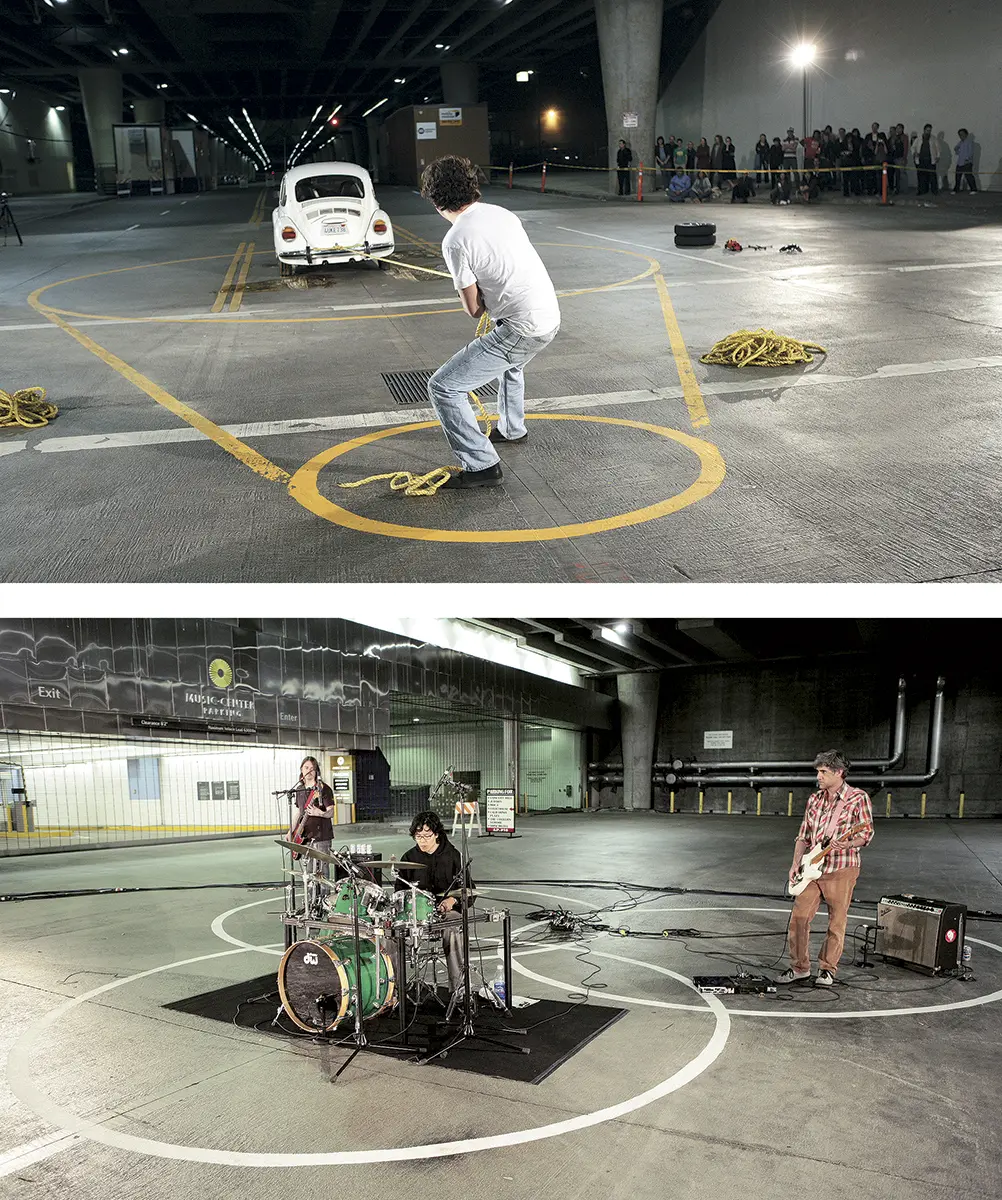
DO: I consider these three works a narrative, an evolutionary succession. I often write down my ideas in a notebook and develop the third one first, then the first one. I don’t follow a specific order with the trilogy. I don’t remember if the first piece was Moby Dick or Cosmic Thing. I wanted to use the name Moby Dick to create an obvious reference to the white car as a cartoon of the white whale.
AR: Was Moby Dick created as a performance?
DO: It was born as an experiment. I think there is a tension of forces, the constant contraction, and expansion that takes place between an object and a person, between an animal and a machine: traction as an instinct or an impulse, in balance. I think these ingredients could also be at play in an academic sculpture, a theatrical play, or in any technical process. That is why I believe there is a sculptural relationship in understanding how matter works, how it reacts, and how it can be activated in nature in order to channel or convey energy.
AR: Does Moby Dick reflect man’s desire to control his environment?
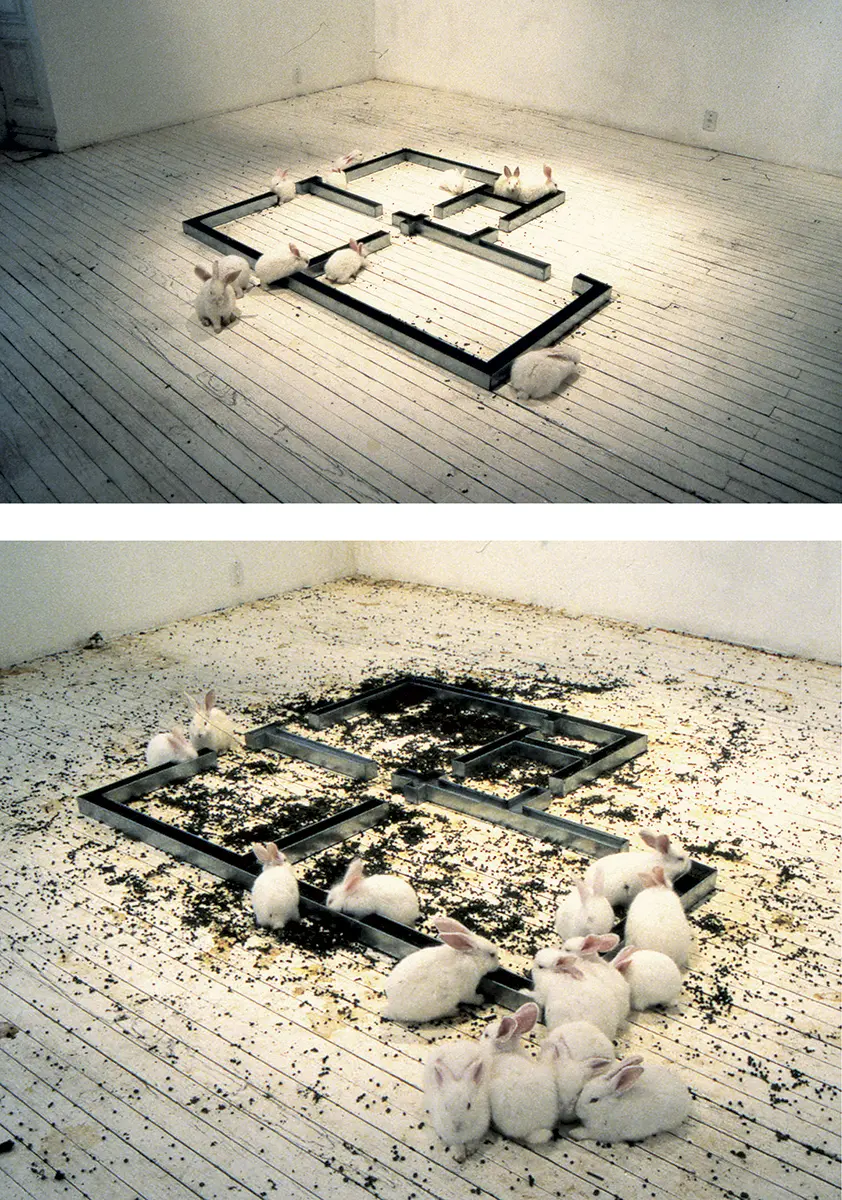
DO: I think so, and at the same time, it reflects how nature transforms the individual. There are some works, other works of mine, which speak of that, like Reglas e instintos (Rules and instincts) from 1997. In that piece, there was a white space, the neutral space of a gallery, and I reproduced the architectural blueprint of the place with water channels and food. There were seventeen white rabbits inhabiting that white space, and they lived there for one month. They ate and drank and defecated as much as they could, and they started transforming all that space through their ingestion and digestion of the architectural blueprint. There was a mimetic relationship between the white of the site and that of the rabbits; a living space that was eating and digesting the very building where it was on display. I find a connection between that piece and Moby Dick.
AR: Moby Dick was made in Mexico City and then re-created in Los Angeles. Where in Mexico City did the original performance take place?
DO: It was in a parking garage that is three levels underground. The location interested me because of its dimensions and the firmness of the columns. It’s a supermarket parking lot. This idea excited me, and at first, I didn’t understand it fully, but I found a relationship between the heroism of the hunter and the domestic act of going to the supermarket to buy a packaged and homogenized product. There was playfulness in it that caught my interest. The initial idea was to suggest a sort of cavern, a primal, essential ritual of survival, that of the hunt.
AR: Let’s talk about the performance in Los Angeles. Where did you stage it?
DO: On Lower Grand Avenue, is a spectacular place because of the architecture and its size. The avenue runs under a bridge, and they have filmed some Hollywood movies there, with car chases and crashes; it’s also where they hold Harley-Davidson parades.
AR: You said one of the reasons that led you to restage the piece was that you were not satisfied with some elements of the original. What did you change?
DO: I think the most important thing was trying to confront an approach and a process that I hadn’t mastered yet. I’ve tried to work with materials and techniques that are unique to the sites where I am invited to show my work, spaces with an established artistic tradition, like that of glass-blowing in Italy. There is local craftsmanship, and there are some great masters. It’s something that flows naturally. I wanted to make a proposal along those lines, and it worked. Angelenos have the music and film industries. There is a movie theater, a drugstore, and a rock band on every corner. I thought it would be interesting to join that flow of experiences and professions.
AR: Beetle ’83 Escarabajo is the third work in The Beetle Trilogy and, as I understand it, completes the life cycle of the car, which begins at the Puebla factory, where it was assembled and where it returns after many years in Mexico City. Could you tell us a little about this part of the trilogy?
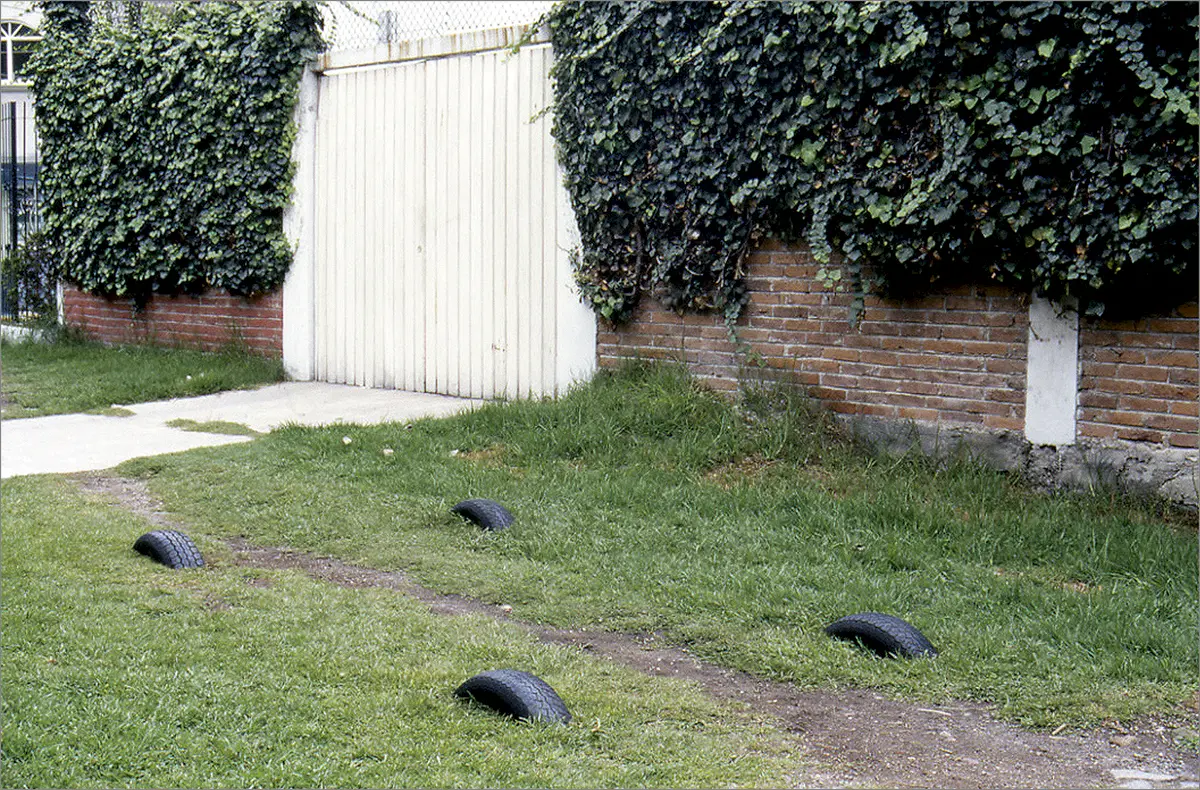
DO: I started to do some reading on mythology, and I love the story that is common to many cultures, and repeated at different stages of history, in which the hero leaves the native land to explore the world and finally returns to die at home. I was thrilled by the notion of recreating this odyssey, this mythical voyage, where a car could leave, has its own life in the streets just like a heroic character, and finally return to Puebla, where it was produced, or to Germany, where it was conceived. It is a voyage of return to the origin.
AR: This Mexican VW, or little Ulysses, if we want to compare it to the mythical hero, is going to make its return voyage to Puebla?
DO: Yes, in order to take it to where it was built. It’s a car that is in pretty bad shape. I hope to stay on the road until the car stops running or I find a place where I can bury it.
AR: The trilogy closes with the death of the car before the new year. Have you thought of any other work in which you will be using the concept of three?
DO: Yes, there has been something very advantageous in the use of a trilogy or triptych. Generally, I always work in photography with a series of three. I am interested in narrative, and I think three is the minimum number required to describe any process that involves an origin, a transformation, and a conclusion. There you have a story.
* Translated from the original text in Spanish by Fernando Feliu-Moggi, Ph.D. Assistant Professor, Languages and Cultures. University of Colorado, Colorado Springs.
ALMA RUIZ
Associate Curator at MOCA, Los Angeles.