
Taking their inspiration from some verses by the eighth-century Chinese poet Tu Fu, Carlos Ashida and Dulce María de Alvarado titled and curated the show presented at the Museo de Arte Contemporáneo Camilo Gil from August 27 to October 23.
The show encompassed several generations, from José Clemente Orozco to emerging artists such as Saúl Gómez, the youngest in the selection. With fifteen participating artists, the show attempted to present an overview of painting that represents the grotesque, due to its scatological tendencies, its sexual allusions, or an expressive voracity of savagery and strangeness.
Given these topics, I was surprised not to find works by Daniel Lezama and Dr. Lakra, or by female artists such as Martha Pacheco or Fernanda Brunet, even though the wide selection of artists and works, one hundred in total, produced a vast show that was definitely heterogeneous in terms of trajectories, proposals, and results.
Within such generational diversity, the show could be divided into three large groups. The first group included José Clemente Orozco and Alberto Gironella, born in 1883 and 1929, respectively; the former is a representative of the Mexican School in painting, and the latter is a representative of the Ruptura.
The second group included artists born in the late 1940s and the 1960s: Juan Kraeppellin, Helio Montiel, Roberto Rébora, José Luis Sánchez Rull, Cisco Jiménez, and Germán Venegas. This roster of well-established artists covers expressionism to postmodern art, and this section was, undoubtedly, the most solid. While Orozco and Gironella share thematic lines with this group, I feel a clear gap in terms of their intentions, with the result of their works being distanced from the rest.
The last group comprised artists born in the 1970s: Balam Bartolomé, Humberto Duque, Charles Glaubitz, Manuel Mathar, Álvaro Verduzco, Iván Villaseñor, and Saúl Gómez, all of whom reveal in their work the influence of comic books, popular art, and marginality.
The show was dominated by large-format works, and it alluded to the persistence of painting as a genre with a long tradition in Mexico, a genre with a great expressive power that, in the words of many of its practitioners, has been in competition with new technologies and with the current predilection of many art spaces for showing installations, interventions, and three-dimensional art in general.
Amidst such artistic diversity, Orozco’s selected works for the show were Cabaret popular and La victoria, which I see as separate from the exhibition’s general discourse. Although they share with the other works a similar theme and an aversion to vacuum, it seemed a little forced to include these paintings in the show simply because they belong to the Museum’s collection.
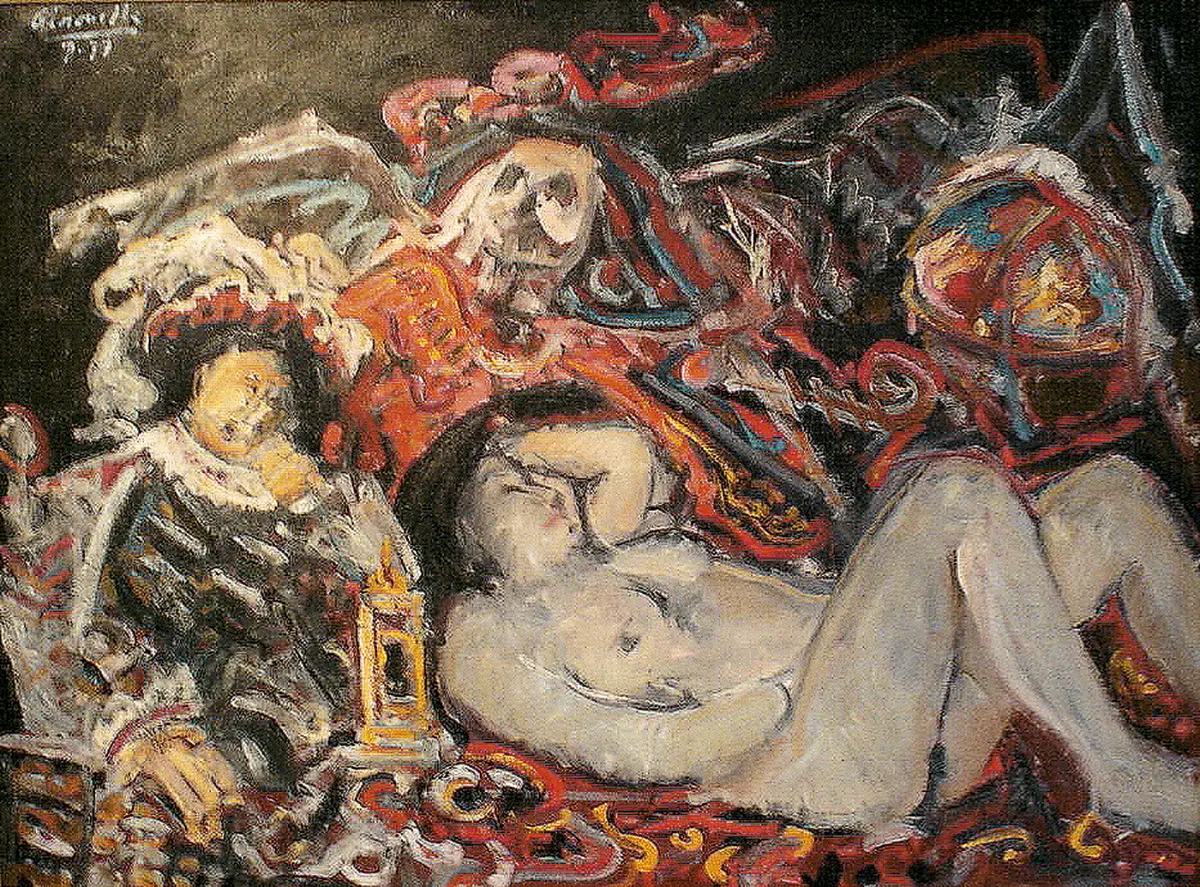
In the case of Gironella, another deceased artist, two works were on loan from the Televisa Foundation Collection: El sueño es un jamón and Vanitas, from the same series and year (1977). In these works, Gironella combined in his peculiar way historical elements with a mood of disappointment and everyday life. Gironella’s expressionistic brushstrokes, which tend toward abstraction, make his work an excellent example of the path followed by painting in Mexico in the 1970s.
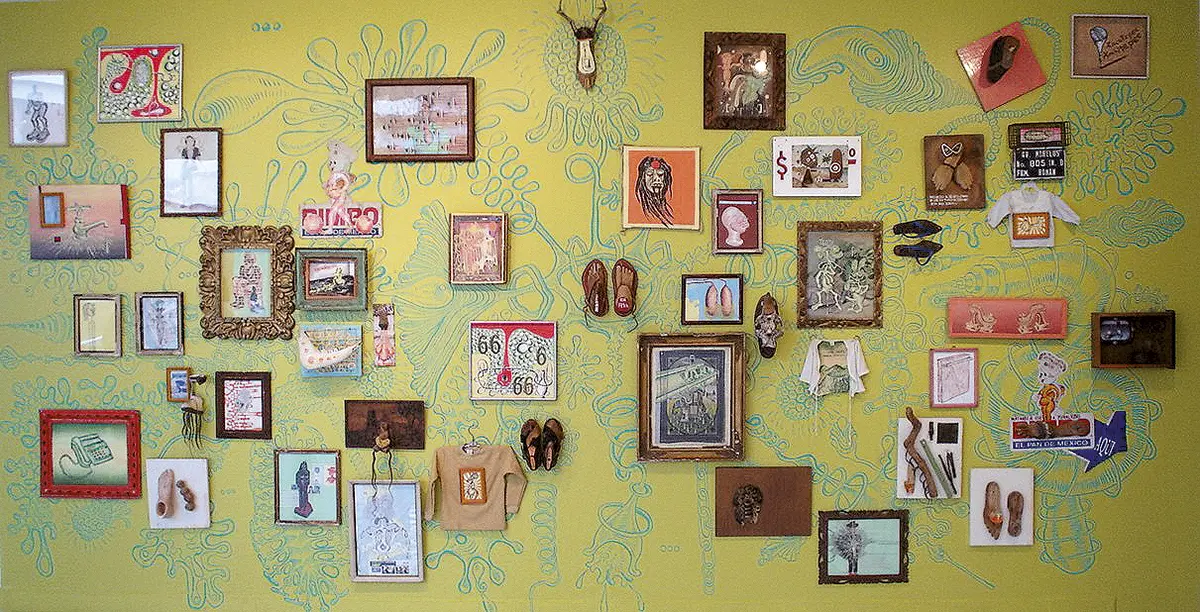
Also present were works by artists who develop a serious oeuvre, such as Cisco Jiménez (born 1969) who in his highly personal, sarcastic, corrosive, and subversive style presented a series of elements as a wall installation. In his Culatazos series, fifty small-format, mixed-technique works created between 1992 and 2005, the artist incorporated paint, objects, clothing items, and elements of popular culture.
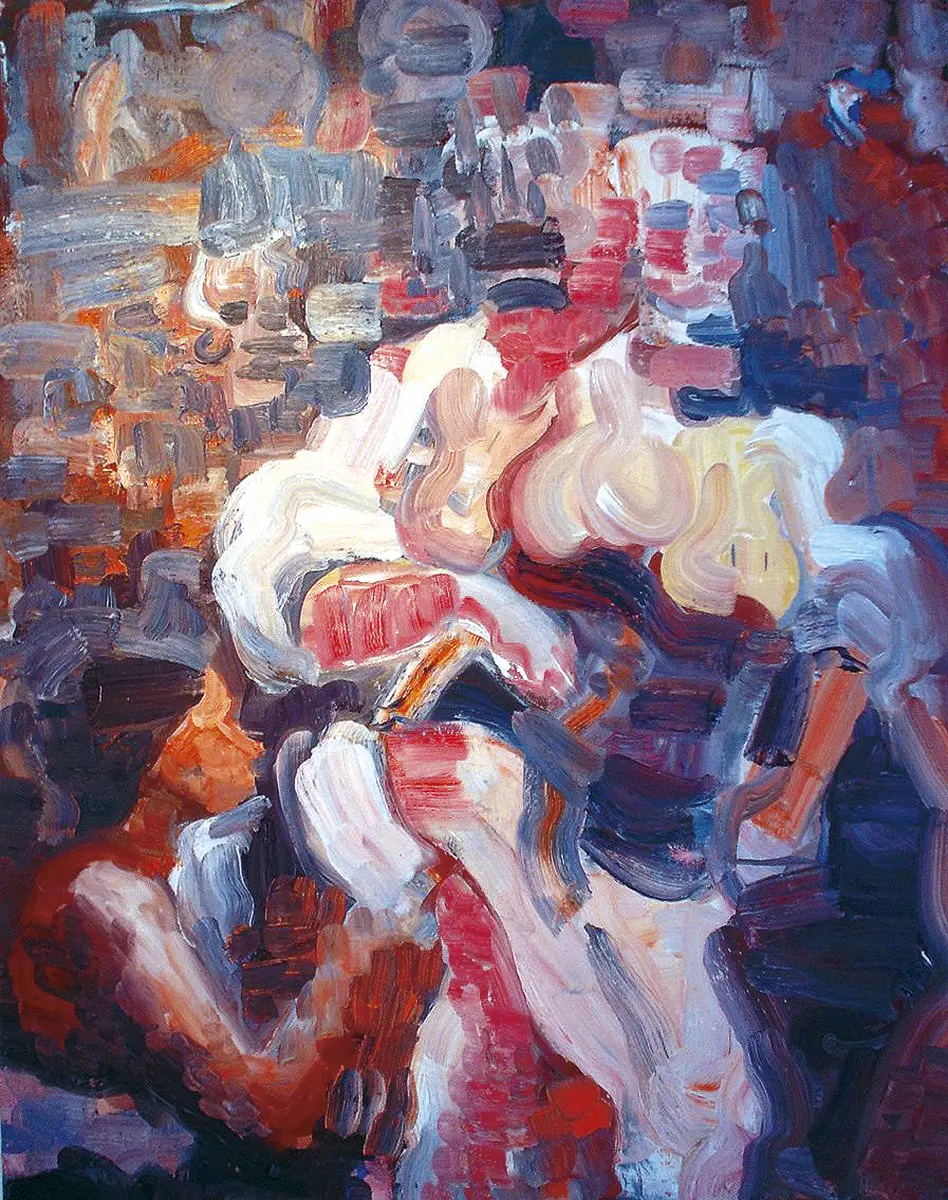
Similarly, the Puebla artist Germán Venegas (born 1959) has devoted his efforts to capture the grotesque in painting or sculpture. In this case, he surprised us with a series of works that could very well be considered the best in the show. Created this year, Fotografías eróticas is a series of thirty-five works superimposed and gathered into a vast space where we find erotically-themed paintings deconstructed and synthesized into a single work: number thirty-six, displayed on the adjoining wall, goes all the way toward abstraction in a very forceful whole.
The works were presented throughout the building’s third floor, without attending to the style of the period. One of the show’s first works was very intriguing because of its proportions. It was a work by Charles Glaubitz (born 1973) a Tijuana-born artist who is also a member of the American collective Art Dorks. Influenced by illustration and by artists like Tim Biskup, in Yo soy la lluvia en tu desfile, yo soy la verdad en tu ilusión (2005) the artist presented a strange scene populated by mouse-eared beings, stars, and verses.
No less disconcerting is the work of Juan José Ávila Aceves, better known as Juan Kraeppelin, a Jalisco artist with a long career behind him, who is considered a truly eccentric character in the city of Guadalajara. In his work, this artist introduces esoteric and astrological symbols as well as literary references to poets such as André Breton and Antonin Artaud. In his 2004 work The Crypts of Cthulthus I displayed a whole menagerie, filled with characters and symbols that are illegible but nonetheless attractive.
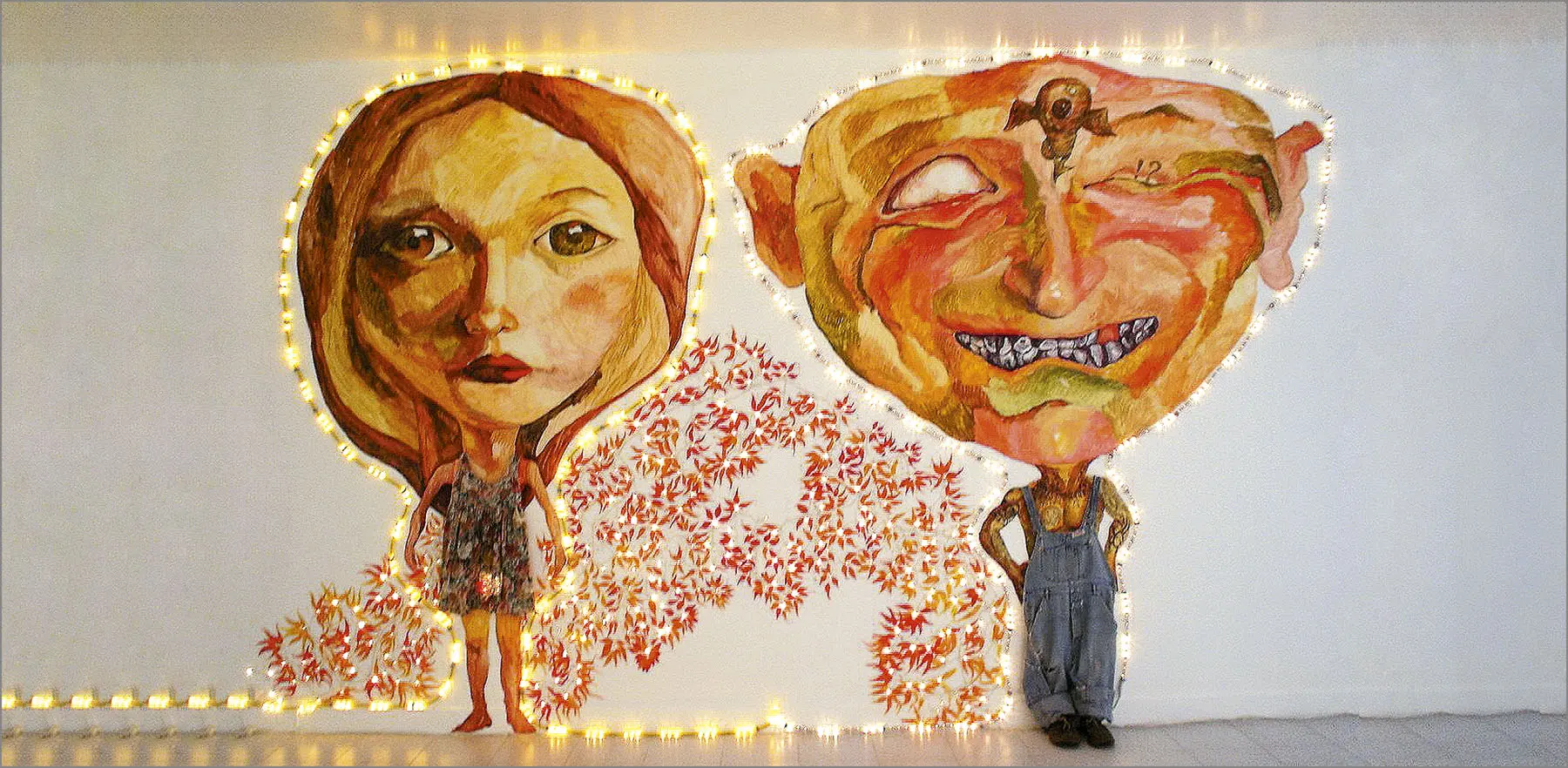
Speaking of works by recent artists, there was an interesting intervention titled Rosa y Santiago Luminicentes, an illustration-like painting with notes of urban poster art that incorporated clothing, shoes, and a light series in an attempt to rescue the caricature form. At once naive, childlike, and defiant because of its dimensions, it proceeded from floor to ceiling and seemed to challenge the viewer with a somber gaze or the absence of gaze, the result being a kind of hypnosis as one followed the lights and interacted with the work, which exuded a certain creepy aura that was at the same time mesmerizing.
The emerging artist Saúl Gómez presented two works, Guácara, a clearly scatological floor painting, and El Paisa, representing something very close to everyday life in Mexico: tacos al pastor and all their accouterments, such as salsas, lime, cochambre, and chesco. Given that the name El Paisa is commonly adopted by taquerías, this work played with collective referents, turning something simple and routine into a tribute to the collective taste for a traditional and irreplaceable element of popular gastronomy.
The show was highly uneven in terms of the proposals presented, and it is rather difficult to locate a point of convergence beyond thematic and formal similarities. Perhaps the one global concept was the concept of degradation. This concept works at several levels and produces various meanings. There is a pictorial degradation implied in taking creative processes to the most radical plane, not just carrying on with a search for formats, materials, or supports but widening painting’s potential and degrading it, not in a pejorative way but as a kind of destitution. Extending painting’s limits and taking it to its ultimate consequences in a thematic sense goes beyond mere sensational effect in dealing with sordid topics or in a purportedly vulgar manner.
Degradation can also come from a sense of returning to the most primitive, to animalism, to the instinctual. Similarly, it can be applied to the waning of forms and a sort of decadence of a style, such as that very Latin American taste for the gaudiness and the neo-Baroque. Whatever the case, art today cannot help but transfigure itself and adapt to the current idea of what deserves contemplation, so distant from what it was for many centuries in the history of art. It forces us as viewers to be thankful for different proposals that do not seek to elicit an easy reaction but make their secrets less obvious in order to provoke and transform us.
LARISA ESCOBEDO