
The recent exhibition of new works by Adriana Varejao (born 1964 in Rio de Janeiro) at Fortes Villaca Gallery includes a series of unsettling large- and small-format paintings as well as drawings, in which the artist proposes environment works, true simulacra of architectural environments enveloped in the symbolic density and the unquestionable sensuality and desire that unfolds in her pictorial discourse. Works like The Guest, The Preferred One, The Shy Man, The Mystic, The Liar, and The Chinese claim as their own the space between the work of art and the viewer. In these works are remembrances of different incarnations, subtler, more diaphanous, but also of an undeniable, albeit more tempered, neo-baroque fury, where Varejao paradoxically seems to be offering a lesson in transparency.
What is painted on the support is, without a doubt, much more than the painter’s vision. As Merleau-Ponty wrote in L’oeil et l’esprit, the artist offers his or her whole body in the act of painting. This implies a vital, existential commitment and a strong self-referential catharsis on the part of Varejao, reaffirmed in each layer of work, with successive approaches and distancings. Varejao has an aesthetic production in which she approaches the primal naturalness of painting, without ceasing to be intentionally implicated in the stories she tells using semantic and syntactic strategies as baroque and complex as ellipsis and hyperbole.
But Varejao makes sure to keep enough distance from her intricate, suggestive scenarios, and her feeling alien to them acts as a magical ritual that guarantees her own immunity: only those who apparently have nothing to do with the events can express themselves with complete freedom. Forgetting certain things or leaving them in suspense allows contemporary artists to backtrack over their own steps, remembering the past as though it were a trace or an active ruin. As Borges put it: “forgetting is one of the forms of memory.” Of course, it is a layered memory. What is new in these works by Varejao is a contained physicality of the senses and generous accumulations of concepts. These works function from silence, from soliloquy and atemporality, encrypted in scenes empty of men, and as zones of ungraspable, disturbing beauty.
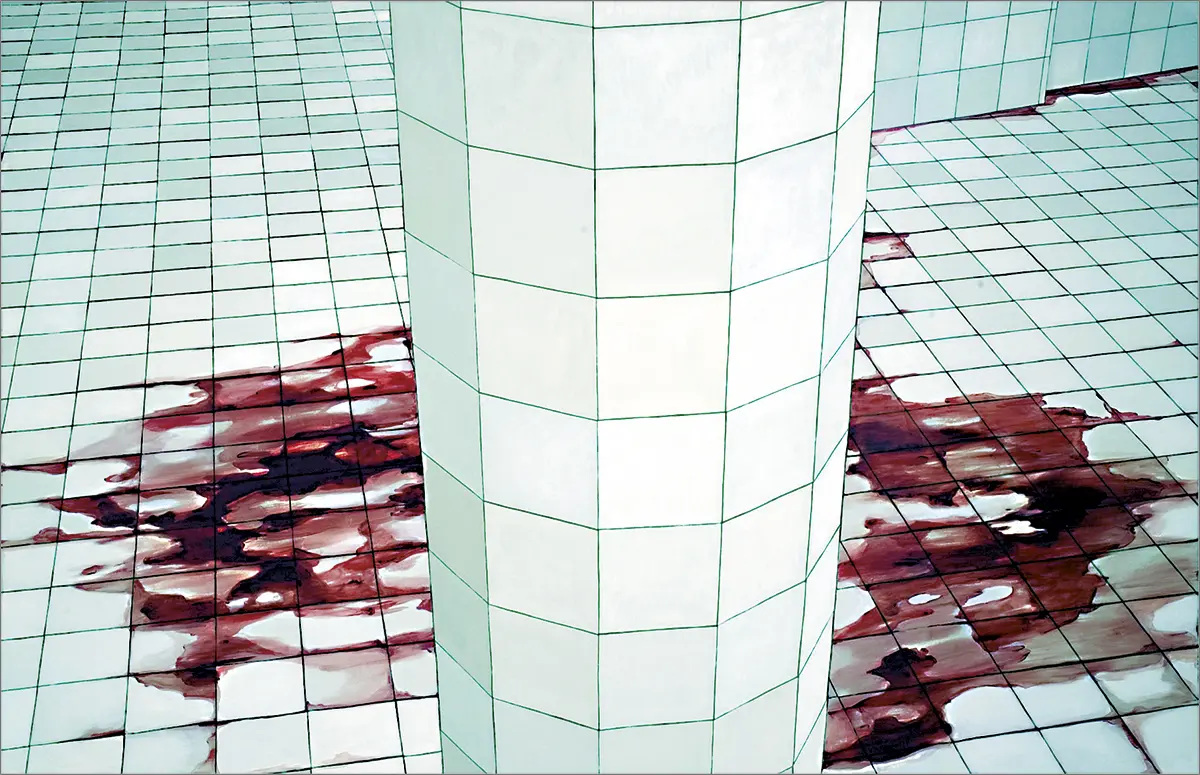
These works are views of saunas, pools, bathrooms, and hallways, all closed-in on themselves. Varejao’s figuration supports a multiplicity of visual games and geometric grids that expand over every surface and display horror vacuii, another principle of Baroque art. These works are mappings, cartographies from which the register of the human has vanished. Like the monad theorized by Leibniz, the Baroque philosopher par excelence, everything here is pure interiority, indivisible and microcosmic: there are no windows or openings to the outside. Everything is sealed. The folds of the body in absentia send us back to the folds of the soul.
Varejao’s dancing structures and reticules unfold with a highly complex handling of color and value, in almost monochromatic schemes of green, blue, turquoise, ochre, gray, and white, with some menacing blood-red touches. Such is the case in The Guest, where the scene’s minimalist whiteness is invaded by an overflowing wound. The liquid-like flesh is disseminated as in a prolonged eschatology. In that sense, Varejao’s current works are pictorial bodies whose voluptuousness as expressed through color is freed to agree, contrast, and harmonize. In her prolific career, Adriana Varejao combines an analytical and a perceptual aesthetic, the latter with the aim of recovering the pleasure of a sensual, retinal painting that explores lexical signs—traces, stains, marks, and ridges—added to a summarized, restrictive iconography.
In this powerful group of works, Varejao has set aside her characteristic painting-objects, filled with thicknesses, sutures, and scabs, to approach the frontal plane in a quick succession of rhythms that are restless, pulsating, and hypnotic for the viewer. In the manner of a mute—ascetic, unadorned, and consciously withdrawn—this series signals an important turn in the Brazilian artist’s work. Her work is painting-body, painting-organ, and environmental painting. Varejao has elaborated an allegory of difference in painting, where fiction and the representational illusion create a feedback loop. As the artist says, this allows us to see the work without being tied to any kind of sequence or any notion of causality.
CLAUDIA LAUDANNO