
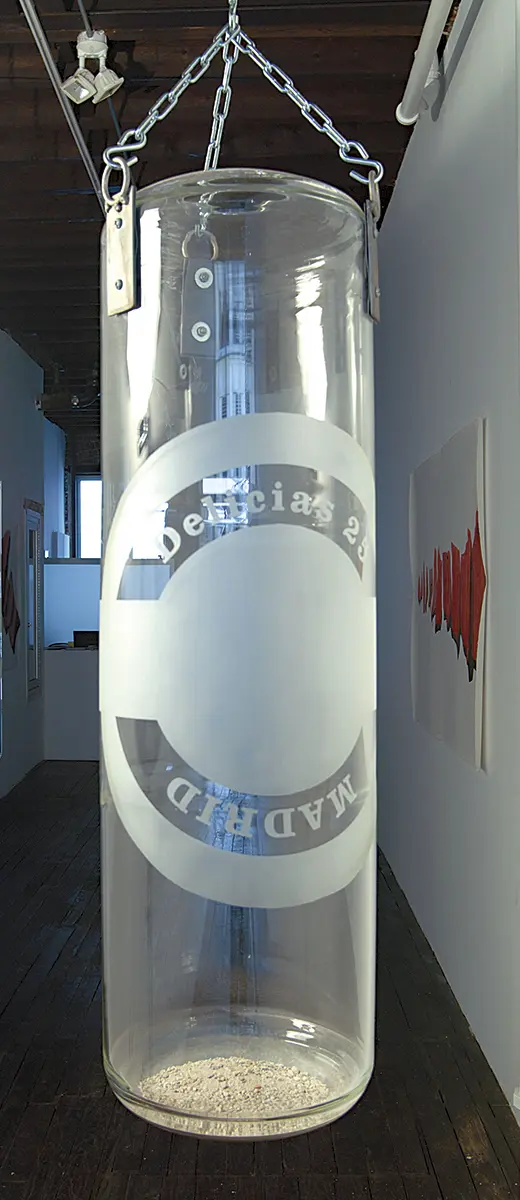
Through the gallery window on Tenth Avenue, one sees some unexpected objects and some works of art on a wall. The objects compose Alexandre Arrechea’s installation Dust, which gives the exhibition its name. There are five life-size punching bags made of blown glass, containing debris from places in the world that are significant to the artist. On the wall are eight watercolor paintings held with surgical pins from the series Dust and The Limit, on topics that intertwine conceptually and on which the artist worked simultaneously. One’s mobility is a symptom of our time—what one gets from each place and what one gives to each city in which one lives, even if briefly, are significant exchanges for Arrechea. Many of these things are not tangible, like friendships, affections, and aromas, and Arrechea represents them with mounds of debris that are securely contained, out of reach at the bottom of each punching bag, while the transparent bags express the force with which these moments have impacted the artist.
Printed on the glass of one of the bags is “49 Walker Street, Nueva York”; on another one is the address where he lived in Madrid, and so forth, including Cuba. Each punching bag is held by an iron band and hangs from the ceiling with chains. The combination of materials—glass, iron, dirt, and ink—makes objects that are strong and fragile at once. They symbolize living in contemporary society: to be extremely sensitive, to arm oneself, to shield one’s fragility. Extended reading of this situation is that the punching bags are seen in their transparency, mingling with a variety of other lived experiences, from before and from after. Defending one’s self, defending one’s territory, defending one’s achievements—all of that requires training. Some train with their fists, another train with ideas.
Alexandre Arrechea was born in Trinidad, Cuba, in 1970. He graduated from the Instituto Superior de Arte in Havana. Until recently he was a member of the acclaimed group Los Carpinteros, and now he is exhibiting his work as an individual. He expresses himself through a variety of media, including installation, painting, and objects with “elements of truth,” such as the debris inside his punching bags. These glass vessels were created by Dan Spitzer, a specialist at Urban Glass in Brooklyn. The crushed debris includes everything from dust to small stones, and the dominant colors are grays, light earthen tones, and brick-like ochres. The debris contains small markers of the place of origin. They are out of our reach, protected, and treasured inside the punching bags.
The exhibition incorporates not only physical vestiges of places but also maps, fragments of walls, and pieces of measuring tapes, all painted. With measuring tape, Arrechea implies the act of measuring infinite distances: those traveled and those desired. Bundled-up parcels or atadito, the belongings of poor migrants in Latin America, are characteristic of underprivileged populations. Arrechea also painted a deflated soccer ball, which he uses to support a piece of debris, evoking the shape of a sports shoe. Other fragment constructions are tied up with measuring tape, suggesting the shapes of a shoe, a foot, a pillow, and a sweatshirt. With our feet we walk through places; on a pillow, we rest to continue later.
The frameless watercolors offer the sensual lightness of the technique and the support. They depict fragments of buildings, numbered as in archaeological fieldwork or as in museum identification, and follow their own order, creating keys that evoke the lives that have passed through those places and the mysteries of history. Taken out of context, these are abstract works, negations. The shadows painted on these fragments speak of the artist’s desire for certain veracity; this is how he saw it, this is how he remembers it, and this is how he wants to transmit it. In his paintings, Arrechea uses a warm palette. Beyond the original colors of these fragments, the artist evokes the light and the climate of his native land. The watercolors in the series The Limit include the theme of boxes, and highlights from this series are the paintings using maps. The world we know to be round is rendered on a flat surface—flat like the minds of some of our leaders. Geography is reconfigured as a printed motif, inside and outside of cubes. The names of rivers, seas, and paths intersperse. Dust and The Limit allow for a variety of thoughtful digressions: the geographical limit, the limits of dust, limited only to dust.
GRACIELA KARTOFEL