
From October 19 and November 30, 2005, Galería Millan Antonio hosted a vast exhibition of works by the late sculptor Amilcar de Castro (b. Paraisópolis, Minas Gerais, 1920–d. Belo Horizonte, Minas Gerais, 2002), curated by Rodrigo de Castro. The group of works, composed mostly of monumental oxidized steel sculptures intentionally subjected to the effects of the environment, included a cycle of acrylic-on-canvas paintings in rigorous black and white values and also generous in size. The whole corpus was distributed around the ample space of the exhibition gallery, taking over the lower level, the park, and the first floor.
Amilcar de Castro’s sculptural language was always based on his spatial innovations that pushed and reformulated such orthodox concepts as mass and volume, challenging traditional sculpture to escape its inherited and recurring patterns.
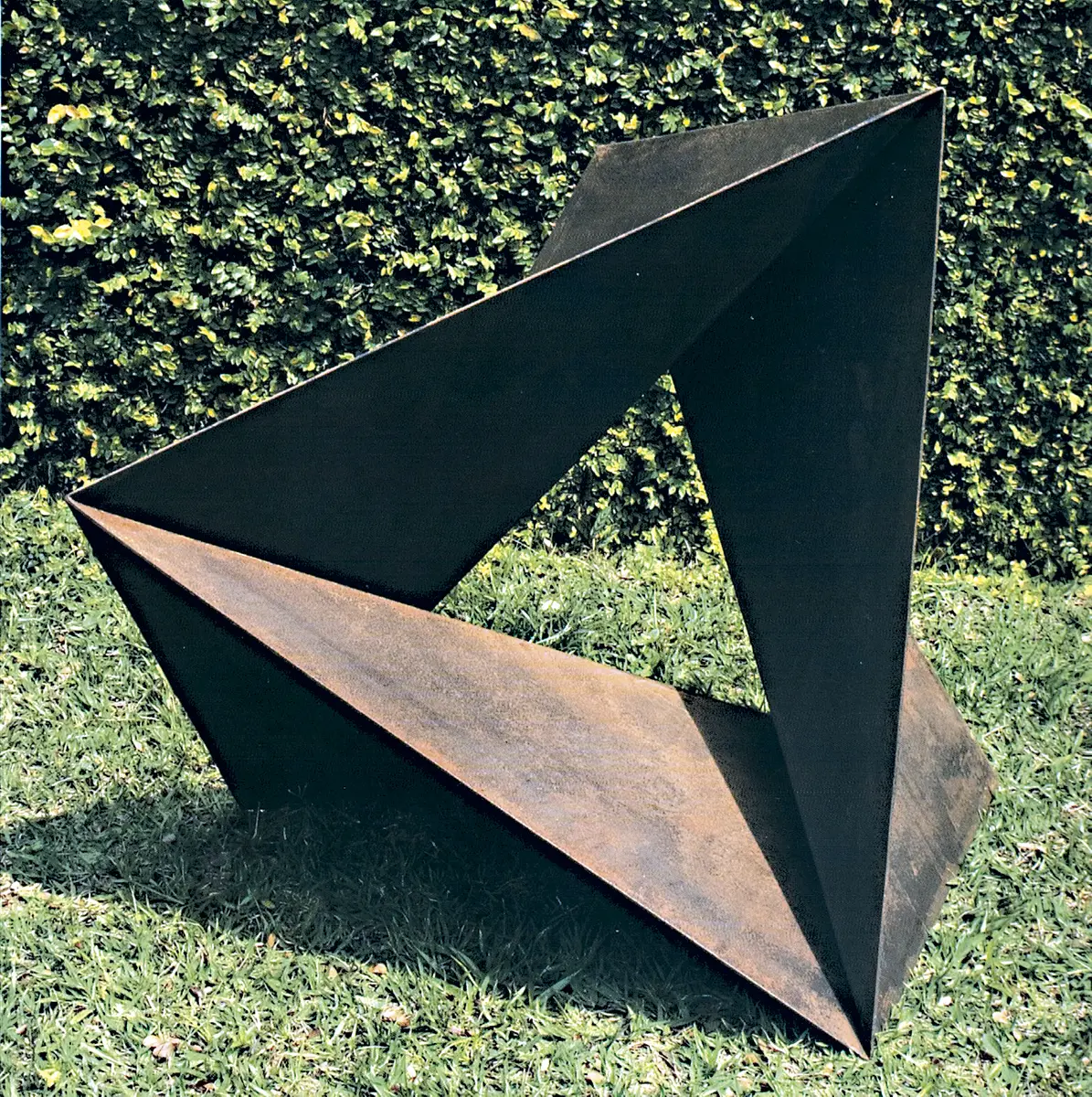
In this exhibition, de Castro’s folds, circumvolutions, carved surfaces, negative spaces, longitudinal cuts, and incisions described cyclopean, vigorous, and forceful structures possessing an undeniable dynamism, such as the large sculpture Sin título (December 1990, 120 x 80 x 0.6 cm) executed in steel. In this work, a triangular body opened onto a void through a complex bending of corners and planes in space, playing with the concept of mass as a hollow, virtual container. In the same vein was Sin título (also dated late 1990, 120 x 120 x 2.5 cm), which resembled a square-shaped portal with an ancestral undertone, with a large central opening slightly skewed to the right,
Some works in smaller formats adopted different positions that gave them a markedly playful character; these works could be freely manipulated by the viewer and turned into self-transforming sculpture-objects. For example, the Montajes, were solid, modular blocks of steel (23 x 46 x 23 cm) that could be moved or separated, being independent of the specific places they occupied.
The show included a series of dislocated circular sculptures with cut-out triangular and rectangular silhouettes that expanded, generating a number of transformations that redoubled the space around the landscape and the natural environment. These works expressed serenity, asceticism, and formal purity, three important components of de Castro’s praxis and his aesthetic theory. As he stated in one of his most important declarations: “We must trust the kingdom of Silence, where words are useless. Just like a bird in his flight traces a figure in the air, our thoughts do the same in the kingdom of Silence. To feel that is to discover the mystery of the wisdom of SEEING.”
An undisputed pioneer of “New Sculpture” in Brazil, de Castro was also one of the main authors of that movement, which was a turning point and foundational moment for the medium, on the basis of strictly avant-garde and contemporary assumptions. Already in 1953, de Castro created his first Concrete sculpture, a pure geometric abstraction, entirely self-referential and inspired by the legacy of Max Bill and the Bauhaus school.
De Castro’s repertoire of oxidized steel and iron constructions, montages, and assemblages, as well as his process, forms, materials, and thematic series, are so radically different that the very term “sculpture” seems too narrow for him. But the variety of three-dimensional expressions he developed until his death in 2002 is still categorized under that label.
Amilcar de Castro’s works display a rhetoric of plasticity where the compositional tensions between planes, lines, textures, color fields, or zones furnished by his geometric volumes are able to generate dramatic or expressive effects that remain within a modality inherent to the works themselves.
Meanwhile, his paintings and drawings, despite their strong geometric base, display an uncompromising gesture that is, at times, almost brutal. Their strong outlines arrange blotches of value, furiously reduced to black and white and appreciated as a reference to Malevich’s Suprematism. De Castro’s pictorial abstraction unfolds from a visceral spirituality, based on the presentation of forms of its own. It is capable of configuring neo-concrete two-dimensional spaces that become volumetric mass, or solid sculpture.
CLAUDIA LAUDANNO