
An interest in the many facets of cartography can be seen in much contemporary art. The lack of order, the disproportionate use and abuse of resources, and the anarchy of faulty global models in which hegemonic metropolitan and European centers are the only producers of discourse have prompted artists to think about the legitimacy, authority, pertinence, and meaning of the map. Almost everybody wonders what maps are for, if physical borders are broken by obtuse military actions, openly suspicious rhetorical fronts, and presumptively diplomatic gestures that employ the concept of Otherness behind false multiculturalism, inasmuch as it is greatly profitable, given the kind of marketing to which it is subjected.
Latin American artists, except for those that find borrowing and staging foreign models a guarantee for success, have always searched for ways to question the order and destiny of their culture, from when the fundamental cultural texts were written with authority by those who came from afar. In that sense, cartography and its veiled exercise of power through the arrangement not only of the world but of thought itself becomes the pretext for a large number of investigations that go beyond even the borders of the map in question. It seems that this motivated the most recent show of works by the London-based Venezuelan artist Cipriano Martínez. His exhibition at Pagès Espai D’art in Barcelona was a large cartographic trace in which his ambiguous use of representation revealed an uncertainty regarding any criteria for truth, trustworthiness, and authenticity in the story told by the infinite bifurcations and juxtapositions found in maps.
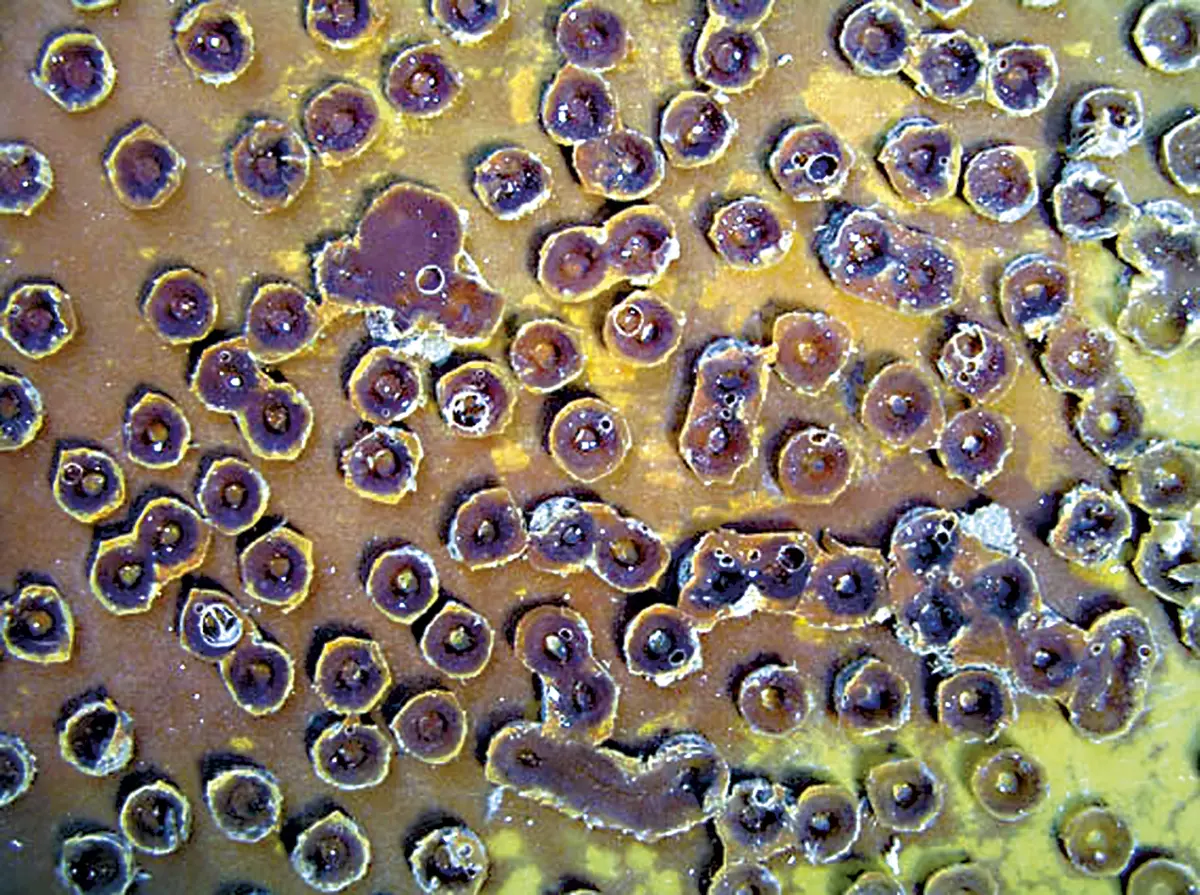
Composed of nineteen works, all pictorial in nature but with different treatments of the support, this show disguised a trap of sagacity and nerve. Each work followed an internal logic where polarities of Cartesian order and chaos were established and never resolved. At any rate, and in this particular proposal, the duality of order/chaos was not expressed as an opposition in the strictest sense. Cipriano Martínez is an artist of knowledge, and some of this knowledge lends a gift for abstract and relative thinking.
The works on exhibit, collected in the series Ordenamientos: Mapa I y II, Pesadillas Naranjas, and Derrames y Metástasis, escaped any schematism, even of representation as a criteria for truth. Visualizing an alleged order with abstraction, a desire for purity, and a loosening of restraint, they questioned the objectivity of the world and the blindness of conventional cartography. Martínez’s abstractions, which may refer to false maps, are not victims of the anecdotal and of description, inasmuch as they aspire to become metaphors of mental, cultural, and even physiological processes. It is because of this that some critics have wanted to find—in his splattered accidents, in his ordered or semi-ordered chaos—associations with the interior of the body, the almost magical world of interstitial fluids that meander through the inscrutable corners of our anatomy.
Weavings, patterns of nerves, mental projections prefiguring misleading ideas of possible maps—these are some of the resources Cipriano Martínez uses to draw a landscape. Nobody can encounter his work with an innocent gaze. All have the favorable prejudice that art always means something, because the lack of a name confounds, torments, and unhinges pure reason.
Martínez’s work implies the falseness of the external world and its circumstances, the lie about art as a reflection and as a mechanism that interrupts consciousness, and the reality of a perceptual horizon that grows increasingly impossible to comprehend. All the works presented in this show, under the title El orden desde dentro, have a common element. It is the use of ambiguity to represent a perennial stage of doubt. Who remembers what has been said about that which some theories call representation? Doubt—and in its place a craving for doubt—defeats reason, simply smothering it.
ANDRÉS ISAAC SANTANA