
In 1995, when Elio Rodríguez Valdés won the main prize at the Juan David Salon, he also won the opportunity to present an official show parallel to the Sixth Havana Biennial, two years later at Centro de Arte 23 y 12, where he was to revisit the themes of his winning work, Macho Still Life. This was a new kind of still life, using this pictorial genre as a discourse on matters of gender, cultural identity, and certain socio-economic contexts. Like later works and some previous ones, it was sponsored by Macho Enterprise, S.A., an imaginary firm founded by the artist as a survival strategy in a strong market (including the art market). When I asked him about this ironic commercial entity directed toward giving publicity to his work, he replied: “In reality, it is a mise-en-scene, a resource used to give my proposal greater ‘flavor,’ and at the time it allowed me to structure the work.”
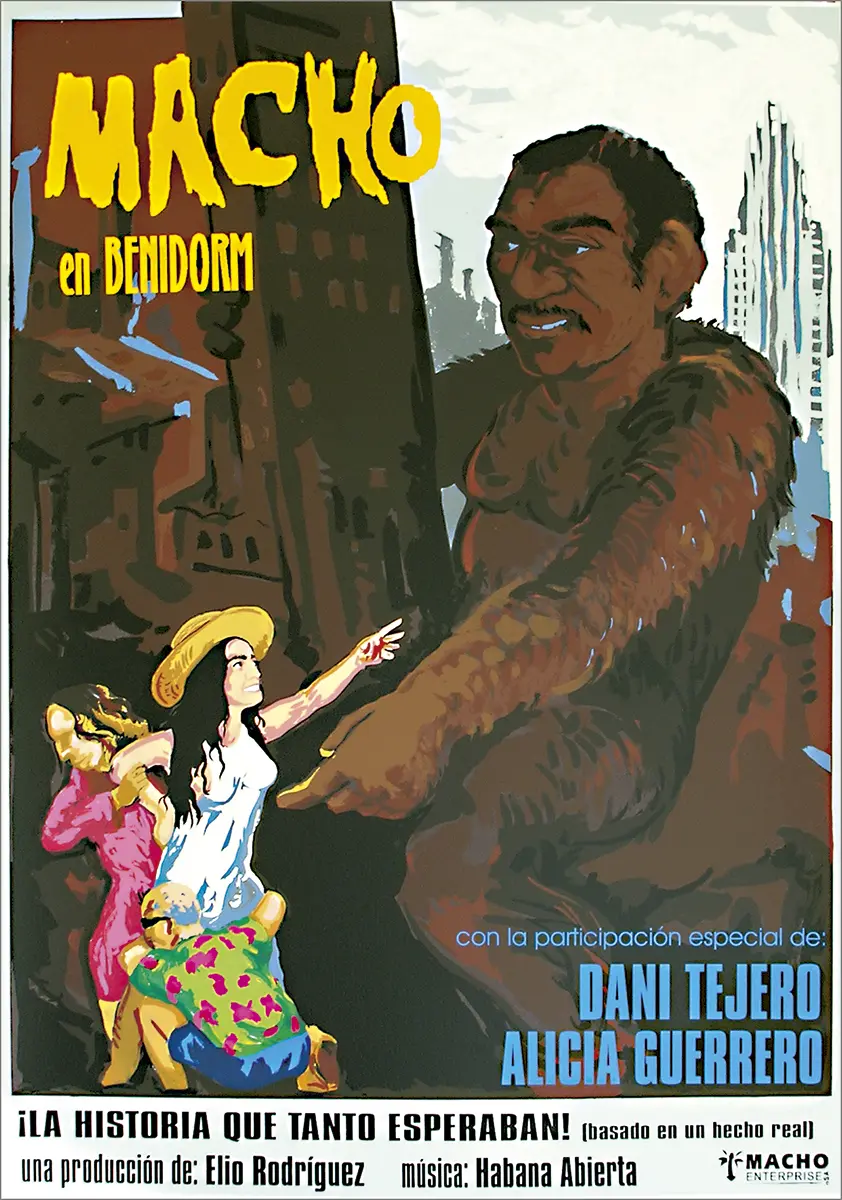
He constructed the work with text labels, typographic intentionality, and grandiloquent images—features of advertising design that are equally present in Remakes, Rodríguez’s second solo show at Centro de Arte 23 y 12, “El Macho.” In this exhibition, presented between November 2005 and January 2006, the artist offered ten works that represented three series and alluded to various advertising supports. In the title work, he revisits his tribute to film posters. In Mulatísimas, he injects new life into nineteenth-century cigar advertisements, where ethnically mixed women were represented as products resulting from the encounter between cultures and as sexual objects as desirable to foreigners as cigars. La Gran Corrida parodies bullfighting posters and subverts both the colony/metropolis and the center/periphery relationship. Here, the black male, a former slave and icon of virility and brute force, emerges as the conqueror of white Spanish women in the “Motherland.” Or, armed with a baseball bat, which is both a phallic object and the emblem of Cuba’s national pastime, he confronts a bull, a symbol of animal virility and of a traditional Spanish sport. The artist’s portraits of himself, his partners, and close friends in fictional roles and situations give these simulations of graphic design a testimonial character, mixed with narrative fiction. But they do not diminish their credibility or consistency as samplers of socio-artistic issues.
The serial character of the works created in 2005 corresponds to the multiplicity demanded by advertising. And even though he has explored large-scale photography and digital printing, Rodríguez has mostly focused on silkscreens. This traditional technique in Cuban poster art from before 1959 mixes well with painting in the creation of multiple originals; unlike other printing techniques, it allows the artist to work with transparencies and pastes, to drip, block, and experiment on the screen as if it were the surface of a canvas. Perhaps it was this connection that the late Cuban critic Ariel Ribeaux—in a 1996 text reprinted in the catalog—pointed to, describing the use of advertising in Rodríguez’s work as the “medullar body in a poetics of representation, inescapable and globalizing anchor of a pictorial cosmos.” These graphic works bear a certain similarity to painting in that they do not require a prior commission and seek multiple meanings and slow, careful reading, albeit from a compositional synthesis. In the late 1980s, when Rodríguez responded to an institutional commission and took part in the Muros y Vallas project in the Cuban capital, he used a wall on a street with heavy traffic to show his own work exclusively as an aesthetic/artistic product. Already, he was interested in the more direct communication with the viewer that is afforded to works situated in the street, as is the case with urban graphic design, mural painting, or public sculpture.
The poetics of this artist born in Havana, in 1966, are postmodern. His posters and billboards have never been useful as graphic designs. Their purpose has always been aesthetic/artistic; they enjoy great autonomy and transcend the moment of their creation, like painting and other artistic media considered artistic in themselves. In them, this graduate of the Instituto Superior de Arte has used the resources of advertising and placed them in the antipodes of current political/cultural propaganda.
Rodríguez also mixes portraiture and still life, two traditional genres that were revived in Cuba in the 1990s. He uses pastiche, revival, games, parody, Apocrypha, pseudonyms, simulations, the recovery of “minor” or “non-artistic” genres, ethnic minorities, popular culture, and kitsch. And he seems to agree with Celia Cruz in that “life is a carnival.”
ISRAEL CASTELLANOS LEÓN