
The Corp Group Centro Cultural Foundation is exhibiting, since last November through February 2006, a selection of works from the last thirteen years of artistic production by Gaudí Esté. Focused on animal figures, a preferred topic in the artist’s work, horses with caiman heads, held in stables or segmented, small donkeys on wheels, and imaginary unicorns comprise a fauna that brings us closer both to the anatomy of animal nature and to the mythical beliefs that emanate from archaic times. “Without leaving aside an acute observation of animal behavior,” says Federica Palomero, the show’s curator, “Gaudí Esté goes well beyond that and posits her creatures as metaphors for the human, by means of which she engages in a sharp critique of our society…” In other words, the artist seeks to express an ancestral and perennial human feeling: religiosity. This is why the title given to this show, Fetiches, ritos y devociones, transmits some of the feelings inspired by the statues of old civilizations —Sumer, Assyria, the pre-Columbian world—, erected as tributes to their gods. The totemic configuration of these works, given by combinations of mutant forms in which the artist creates metamorphosed figures” dogs with caiman mouths, bird eyes, or human facial features, accentuates her proposal’s animist character.
The show’s sober museography, minimalistic in its use of resources, contributes to dissipating visual noise and creating a subdued atmosphere that favors intimate dialogue; a pertinent climate that gives monumentality to the whole. The show gathers a total of 22 works in medium and large formats, as well as some installations integrated into the architectural space, distributed in two wide rooms, the entrance hallway, and the staircases. The montage, delicately lighted with some spotlights, increases the solemnity of the works, as can be appreciated in Perro Nagual cantándole a la luna, (de la serie Nagual), 1994, whose hieratic brings to mind the famous ancient Egyptian Memphis Sphinx (Fourteenth or Fifteenth-century b. C.) The horse figures are some of Gaudí Esté’s most recent productions: in Potro Caimán, 2004, and La patrona Trini-Caro, 2005, both from the Devociones series, the artist hangs a figure, close to life-size, inside a rectangular metal structure that supports the large body and also makes part of the composition, through which she is able to raise the figure to suggest agility and lightness. In Caballeriza, 2005, the sculptor creates an installation where form and space recreate these quadrupeds’ artificial habitat, while at the same time communicating a certain vitality arising from expressive poses that imitate the movements of a horse.
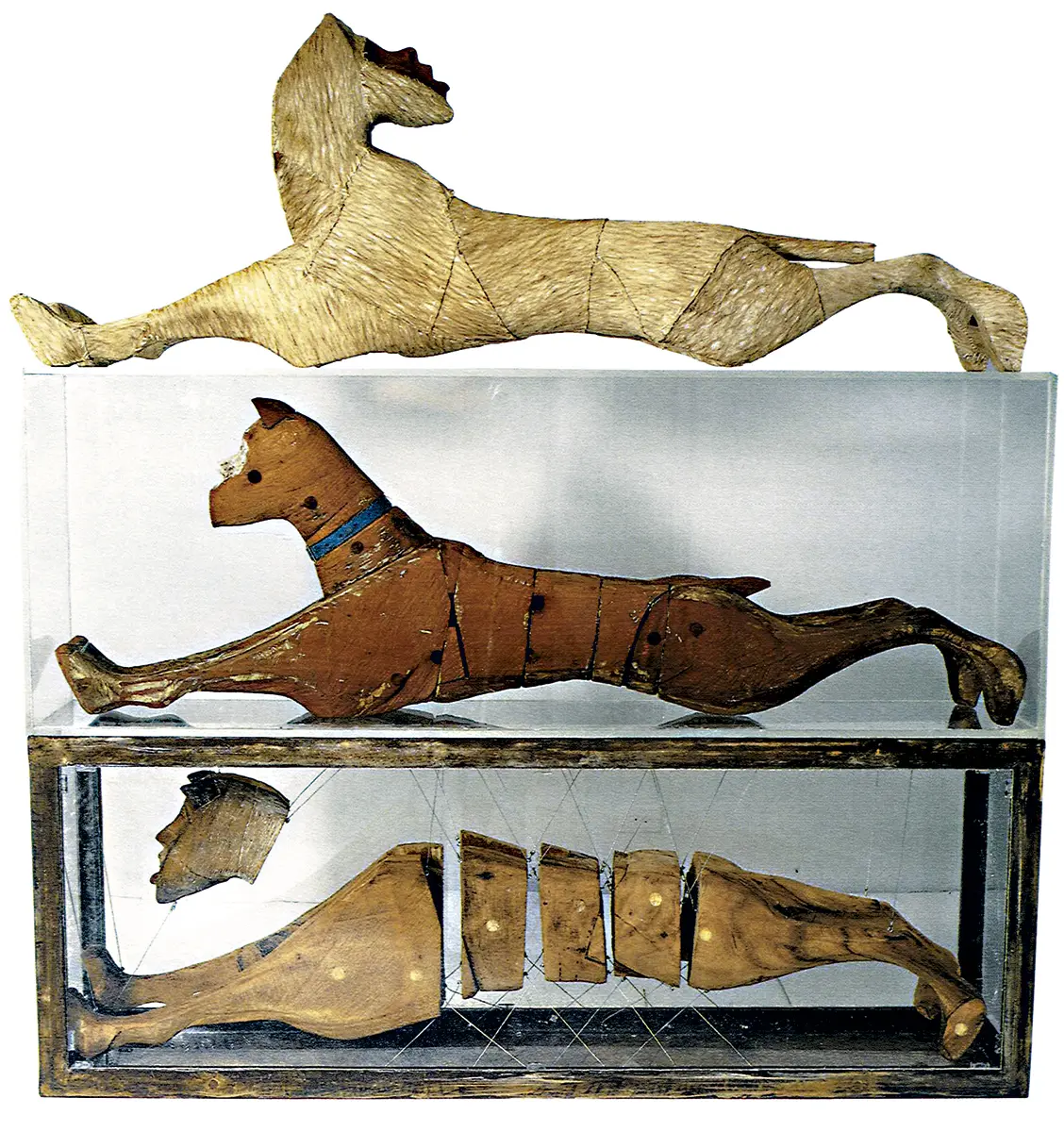
In this period of her work, Gaudí Esté intervenes volumes and intentionally leaves traces of ever more audacious and energetic actions, abandoning the careful style of smooth and shiny finishes that characterized her previous works. Blows, scratchings, carvings, chiselings, and the incorporation of other elements like dies, nails, sewn and glued skins, wheels, etc., with which she creates dynamic contrasts that enrich and give texture to the wood surfaces. Todos los seres ya sidos, vuelven a ser, of 2004, is an example of these initiatives where nine dog figures are covered in marima, a fibrous tree bark that resembles an animal skin. In other cases, the bodies are segmented, encapsulated in display cases, or hung by metal wires, as in Compañeros de ruta, 1999, a triad of canine figures that seem to mutate their internal and external nature.
Imagen de vestir, 2002, in turn, is a video installation displaying the film of a procession with a figure somewhat like “La Dolorosa.” This work, along with Ensamblaje II, 2004, a composition of a devotional character, brings to memory some traditions linked to Catholicism, such as the cult surrounding venerable images or the offering of small objects as tokens of gratitude for received graces, for example, the exvotos.
Since 1976, the presence of Gaudí Esté in the local and international visual arts scene has grown more and more solid, thanks to the technique and language to which she has remained faithful since the beginning. The trunks f many trees have been the ideal support for the expression of that search where the aesthetic, the spiritual, and the natural posit a new way of seeing and understanding sculpture.
GLADYS YUNES YUNES