
Guillermo Trujillo, without a doubt, is one of the great figures in Panamanian art and is considered a true master not only by his students but also by collectors and the general public who have followed his career since the 1950s. The interesting aspect of this septuagenarian artist’s new work is the fact that he has returned to his place of origin, interpreting shapes and colors that characterized his work decades ago and condensing the essence of a highly personal style into compositions of great simplicity. Trujillo’s most recent show in Panama—a collection of acrylics, drawings, and sculptures—was presented by Galería Habitante and was accompanied by an especially valuable catalog with many color reproductions and three analytical essays by respected figures of Panama’s cultural world.
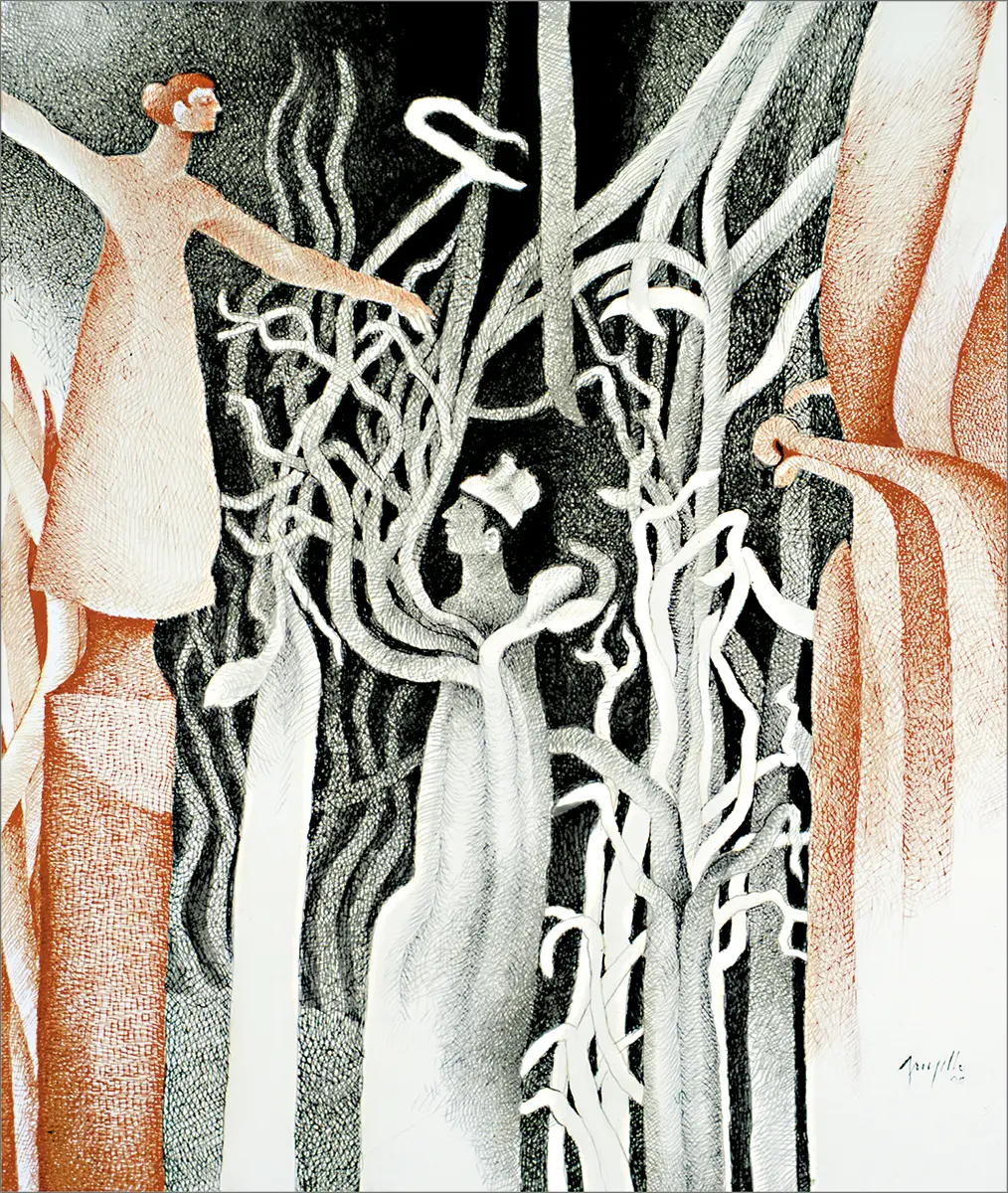
Trujillo’s paintings, large acrylic-on-canvas works about five feet in height, dominated the exhibition space and harmonized, both in terms of color and in terms of gesture and content, with the more than one dozen mixed-technique drawings also on view. The general mood was one of serenity and elegance; in these works, including the dark-patinated bronze sculptures, the artist limited himself to a small range of colors: white, black, and red ochre. The visual effect was that of being surrounded by expressions that are modern in their execution and use of materials but are, at the same time, old in their elementary shapes and restricted hues, like designs of prehistoric art found in some Spanish caves, or in Trujillo’s own works of the 1970s. White, black, and red are also the dominant colors in the decoration of Panama’s pre-Columbian pottery (huacas), artistic works that Trujillo knows well and even collects, and to which he has been exposed since childhood in Chiriquí, Panama’s westernmost province.
The red and black, mostly vertical, schematic figures in Trujillo’s works show human beings, biomorphic trees, and zoomorphic outlines in scenes that seem to describe rituals. Natural environments are represented as caves or dark forests. Unlike many of his works, this series does not show either open skies or dramatic horizons because all of the action takes place inside grottoes or night scenes. The artist achieves a feeling of enigmatic ritual in which animals, plants, and human beings play equal roles. Most of the human forms—mainly outlines and profiles—have heads, but only a few show any detail in their faces. There are women and men, nude or dressed, with hair arrangements and hats, as well as figures merely suggested by vertical bodies and round crania. Animals are interpreted as ceremonial staffs with horned-goat heads, beasts with long beaks or unsettling proboscis; plants appear as roots, branches, or twisty phallic shapes that intertwine into a grid system, and in some cases, they are more dominant than the anthropomorphic creatures.
The execution of these works is impeccable. Trujillo is indeed a master of composition and volume, and he is able to create a new reality with innumerable, repetitive thin traces in black or red, generating chiaroscuros and deep spaces that allow glimpses of a white background; this clarity contributes to the effect of his three-dimensional figures. Trujillo is not afraid of hard work, as he has demonstrated throughout his career, and he continues to paint tirelessly with a decades-long dedication to highly disciplined daily sessions. Throughout his career, Trujillo has explored media as varied as watercolors, etching, and embroidery, and also sculpture, as seen in the bronzes included in this show. These works are abstract verticals that originate in the paintings; they are figures of human proportions, almost six feet tall. Although they are impressive in the sensuality of their surfaces and the incorporation of vegetal and human elements, these isolated figures do not achieve the drama and the compositional and psychological tension present in the two-dimensional works. Sculpture allows Trujillo to create individual icons of his characters—the nuchos, so-called because of their relationship to the ceremonial staffs used by Panama’s indigenous peoples. It is in painting, however, even if limited to three colors, that Guillermo Trujillo is able to erect new worlds, symbolic spaces that echo the relationship between men, animals, and nature, with works that transmit ideas and feelings to their viewers.
MÓNICA E. KUPFER