
Loyal to one of his great obsessions and passions, the sea, Alexis Leyva Machado, Kcho (1970,) corroborates once again his credentials as a sculptor with Los animales, a significant show at Galería Habana that reconfigures poetically one of the essential elements of his work in installation and two-dimensional art, the oar, turning it into the central axis of 6 sculptures and a variety of drawings displayed in folders and notebooks inside glass cases.
It had been a long time since I enjoyed such an organic and cohesive group of works by this artist, whose last exhibition in Havana (Núleos del tiempo, late 2004,) on the contrary, insisted on that same element as support of numerous everyday objects (chairs, sinks, tables, beds, refrigerators,) without great imagination but with such formal and structural saturation that it made me think on an explicit danger for his solid creative trajectory. Fortunately, this new show confirms a delicate, important turn, the repercussions of which in the landscape of Cuban visual arts, specifically in the realm of sculpture, deserve to be carefully studied.
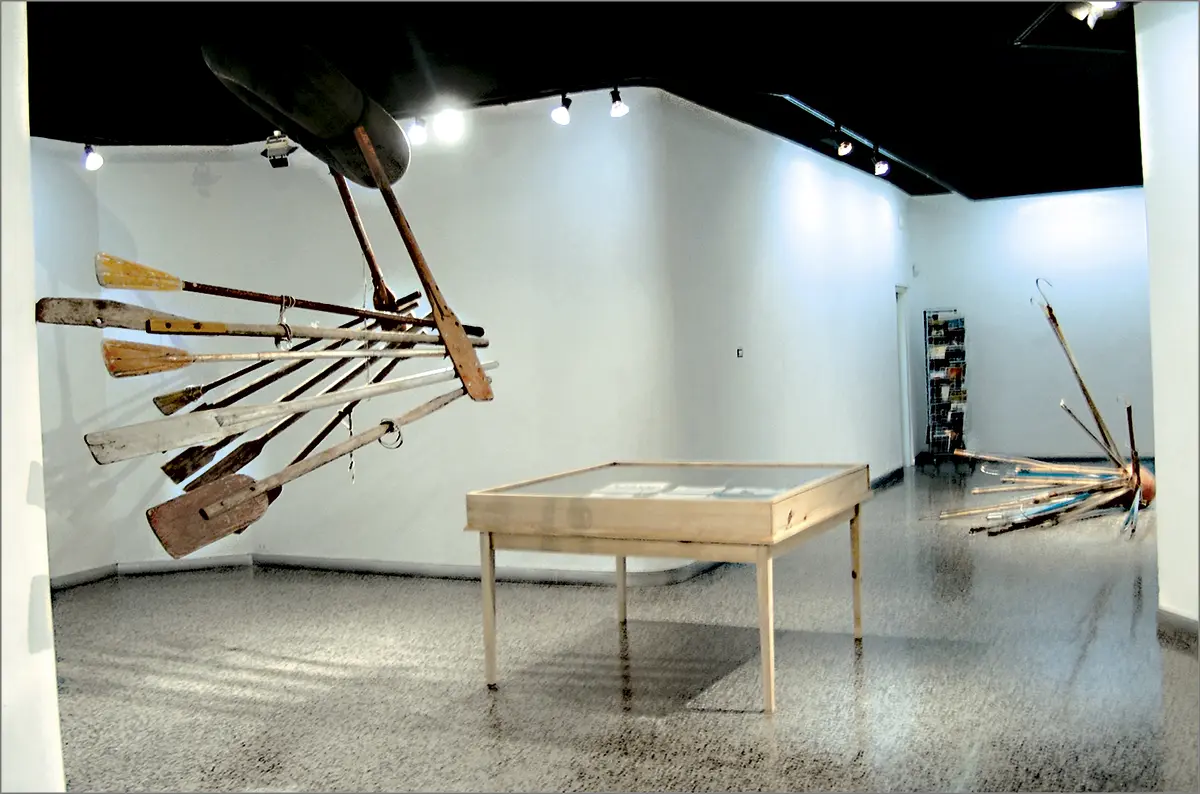
Kcho reveals himself in ways that are, if you will, different, still faithful to himself but not as the creator of impressive installations (to which we were already used) but as the sculptor of new daring and ardor, capable of mastering, with great sensitivity, forms, and volumes in small spaces, and to extend into unexpected domains the coexistence of nature and culture, the human and the animal, reason, and emotions.
The title of this show refers us, in principle, to interest that had not been his for over a decade, but it is, in the end, a metaphorical game,, a text in search of new associations with the sea and its species, with the plurality of landscapes that these spaces form from the depths of its heights, complemented from the island perspective that, like it or not, identifies us. As an interesting fact, note that none of the six pieces has a title, because it is not necessary: it is for the viewer to associate the “animal,” which is to say, its metaphor, with any specific obsessions and human experiences, on the basis of an operation where the imago erodes rational thinking and tilts it towards the affective and emotional space of memory.
We imagine the sea birds, fish, and cetaceans that populate the waters around us; yet I am inclined to believe that Kcho has created his own fantastic zoology, rooted in Borges, closer to wonderment and surprise, to doubt and startlement, to the mystery of universal creation, based on a highly personal way of appropriating found materials that reveal, once again, his ability to express himself as a recycling artist. About this condition, the artist himself had already given an account throughout the 1990s, to the point that he began to be labeled among us an “artist of migration,” the “raft artist,” thanks to his unique use of debris found by the sea.
His codes and symbols, which traversed the world so often as “collective” codes and symbols, representative of a mass phenomenon, retreat now to make room for the construction of a personal imaginary based on the surrounding nature and the islander condition to which we are subjected. Visible in his works, the latter differs from that “damned circumstance of water all around” (an essential motivator of transcendent literary texts in our culture,) locating itself rather at a midpoint between what a curse and a blessing: this is to say, as a circumstance among many that make us singular and different in the regional and global landscape.
Kcho moves under and above the waters, he “flies” like some of his “animals” on display in the gallery (albatrosses? seagulls? pelicans?) and unveils for us the profound significance of that sea that had ceased to be the primordial object of Cuban visual arts since the mid-Nineteenth Century (with the exception of Luis Martínez Pedro’s work in the 1960s and Sandra Ramos in the 1990s.) The sea and the vast gamut of beings that populate it, the men of the sea, or the treasure-trove of instruments related to fishing and navigation, arose little interest among our artists in the second half of the Twentieth Century. Kcho, however, since his time in his native Isla de Pinos —the second “great” chunk of land in the Cuban archipelago— has articulated almost all of his three- and two-dimensional work around that “original” perspective (the perspective of a passionate, conscious isleño) without needing to hark back to the rich pictorial legacy of the Nineteenth Century, guarantor to this day of an exceptional tradition of gracefully academic painting and printmaking.
Kcho, I dare to say, provides Cuban art with a new “seascape,” absent from the contemporary scene for several decades. He recovers used objects, objects forgotten forever or relegated by time, and an incredible act of abandonment when what needed to happen was precisely the opposite; this is to say, they should become “cult objects” due to the services they rendered throughout our short history. Reappearing in these “animals” are Kcho’s wood and metal oars, and in smaller-scale pieces of plastic foam, harpoons, inner tubes, surfboards, alongside innumerable nuts and bolts, rope, nylon, carriers of the patina, and the textures created by erosion. These recycled materials give origin to new forms, those assembled objects become sculptures (5 out of 6 works in the show hanging from the gallery ceiling): In this way, the artist builds his poetic universe in search of true vindication.
At the same time, notebook-drawing continues to be among Kcho’s dearest resources, yet one that is seldom explored and exploited wisely. There they are (I was tempted to write, lay,) accumulated under thick glass, awaiting intelligent labor of selection that will show them for what they are: true works of art thanks to the hand that defines them in ink, crayon, pen, pencil, charcoal, as future projects, embryos, or simply visible traces of a hidden thought, deep and obsessed with bringing to the fore whatever gnaws at him in his human essence.
Although they would seem to exist in this occasion as complements for the larger works (or as appendices,) on their own they comprise a show-within-a-show, and it is about time for them to be presented in their full scope and splendor, not prejudged as minor or secondary, bastard work. On more than one occasion the artist has revealed serious knowledge of the laws of drawing on paper or fine cardboard (remember his exhibition at the Museo Ron Havana Club, Havana, 2004,) of process sketching, of the ideo-aesthetic discourse it implies for the benefit of a tradition that, in Cuban visual culture, remains greatly undervalued.
Kcho once again evades the main currents dominating the local art scene and situates himself alongside those who set out in search of new formal and structural territories but remain concerned with the social fabric in which they are inserted, with the circumstances of our lives, surrounded by water on all sides.
More inclined towards sculpture and safe from the dangers of a constricting marketplace in its various modalities, Kcho returns to the ring of Cuban art with a proposal that is polemical in its conceptual aspects, formally virtuosic, and full of permanent meanings for the collective imagination.
NELSON HERRERA YSLA