
Despite his long and acclaimed career, Luis Camnitzer (born in 1937, Lübeck, Germany) has never had a solo exhibition in Buenos Aires, although his work has been in group shows in a number of local museums and institutions. Perhaps this is because this outstanding Uruguayan artist, critic, writer, and professor has lived in New York since 1964. The small Camnitzer anthology at Ruth Benzacar Gallery confirms the artist’s intelligent and astounding work that uses a variety of materials in a succession of minimal but forceful poetic gestures.
Being a conceptual artist, Camnitzer eschews spectacle; his work offers a chance to reflect. The works on view, from different series, affirm that Camnitzer uses few elements to put across multiple meanings. Evident from his participation in the 2004 group show Dando vuelta al poder at Centro Cultural Recoleta, Camnitzer’s condition as a nomadic artist sharpens his perspicacity and economy of means. The works that open this show belong to the installation Sin título, seen in the aforementioned exhibition, comprising a number of lenticular photographs of wrought-iron fences that guard something unreachable for most viewers.
Camnitzer’s graphic works on paper reveal the artist’s ability to shed light on thought and evoke poetry. Digital prints like Espejismo mostly belong to series from the 1960s and play with paper shapes and very few words. Meanwhile, on a simple leaf, the artist is able to assert the presence and current impact of the Iraq war. In Oilwell, he alters our perception of a given word and its meaning. On a page torn from an English dictionary, he attaches the prefix “oil-” to the words starting with the letter “w.” In other graphic works, Camnitzer approaches topics where the twisty roads and jokes of chance jump into view, producing a strange marriage between the images and numbers of a deck of cards.
In the installation La biblioteca de Babel, Camnitzer cloistered books behind bricks and covered them in sand with glue, hanging them from meat hooks in such a way that they suggest violence and isolation rather than rest.
In a funeral wreath labeled Coronel a tus coronas, flowers wilted as the show progressed. Flowers, glass, stone, and plaster compose a heterogeneous list of materials that are part of Camnitzer’s visual production. He astonishes the viewer with his contagious curiosity and prolific imagination, which result in the manufacture of artifacts as dissimilar as they are penetrating. His works are often accompanied by phrases that, among other things, allude to “The ideas of the past” or “The past of ideas,” as seen in two objects on view.
With Seis aforismos, a series of aphorisms printed on letter-size sheets of paper and stamped with the artist’s signature, one sheet is available to anyone for just one peso (about 33 cents). After placing the peso in a coin box, the viewer becomes the owner of an authentic work by the famous artist, who asserts that “To see without paying is theft” and “Acquisition is culture.” Camnitzer invites the viewer to be a part of the art world in more than one way. He enjoys provoking his ideas, and he can laugh at himself as well.
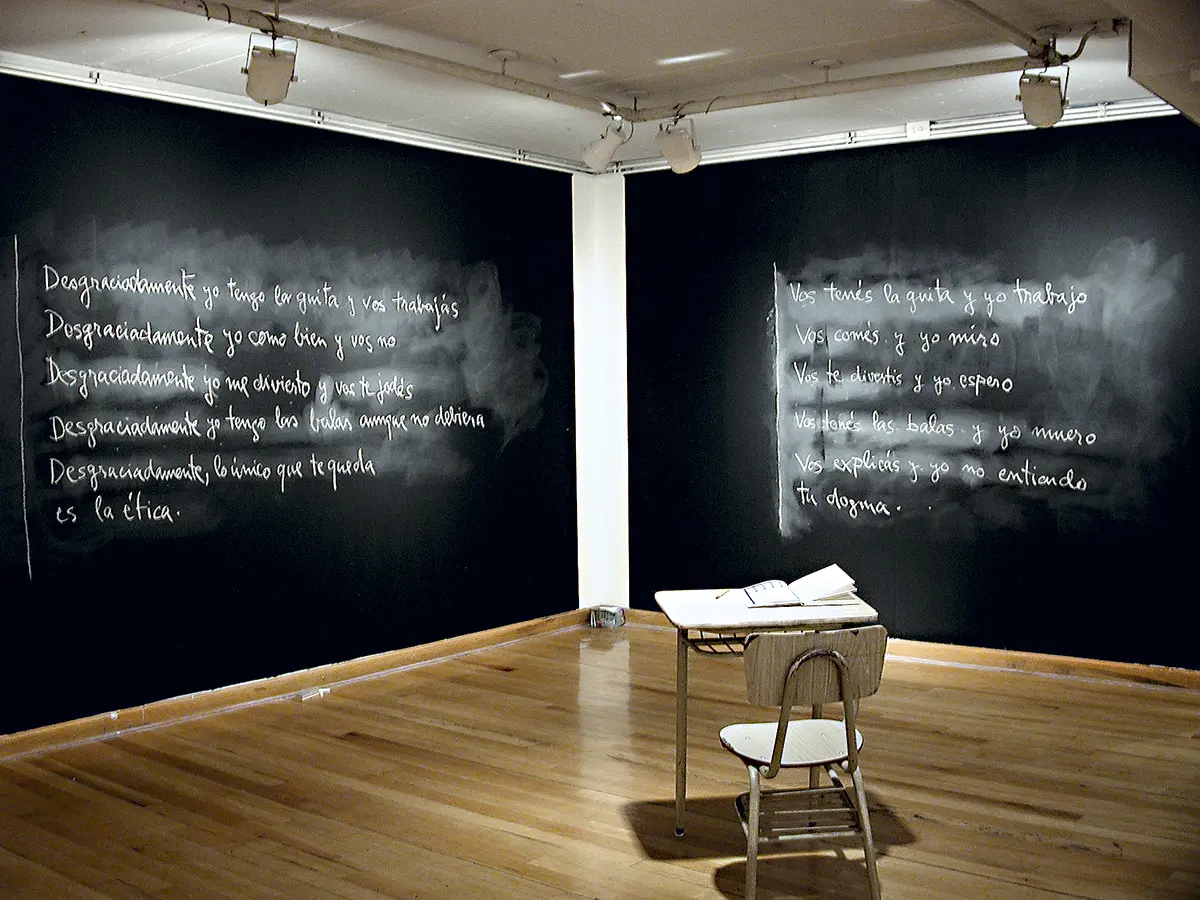
El aula is the largest and most intense work, with a school desk in front of two dominating blackboard-like walls; an open notebook, and a pen resting on the desk. The ironic sentences—“Unfortunately I’ve got the dough and you work,” “I eat well and you don’t,” “I have fun and you don’t”—written in white chalk on the black walls provoke amused, hallucinatory, or irritated responses. Many visitors debated with vehemence the intention and meaning of this sentence: “Unfortunately, all you have left is ethics.” The artist/professor says his piece; the viewer/pupil is challenged and replies with fury, cynicism, or commitment. The massive participation of the public was surprising, even for the artist, since this was not his manifest intention; the work oscillated between meanings, constantly.
VICTORIA VERLICHAK