
Luis González Palma has long been recognized for his haunting photographs of solitary figures whose dispassionate gazes speak of silence and sadness. Intended as personal expressions of the people of his Guatemalan homeland who have been the victims of conquest and violence for generations, each person, whether indigenous Maya or Mestizo, represents the psychological conflicts and personal tragedies of all mankind. He uses numerous symbolic references from Catholicism, Maya myth and ritual, and the culture of Guatemala to create a poignant environment for his subjects. The large-scale photographs, with their saturated hand-painted sepia tones and layers of appropriated materials and images, are as poignant as they are visually provocative. Adopting a Postmodern approach to the exploration of the medium of photography by constructing, rather than only discovering, his world, González Palma poses questions about the human condition and the way in which visual images can both express and manipulate behavior. His self-conscious awareness of his own people, historically and now in a Postmodern World, has led to a technique that gives new meaning to his images. Technically and conceptually complex, each work is composed of collaged objects in an asphaltum emulsion that includes Kodalithic transparencies, gold leaf, and other materials arranged on red paper and then embedded in resin. He will also frequently use alcohol to remove elements on the surface to reveal certain details, especially the eyes, for a mesmerizing interaction with the viewer. These effects give a sculptural presence to each image that further enhances their reality, and vulnerability, and our own involvement. The photographs are beautiful, yet we find ourselves asking: “Why are they so disturbing?” “What does he reveal about his figures and their settings that make us uncomfortable?”
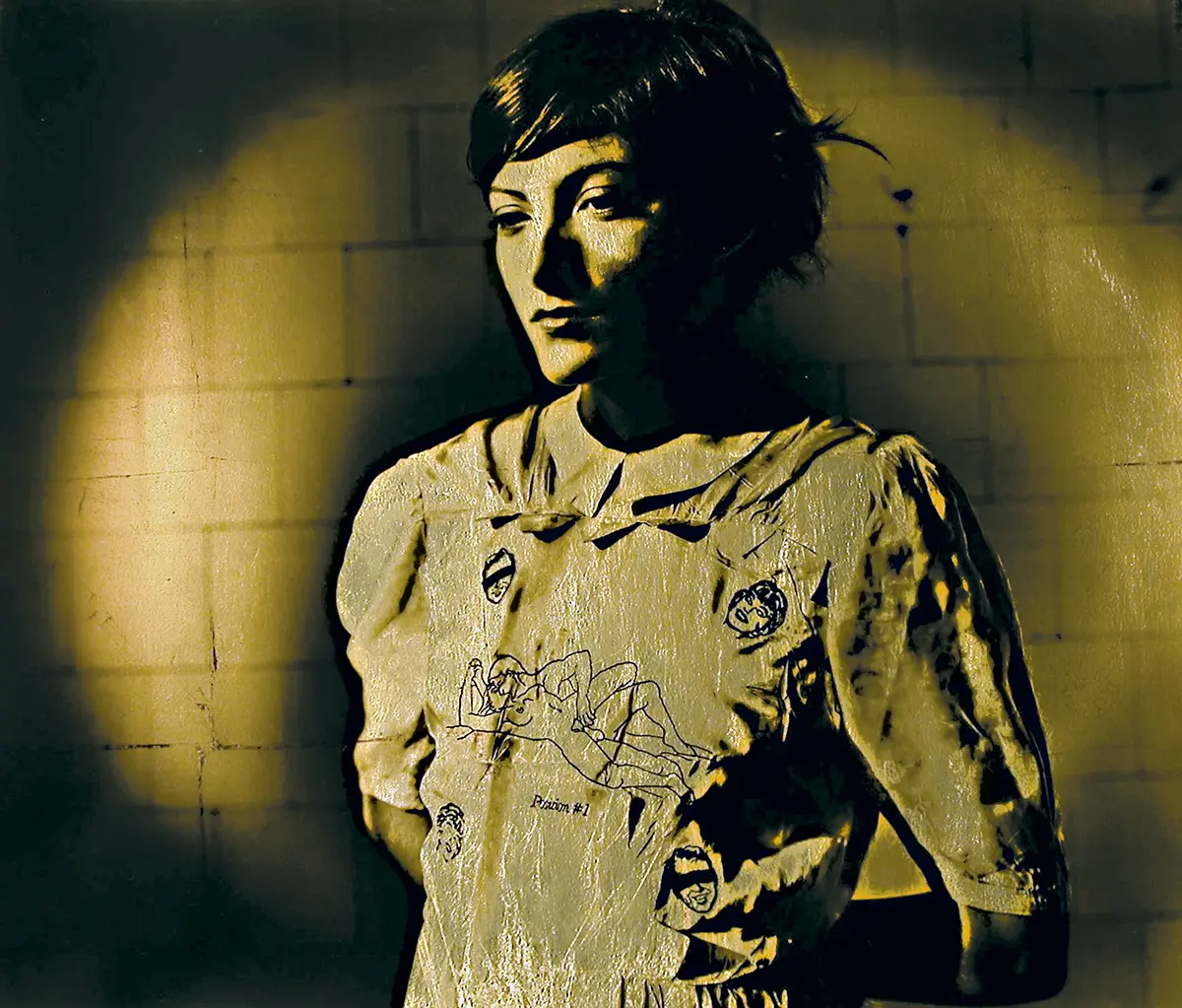
The new works in this exhibition continue the same mood of disquieting relationships, solitude, and haunting conditions. Rather than focusing on solitary figures, these works are more narrative in context as his imaginary constructions, or re-inventions, take on a ghostly presence in “actual” locations. González Palma has always been fascinated by the “Baroque” aesthetic so appropriate to understanding the culture of Latin America. He constantly adds elements, either assembled in collage or envisioned through photography, to mix the past and the present, and to make the photograph itself into an object. Although these new works are not as obvious in their references to Guatemala’s often surreal history through images of her people, there is still layering that brings the imaginative to a new invented reality.
In El Goce de lo no Dicho (The Joy Which is Not Spoken), 2005, the darkness of an interior scene speaks of absence and presence. A Kodalith print on red paper with silver leaf, the image is embedded in resin, which gives it the appearance of being frozen in time. A lonely table with two chairs occupies a room in deteriorating condition. The walls are scraped and flaked and the eerie reflection (?) or ghost (?) of a lit chandelier appears floating beneath the table. There are obviously layers of meaning here about something that happened in the past, a joyous past, which is no longer spoken of and only remains in fragments. His titles are always ambiguous and provocative as well and are meant to stimulate a response in the viewer and to perhaps confuse that response. There is a photograph titled Cuando La Verdad es Absuelta (When the Truth is Absolved), 2005, that includes the same table, with one chair, but the table is cut in half and impossibly standing. Another work is titled La Ilusion del Camino Inverso (The Illusion of the Way Reversed), 2005, and portrays a standing figure of a man with the long female locks in front of him, as if they were the remnants of her presence. He also includes works in this exhibition from his Dreaming Series, which appears to relate the story, or the memory, of a young woman with long dark hair at various events during her life. In Dreaming Serie 2, 2005, she is a childlike innocent whose image stands in and out of a room with a birthday cake on a table. Layers of meaning and memory are reflections that visualize a dream state, a sense of nostalgia that allows the artist to explore the past in a personal dialogue with the present.
For Luis González Palma, photography provides a technical opportunity that allows him to construct a new reality, to invent a world for his memories and for the people of his homeland. Images could be photographed and re-photographed, layered with new materials, and arranged by the artist for new context and meaning. This exhibition of his new works demonstrates that he is still confronting his ghosts and installing them in mysterious settings for a different sense of solitude that is no less mesmerizing and disturbing.
CAROL DAMIAN