
This show, on view from November 27, 2005, through January 15, 2006, comprised nineteen works created in 2005. Lizardo’s previous show of works on paper was presented at Sala Mendoza in 1998. With a significant career as a painter already behind him and following some incursions in photography and conceptual art, Lizardo approached the creative act anew, which implied abandoning traditional pictorial practices and reinterpreting his craft and his work. Thus, the expressive elements that were characteristic of his previous paintings—trimmed lines and intensely multicolored petals—reappeared after a process of mutation: black replaced color in the small shapes, now unattached from the canvas and serving as vibrant components of space.
Two-dimensional images have always involved a figure/ground relationship. Modern artists have sought to escape this restriction, emphasizing archaic frontality and the flatness of the surface and denying artifices for creating depth. In this effort, they have deployed many resources, strategies, and techniques to be freed from the tenacious influence of the plane. Since the middle of the twentieth century, incisions, grids, and filaments became resources systematically used by visual artists with an explicit purpose: to reinvent their centuries-old craft and renew the search for signifying forms. A survey of the creation of new pictorial languages is linked to highly recognizable names, from Fontana’s actions, Soto’s writings, teas, and vibrations, Pol Bury’s erectile entities, and Gego’s reticulate and paperless drawings to Milton Becerra’s weavings and knots. Artists have benefited from using planes parallel to the ground or from articulated shapes confronting the “vacuum” understood as a counter-figure.
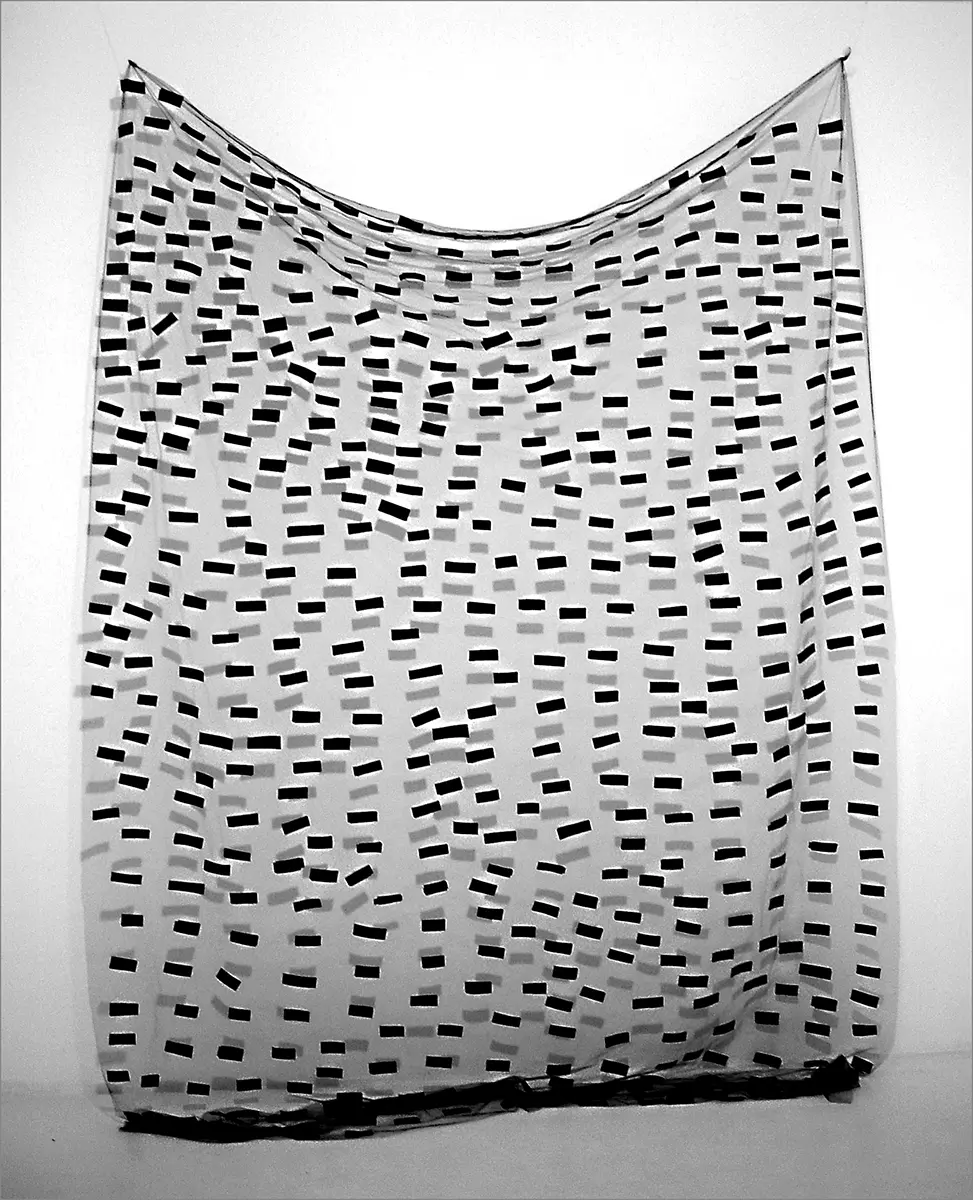
Lizardo moves along the same path with a suggestive interpretation, building fragile structures with lines and tracings that were previously attached to the canvas. With bands, circles, and irregular paper shapes, he combines fragments that gather or rearrange themselves and create a sinuous, undulating surface with folds and elevations entirely separate from their original support; nylon threads and pieces of gauze allow these delicate components to stay in space.
As if they mattered in transformation, the works in this exhibition shift dramatically from the Charcos to the Nubes, from dense, heavy forms to light, aerial textures, from a physicality attached to the ground to an immateriality suspended in nothingness. There is an ascending transition and a liberating or a dislodging of the real. In the earlier work Cinta de piso, there are unfolded grids, paths that open to immensity; in Charco negro, there are cartographies of unknown worlds. Nevertheless, in most instances, they are intricate structures governed by their own intense form, which transforms them into unusual labyrinths that turn on themselves, such as Charco blanco 1 and Charco blanco 2. In the passage toward the light, the articulation of the works shifts, the structure becomes open, diverse, and extended, and three-dimensional perception is enriched with the ambiguity of shapes arranged on the wall or in space; these are the small and large entanglements (enredos). They can be interpreted in different ways; sometimes we note the sensuality of bends and curves, sometimes the dense softness of the plumage, as in Enredo grande 3. All of them are dominated by a subtle lack of gravity derived from the elements they comprise, as seen in Enredo pequeño 3 and Enredo pequeño amarillo. Depending on the density of the irregular petals or the tiny circles, the work becomes dark, such as Enredo pequeño 6, or ethereal, like Enredo grande 2. In the Mantos rumanos the artist reaches the outer limit of the perceptible, the work exists more in the shadow it projects than in its physical reality. The shadows reveal alternations, undulations, and nuances that reconstruct for the viewer the fragile matter arranged on the wall. Nubes, an installation comprised of nine pieces, reformulates the poetic charge dispersed through the surfaces in space, changing the viewer from an external to an internal observer. Like shadow-covered shapes, Lizardo’s small clouds float in an unreal space; they are, if the paradox is allowed, visible immaterialities—daytime lightning that suddenly bedazzles us.
FREDDY CARREÑO