
Titanes de hielo, an exhibition of works by the Venezuelan artist Nan González, was on display in Caracas’s Museo de Bellas Artes, Galleries Six and Seven, from August 18 to October 23, 2005. This show, co-produced by Caracas’s Museo de Arte Contemporáneo Sofía Imber, gathered the most recent works of this artist, a pioneer of video art in Venezuela. After several years of creative investigations, González approached the issue of global warming and its effects on the glacial ecosystem and, by extension, on the life of our planet.
During a trip to Patagonia, González was moved by the tragic beauty of the large ice masses. At the same time, she became aware of their possible extinction due to human intervention in the delicate balance that governs the Earth’s life cycle. “The white energy,” wrote the artist, “lets out a giant cry of beauty and hallucination, and at the same time a warning of the imminence of death.” Focusing on these reflections, the artist presented five new video works.
Titanes de hielo (2001–2005,) conceived as a video-atmosphere, was the most significant work in the show, not only for the drama of large ice masses shown violently breaking down but also for the smoothly enveloping gallery. The walls, transformed into large projection screens, submerged the visitor in the audiovisual experience of this natural spectacle.
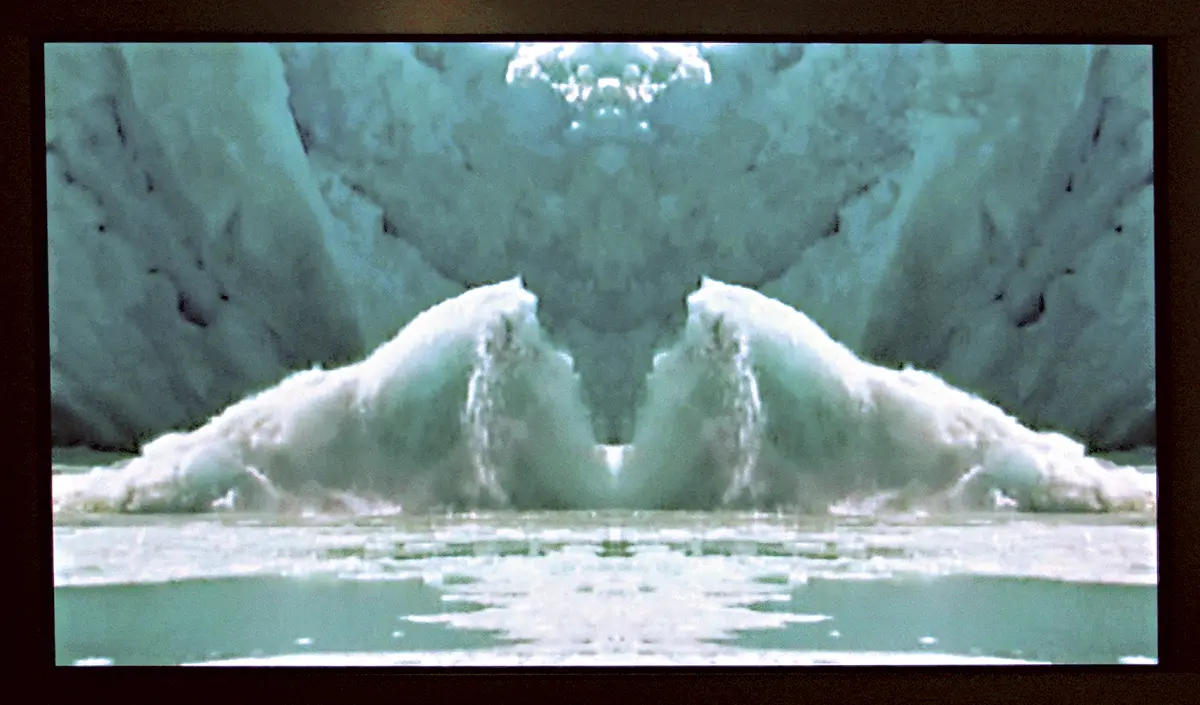
A similar theme was found in the video Alma del glaciar (2001–2005,) but with a more intentionally aesthetic treatment. The image of the glacier as an enormous natural sculpture from which large ice blocks dislodge and fall to the sea was shown in spectacular resolution and was emphasized by shifts in the playback speed. It revealed what the artist calls the “soul of the glacier,” evident in the forceful natural presence, intense plasticity, and metaphorical power of the giant white mass. The life of the glacier was turned into a process sculpture, speaking to us of its diminished eternity, of every death.
A hanging, globular glass bottle, onto which an image of the icescapes was projected, composed the video-sculpture Preservar (2003–2005). It seemed to deal with the melting of the large polar masses. The spherical bottle not only had an essential property as a container of liquids—including the primordial liquid, water—but also referred to the planet, becoming a metaphor for the cycle begun on Earth by life’s essential liquid.
Vida en el congelador (2002–2005,) another video sculpture, pointed toward the characteristic fauna, the animals that live on the ice. This work comprised a refrigerator and three monitors within, showing videos of these animals in their habitat. Inside the refrigerator, doors were clear kitchen glasses, containing photographs of polar bears, penguins, seals, walruses, and other endemic species. Viewers were shown strange fauna in beautiful images that confronted pitiless extinction and the frank condition of animal life. The white refrigerator—a frigid space that may represent coldness in our own hearts—is used to preserve foods of animal origin and became a forcefully ironic image of comfort in opposition to wild nature, a metaphor of a domesticated nature or a de-naturalized world.
González’s video Vuelo interior (2002–2005) closed the show. It was a kind of self-portrait; the artist, as was common in some ancestral cultures, identifies with the white owl as an alter ego that allows her to fly over the wide, cold regions. In the video, the owl gazed inquisitively at the camera in a disturbing close-up and took off in flight above the whiteness, surveying all and calling our attention to it.
Titanes del hielo, as María Luz Cárdenas wrote in the catalog that accompanied the show, reveals an oeuvre of poetic and natural intensity “capable of transporting the viewer to a space that stirs the paradoxical experience of marveling internally at our feelings of contriteness, fury, pain, ecstasy, or rapture, be it in the face of beauty or in the face of death.”
KATHERINE CHACÓN