
Inverting the Map: Latin American Art in the Tate Collection
Given that cultural policies are intrinsically linked to local political agendas and to the fluctuations produced by economic relations between countries, one can chart distinctive historical moments by analyzing the collecting policies of public museums.
During most of the twentieth century, the Tate Gallery’s main objective was the acquisition and exhibition of British art, complemented by the incorporation of emblematic works from the European avant-garde. After the Second World War, some works by Latin American artists were acquired. Notably, these acquisitions were determined by the artists’ involvement in various European art historical movements. For instance, in 1952 the Tate acquired Wilfredo Lam’s magnificent painting entitled Ibayé during a period of high interest in surrealism, a movement in which Lam actively participated. This was followed by the 1970 purchase of the triptych Black Virtue, by the Chilean surrealist Roberto Matta. With similar motivations, in 1959 the Tate acquired a Diego Rivera painting from the artist’s Cubist period to include it in thematic/historical exhibitions of works by Braque and Picasso. During a high point for abstraction—and linked to a political decision to bypass German art since the Nazis traumatized the British conscience for over two decades—works by Soto, Cruz-Diez, Le Parc, and Camargo were acquired under the umbrella of universal abstraction. Some of these acquisitions were mediated by Signals Gallery, funded by the British critic Guy Brett.
Map inversions in 2005
According to the brief gallery guide, the exhibition at Tate Liverpool was the first public display of the gallery’s recent Latin American acquisitions. It also served to demonstrate Tate’s intention to invert the scope of their hegemonic collecting practice by incorporating artists who, despite their impact in the international scene, were absent from the collection due to their remote origin.
The title of the exhibition was obviously inspired by Joaquín Torres García’s inverted map of South America, although the inversion proposed by the Tate looked more like an exercise geared to introduce ideologies of globalised cultural production. This made sense if one took into account the remarkable shift undergone by the Tate from being a gallery of British art to becoming a center for mass entertainment, since the opening of Tate Modern in 2000. Undoubtedly, the pressures to deliver a program for all tastes and to fulfill the role of tourist attraction must have had an effect on the acquisition of seemingly multicultural art.
The exhibition presented a selection of works by sixteen artists, acquired since the inception of the Latin American Art Committee and the hiring of Cuauhtémoc Medina as its main associate curator. According to Medina, the orienting principle for this new shift in acquisitions was not to build a historical collection but to focus on contemporary production and a few emblematic examples of post-1960 Minimal and Conceptual art for the significance of their legacies on contemporary art practice.
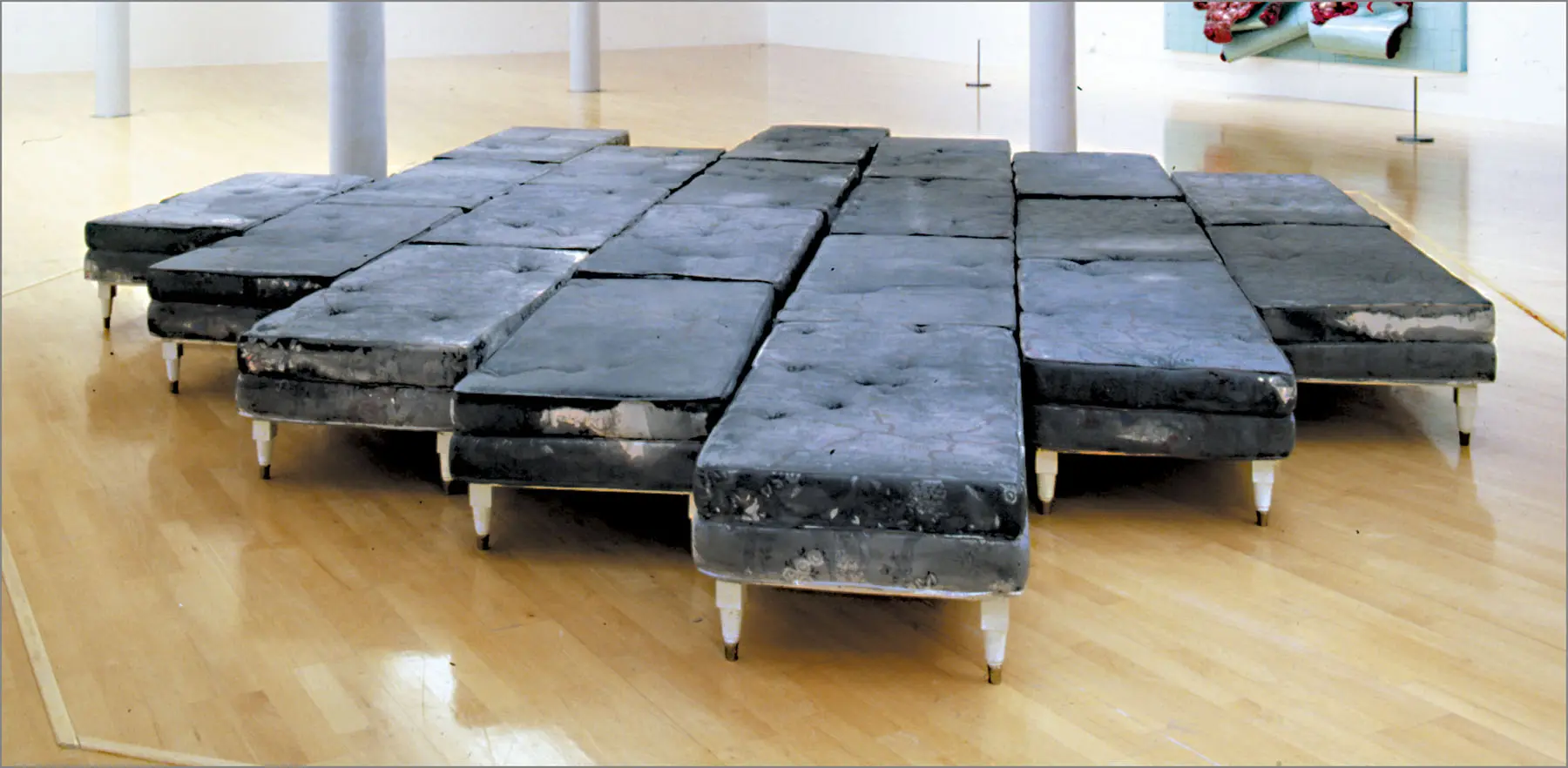
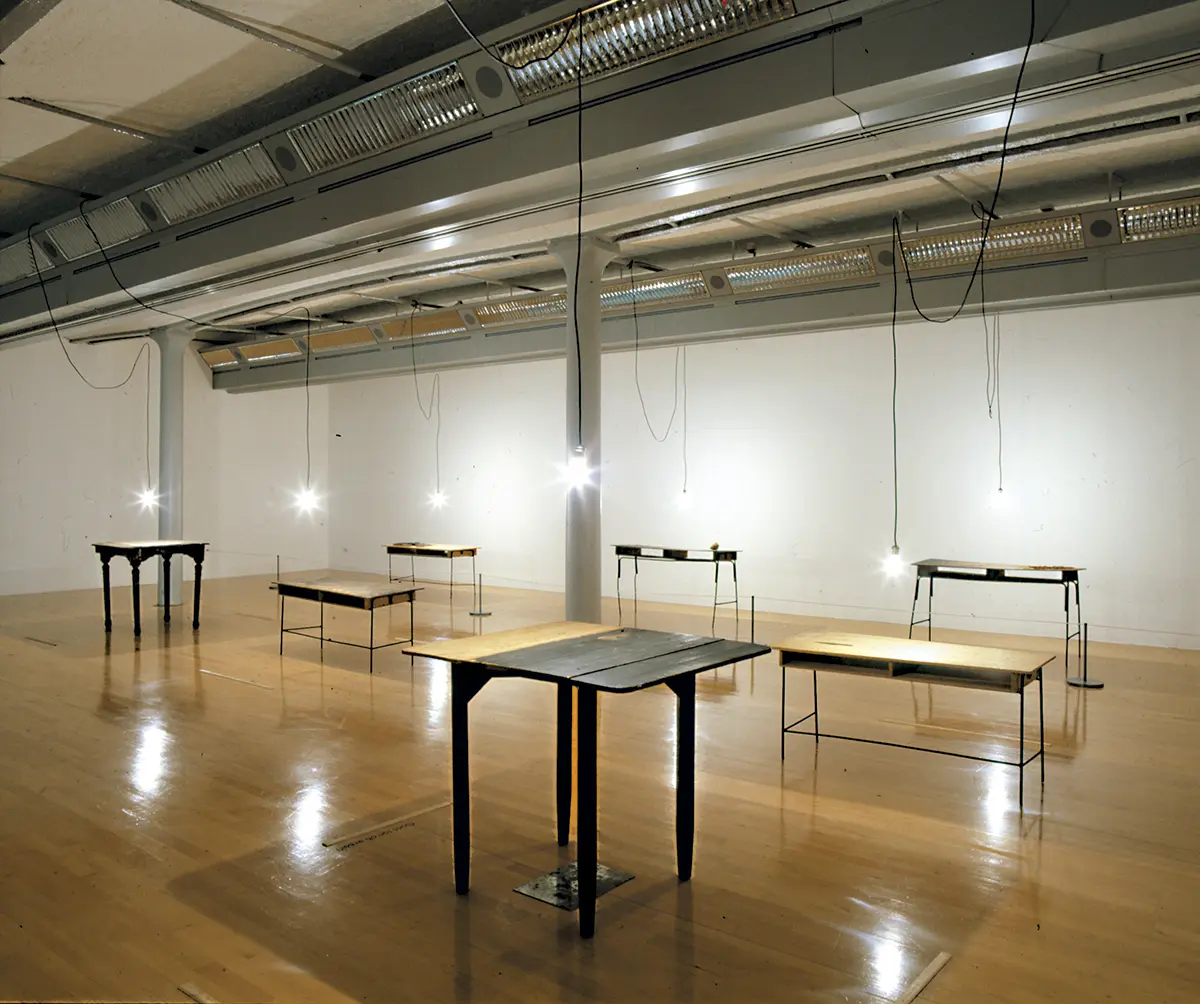
The exhibition showcased an array of innovative artistic languages accomplished in a broad variety of media. The pieces, selected for their high quality and symbolism—and there are weighty pieces here, such as Kuitca’s Untitled installation of beds from 1992 and Victor Grippo’s 1994 installation Tables of Work—were assembled in a non-linear, casual manner that attempted to highlight the persistence of certain recurrent themes in contemporary life. The complexities of life in an unknown continent were represented by a sampling of concepts—the city, violence, the body, repression, mapping, and politics—that summarize the perception of Latin America from outside.
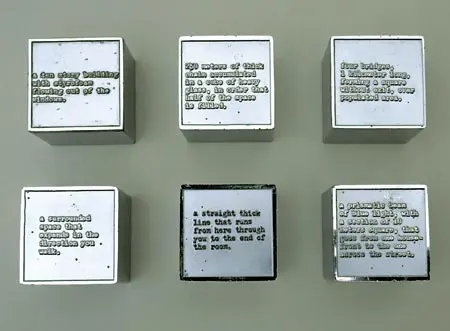
Highly significant was the presentation of two works by Luis Camnitzer, his installation from the 1970s titled Leftovers and the sculptural assemblage Sentences from 1966. Camnitzer is a fundamental figure in Latin-American conceptualism, as his work embodies a complex strain of the movement characterised by its social concerns and its roots in the local. He is also a theorist, critic, and writer who has devoted most of his career to teaching and contributing to the remarkable theoretical corpus from Latin America. The inclusion of his works in the Tate collection will hopefully set in motion the reframing of international conceptualism by widening its historical art critique to more varied concerns.
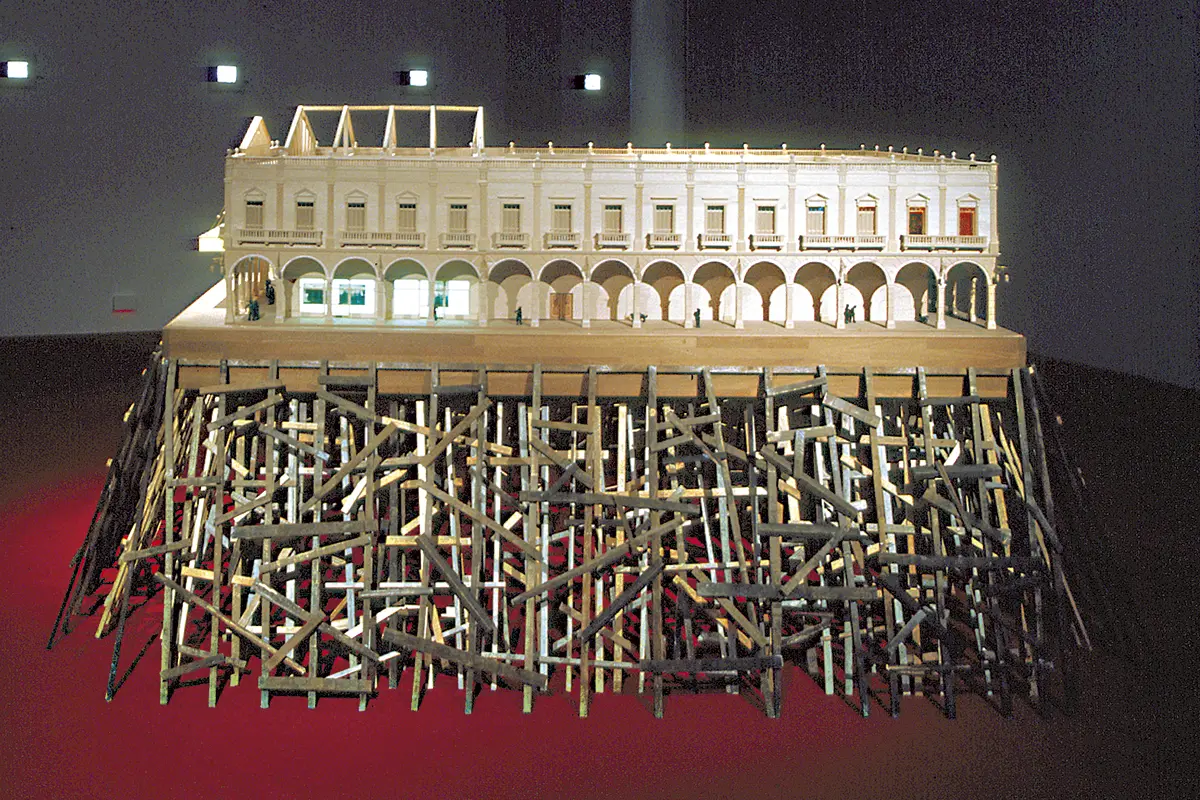
In the main exhibition space, the show presented works by Doris Salcedo, Valeska Soares, Guillermo Kuitca, Gabriel Orozco, Francis Alÿs, Adriana Varejão, Cildo Meireles, Eugenio Dittborn, and Leonilson, alongside younger talents such as Jorge Macchi and Daniela Rosell. Installations by Sebastián Diaz Morales and Macchi could be seen in adjacent spaces as well as Victor Grippo’s aforementioned installation and the large architectural model Letter to the Censors by Carlos Garaicoa.
The Hours: Visual Arts of Contemporary Latin America
Curated by Sebastián López, this exhibition presented a precise selection from the Daros Collection of works by Latin American artists. The principle that governed this selection was highly symbolic if not elusive, but it was very relevant within the cultural field of Latin America since it fed on the kaleidoscopic vision of time held by the Argentinian writer Jorge Luis Borges. Stemming from this idea, the works installed at IMMA and through the city of Dublin marked a strong presence of Latin American art in Ireland.
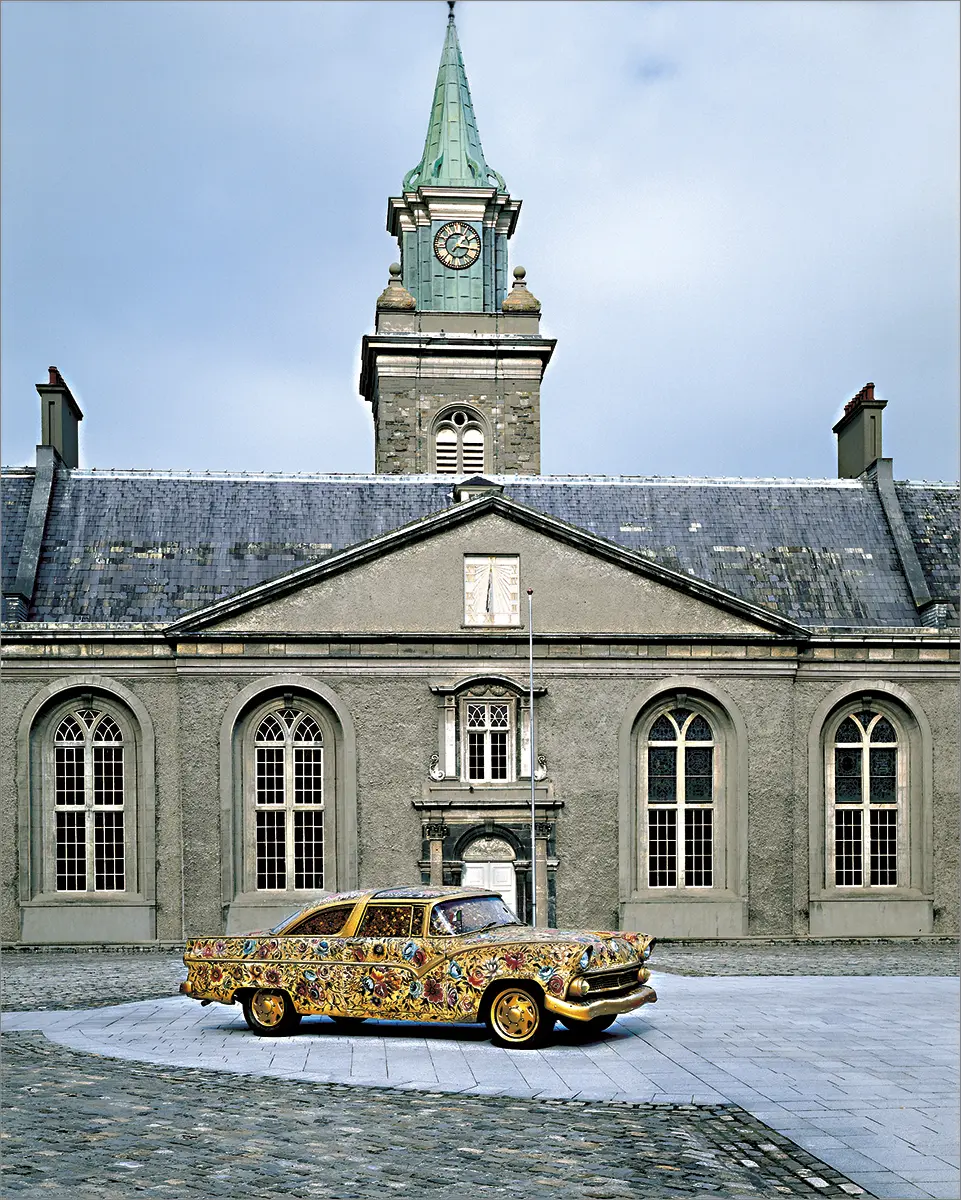
The building that holds the museum dates from the seventeenth century and was a military hospital for 250 years. The Irish government restored it and converted it to a museum in 1991. The architecture, evocative of the building of Les Invalides in Paris, sports a central courtyard of gigantic proportions, framed by a series of corridors crowned by colonnades and arches. Under these, the sound sculpture Vesper by Oswaldo Macià resonated. In the huge central courtyard, Ayate Car, a decorated 1955 Ford Victoria by Betsabeé Romero, found temporary refuge after a long route that started in Mexico City, passing through Colonia Libertad in Tijuana, then Houston—as an illegal alien-car—and finally Dublin, its last destination before parking in the Daros Collection’s home in Zurich.
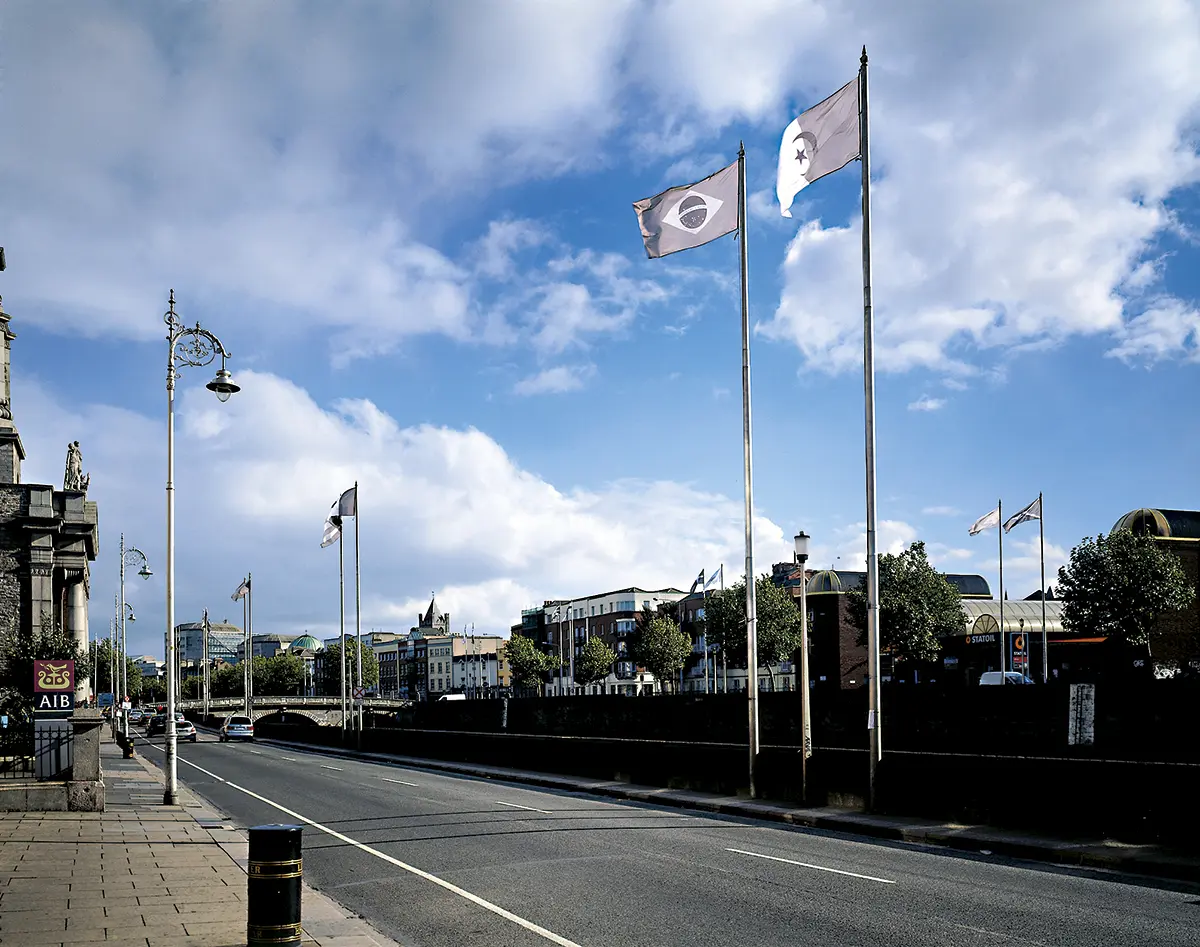
The city of Dublin was also a stage for some public works. The thirty flags that compose Apolitical by Wilfredo Prieto, a piece previously seen at the Havana Biennale, were installed on flagpoles along the Liffey River in central Dublin. The animation A Logo for America, originally created by Alfredo Jaar in 1987 for the Spectracolor sign in New York City’s Times Square, was presented during the week of the exhibition’s opening in the popular area of Temple Bar. The performance Displacement by Tania Bruguera was also outside the confines of the museum, where a video of its first public presentation in Havana was shown.
The thirty artworks in the exhibition stood for different moments of the day, or components of time.
Borges’s poetic approximation to a distinct sense of locality, his allegories of death, and his reflections on beauty, memory, and the infinite provided suitable support to the installations, photographs, videos, and works on paper by the multiplicity of artistic tendencies on view.
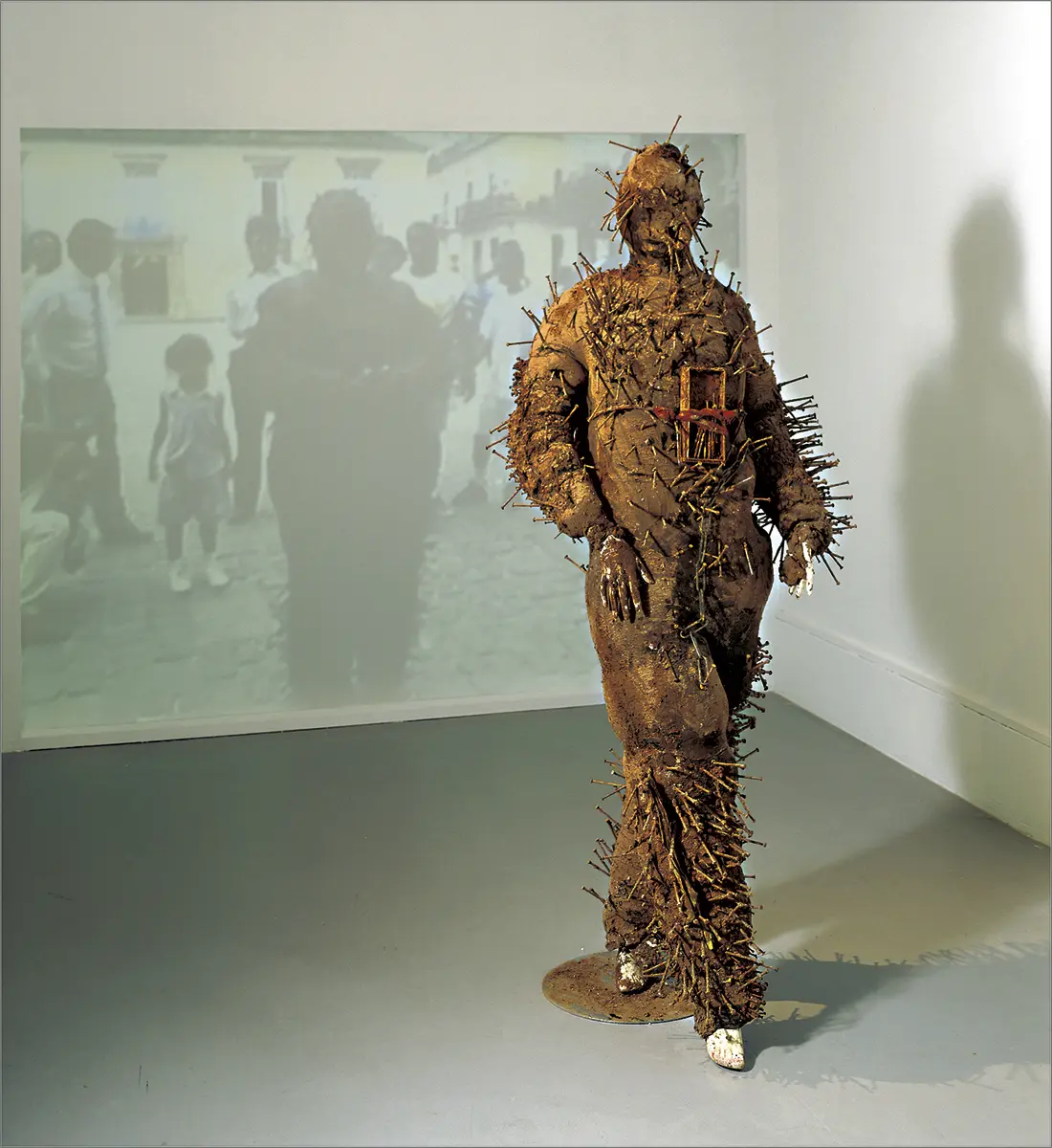
Notable was the gallery devoted to the work of Vik Muniz, whose photographic compositions are a magisterial antidote to the indifference caused by the contemporary world’s overpopulation of images. His emblematic portraits of Che, Sigmund Freud, and Marilyn Monroe, created on the basis of material/philosophical associations, were complemented by the presentation of Soy lo que leo, an early work amplified in this exhibition by its accurate reference to Borges’s encyclopedic culture.
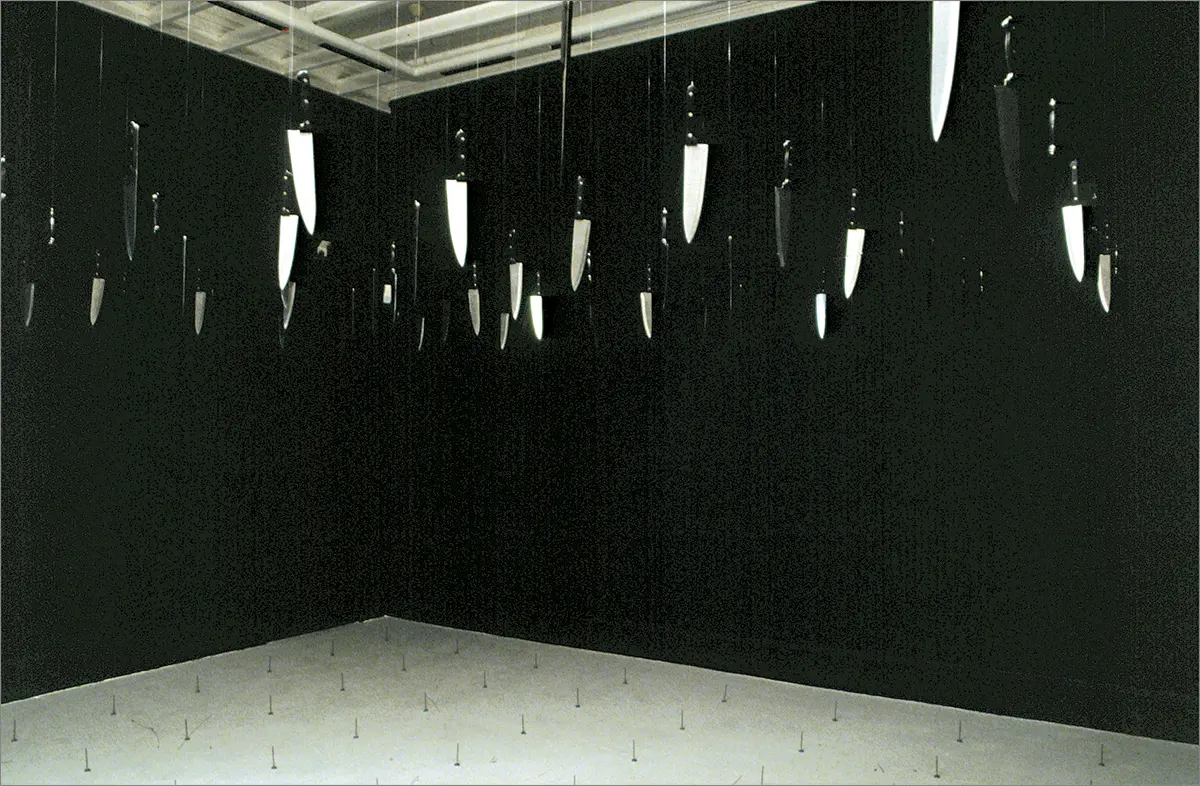
Lázaro Saavedra presented his intimidating installation El espectador y la obra, an eloquent allusion to the impossibility of cracking open the ultimate meaning of art, which also works in the Cuban context as a critique of the verticality of power. The installation, impenetrable for the viewer, comprised a hall painted black, where dozens of sharpened knives hung from the ceiling, pointing down to a floor covered by upright nails.
Another jewel in this exhibition was the gallery devoted to the Brazilian artist Waltercio Caldas’s book/objects of the last thirty years. Their magnificent materials and a visual variety connected harmoniously with Borges’s fantastic discourse.
Furthermore, the symposium that facilitated a conversation among Tania Bruguera, Betsabeé Romero, Oswaldo Macià, Gonzalo Díaz, and Lázaro Saavedra was a suitable platform from which to expand the ideas contained in the works and to analyze crucial issues in contemporary practice such as authorship, participation, and recording of the ephemeral in the context of a historical time of rapid changes.
Time, became a potent alternative theme to the assembled artworks that had multiple meanings in a context where the global and the local seemed to be playing the very Borgesian game of intertextuality.
GABRIELA SALGADO
Curator of Latin American art based in London.