
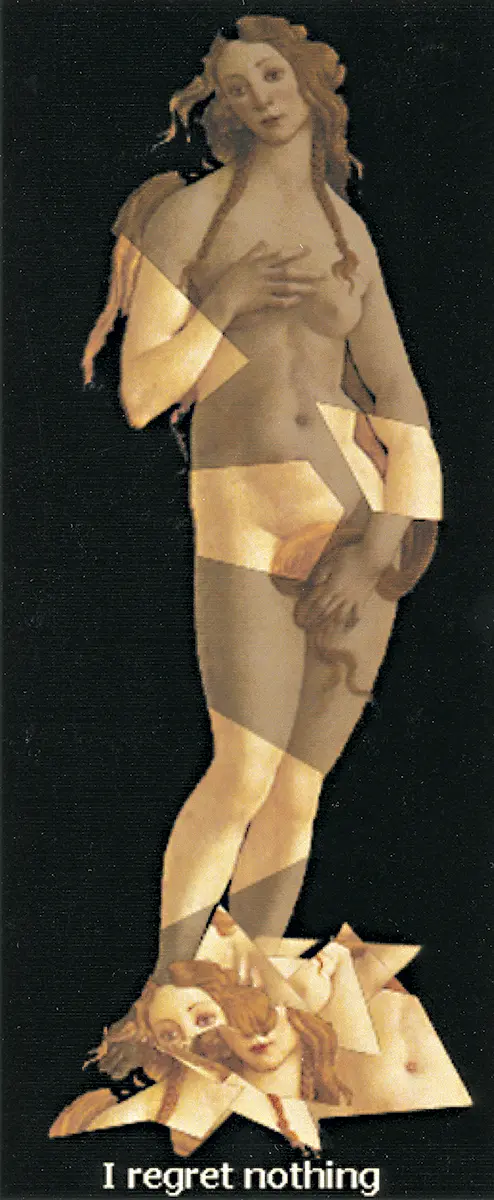
The exhibition, conceptually articulated around a video (from which it takes its title,) comprised fourteen video stills reworked by the artist in a Dadaist spirit, using clippings, collage insertions, tape, and drawing. During the two hours I spent with Romberg (who had at the same time a solo show of watercolors at the Saint-Etienne Modern Art Museum,) I had to attempt to grasp long years of creative work and, while not understanding them in depth, to find in them a communicating thread. To summarize the richness and diversity of this prolix and talented artist and intellectual’s work, I shall say that, moving from painting to film, from video to photography, and from art criticism to exhibition curatorship, Romberg (born in Argentina in 1937, now living in the United States) has never ceased questioning art and its history, as well as space, and has been able to preserve a coherent line of conceptual and aesthetic investigation, connected to a personal philosophy regarding what it is to be a artist in this world. If Romberg declares himself a “free artist,” if he reaffirms that he sees artists as “scientists devoted to thinking,” it is to better articulate knowledge and enjoyment, and to “sensualize —as he puts it— social problems.” Romberg’s essential concerns are clear, because what originates are life and art mixed together.
The 42-minute, three-part video was recorded in 2000 (for the Salzburg festival) and presented in its current form in 2002, on the occasion of the opening of the Sloguht Foundation in Philadelphia.1 Sound gains great importance here, especially in the first part, titled “Bésame mucho.” This epic of love and its utopia brings to the stage small robot characters in transparent acrylic, a kind of “dolls” manipulated by means of invisible wires, resembling the figures in Oscar Schlemmer’s 1923 Triadic Ballet or those in Fernand Léger’s 1924 Mechanical Ballet. Their programmed wanderings narrate the amorous vacillations of two fictional characters, Carlos and Isadora, perhaps a knowing wink in the direction of Ramona and Juanito Laguna, the poor neighborhood heroes presented several decades ago by Antonio Berni. This love/passion “dance,” where the relationship between man and woman is woven and unwoven to the rhythm of melodies and images, the movements of the dolls are accompanied by emblematic songs, and the sketches are written title boards presenting, silent movie-like, the next scene. Boticelli’s Venus is built and un-built as Edith Piaf sings (Non, je ne regrette rien) while the homeless hero (Carlos) reflects on death in front of a Caravaggio. In the second part, titled “Rondo caaprichoso,” Fayoum’s portraits (Egypt)parade in front of us and alternate with the Jewish mysticism of the Kabala and with images of Michelangelo’s David and Boticelli’s Venus. These are all emblematic references, provocative associations that inspire us both to reflection and emotion. Osvaldo Romberg tells us that he feels like an “emotions engineer,” and that “what is important for the artist is not what he feels, but what he makes others feel.” In the third part, titled “Es Brent” (Yiddish for “The Village burns,”) Romberg says that physical relationships have ceased to exist. Sexuality is now only virtual. With music by Wagner, the artist plays with art images and others designed in a computer. There, men (male “dolls”) make love to women (female “dolls,”) or to male images taken from the selected works of art.
In a corner of the show, a gold-colored fish from a misanthropic tropical species floats inside a transparent fishbowl. A metaphor for the inescapable solitude of Man, or a metaphor for doomed love, which is what, in he end, marks the works on display…? Nostalgia seems also to be somewhere else. Could it be in his native Argentina, where Romberg is (almost or excessively) unknown?
CHRISTINE FRÈROT