
In 1952, the German artist Mathias Goeritz built the Eco Experimental Museum in Mexico City’s Colonia San Rafael, sponsored by the industrialist Daniel Mont. Conceived as a site for artistic experimentation, the Eco was also born as a space in motion where open-ended forms of artistic expression could be developed, among others, the possibility of creating an art object in situ and not to seeing the building as a traditional museum designed specifically for the exhibition of mere artworks. Such was the case of a now-lost mural painted on a wall in the main hall by the great British artist Henry Moore. For Goeritz, the Eco was more of a sculpture than a place with an architectonic sense. In fact, the original meaning of the work changed as construction progressed since there were no blueprints but only painterly sketches of the building.
For years after the death of Daniel Mont, when the building changed owners, the Eco was kept from fulfilling Goeritz’s idea. Today, thanks to the efforts of the Universidad Autónoma de México (UNAM), the building has been recovered and the German artist’s original notion is once again supported: a communitarian space capable of containing the widest variety of artistic expressions. On October 7, 2005, exactly fifty-three years after its first opening, the Eco reopened with a group show of the conceptual artists Gabriel Orozco (born 1962), Carlos Amorales (born 1970), and Damián Ortega (born 1967). The show comprised five interconnected works that related harmoniously to Eco’s sculpture-like nature, with clear mimetic intentions.
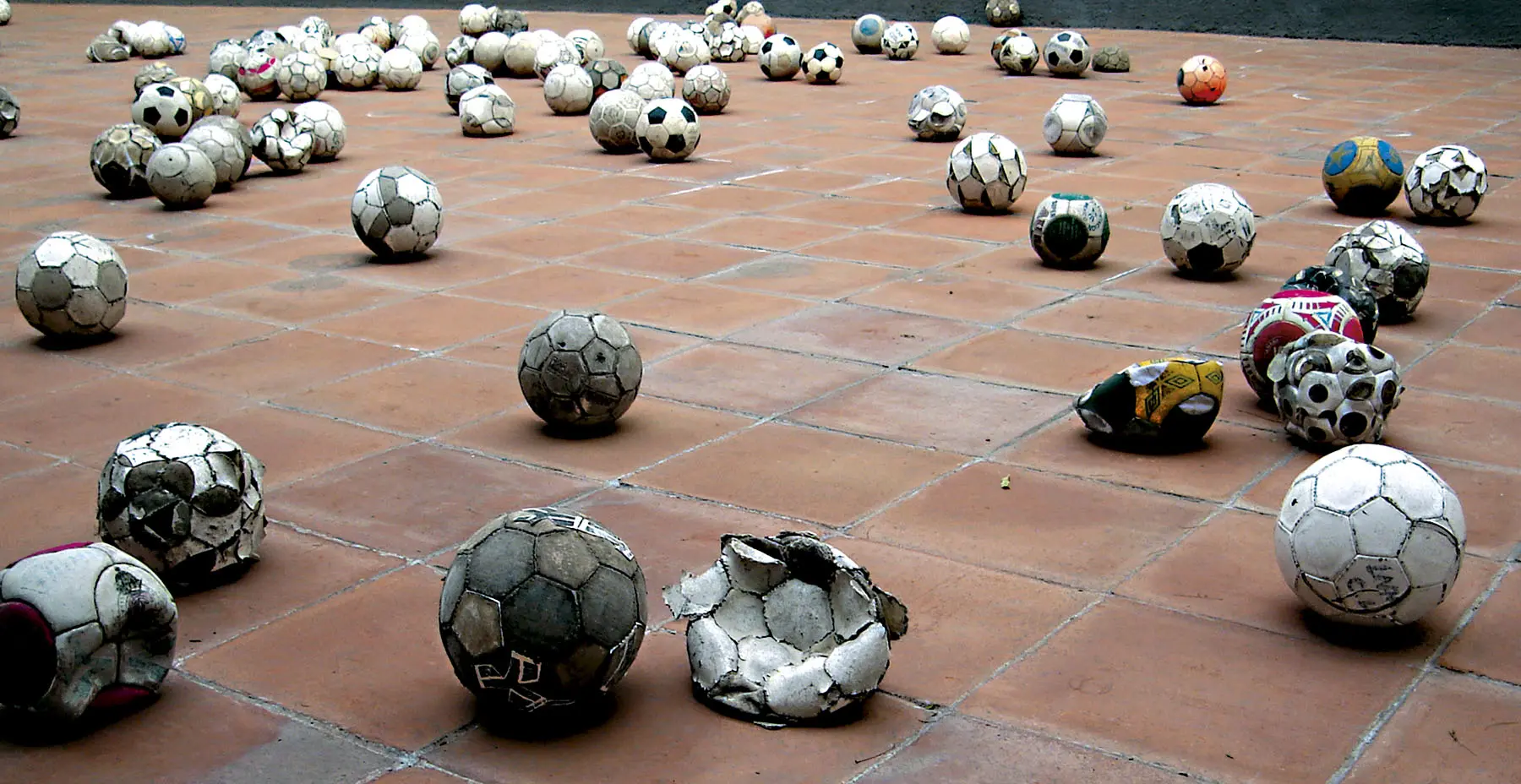
Gabriel Orozco’s Accelerated Soccer Balls (2004), located in the main patio, was a series of “intervened soccer balls” organized in a seemingly chaotic sequence that nevertheless denoted a certain order when seen from a certain perspective. The idea was for the viewer to interact with the old balls in such a way that they could be touched and move. Curiously, however, they couldn’t be kicked, since the artist’s intention was to observe the balls’ process of deterioration as they were left outside. There was a contradiction in that soccer balls are objects that deteriorate from being kicked around and manipulated by human beings, yet the work focused solely on decay caused by weather conditions. The balls used, says the artist, were initially those that fell inside his neighbor’s garden. As the project grew, he acquired balls from the UNAM “Pumitas,” the little-league division of the professional team. In exchange for two used balls, Orozco offered a new one.
This project also corresponded with two other works by Orozco: El ojo de Go (2005) and 670 invariantes (2005). The former was a work of acrylic on canvas that contrasts the latter, an eleven-inch digital graphic animation. The succession of circles in the animation changed colors from a blue base and the circular sequence simulated movements on a chessboard. The geometric figure and its variations were recreated on the basis of chromatic simulation and the shape’s oscillations depended on the color changes. The three works by Orozco in this show suggested communicating vessels, from which several theses could be derived. The chromatic transition can strictly be a simulation of a given movement, even if it is an apocryphal variation. The interpretive difference will reside in the direction of visualization or the position from which it is observed; in the round figures of the soccer balls, the impact came from perspective; in the animation work, from following a specific color. With these pieces, Orozco cast his viewers into searching colorblindness and an unsure space.
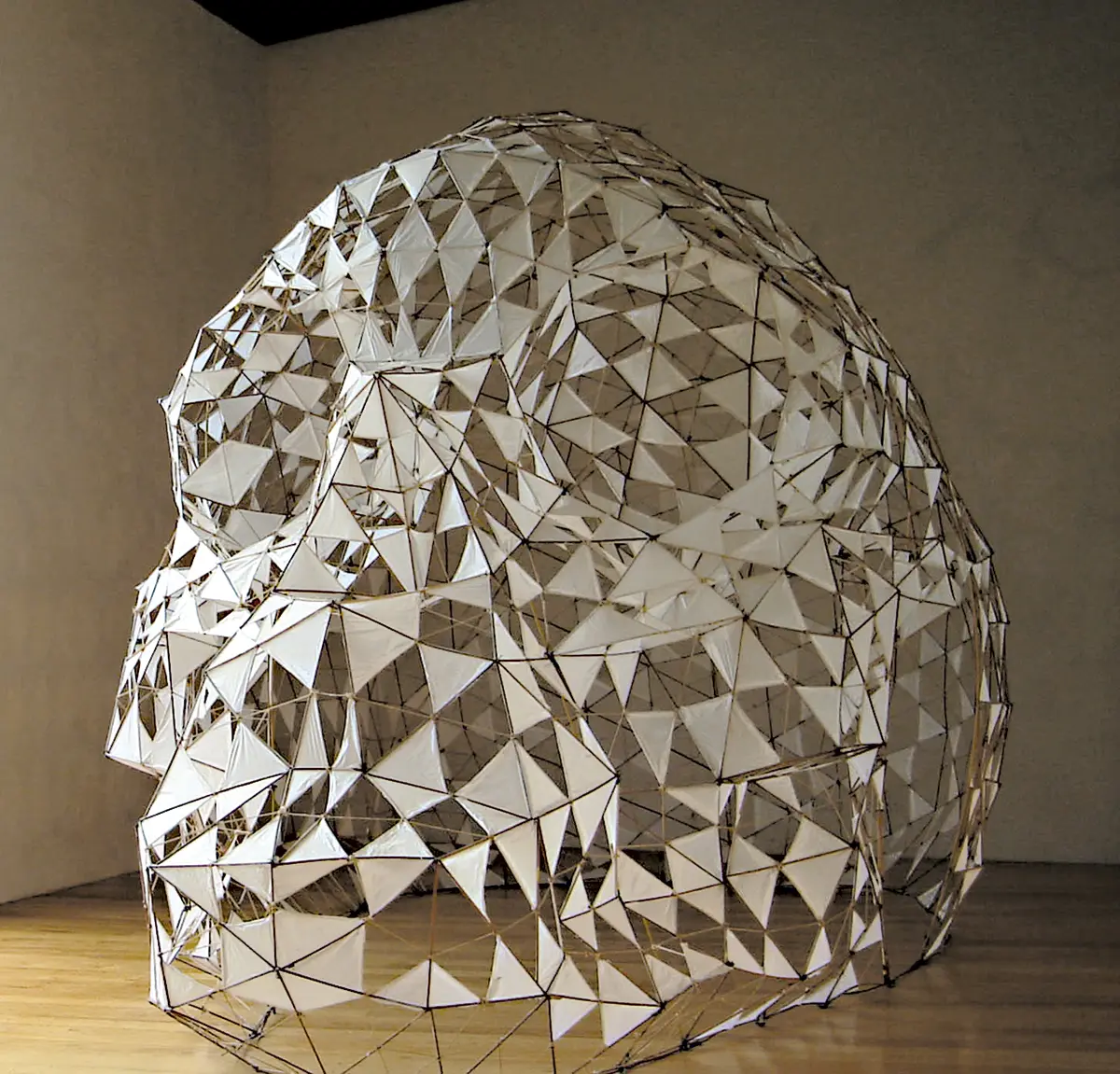
Crítica al estado filosófico, Papalotes negros (2004) was Damián Ortega’s contribution. Invited by Gabriel Orozco to contribute to the exhibition, Damian Ortega’s work is a series of interconnected kites that simulate a skull. Using a variety of materials (wood, canvas, China paper, and wire), Ortega suffused the work with a certain philosophical pessimism. The irony was that the viewer could enter the skull and interact in an area corresponding to the temporal lobes. This piece referred to an earlier work by Gabriel Orozco also titled Papalotes negros (1997). Installed in the Eco’s wide nave, Ortega’s Crítica al sentido filosófico hadn’t been shown before and was created with help from students in the School of Architecture at UNAM. The philosophical dialogue among the three artists was based on the idea of fragmentation as a counterpoint to mental structure. Ortega’s large skull, for example, is comprised of a number of kites joined together. by wire, wood, etc. Orozco’s works, although based on spherical structures, spoke of segmentation and of how it, in the sum of its elements, approached Ortega’s representation of human neural structures.
The last work in the show, Manimal (2005), was by Carlos Amorales. It was a lacquer-varnished and digital animation work intended to present a tragic story, a bizarre process of “animality.” The animation showed a vague narrative: a pack of wild animals in clear confrontation with modernity. That undefined narrative eclipses a causal dramatic sequence and appeared as a bloody and chaotic debate between the modern and the untamed. The animation was projected onto the black wall of Eco, that demarcated the museum’s old bar. Also notable was the unsettling music score by Julián Lede, which contributed to the work’s disenchanted and tragic atmosphere. Amorales’s animation was a suspense narrative that demanded reciprocity from the viewer. It was perhaps the one that best cohered with the Eco’s architectural spirit. The projection on the large black wall integrated the visual and digital intention in Amorales’s work with the exhibition space: a node of the building that gives sense and anchors its architectural form. It was as if the walls talked with their equals. The main purpose of Eco’s re-opening was to recover a sculpture space originally designed as a community artistic temple and to promote the space as a fulfilling experience of artistic creation, that is, an experience on how to live a creative genesis, design it or direct it, and, at the same time inhabit it. The re-opening show at Eco was on view through February 2006.
CARLOS ANTONIO DE LA SIERRA