
With a number of visitors that, according to the Cuban press, broke records in terms of art openings, Roberto Fabelo’s show Mundos was presented at the Cuban Art transitory gallery of the Museo Nacional de Bellas Artes. The show opened its doors November 4 and remained on display through January, with a constant, heterogeneous flow of visitors.
The artist had received the National Visual Arts award in 2004. This award is the highest recognition for lifetime achievement in the visual arts in Cuba, and this exhibition is derived from it.
Mundos could have been a comfortable anthology exhibition. However, Fabelo decided to run the risk of offering a different image of his work. He presented works that, factually and in their poetics of sparseness, differed from the eloquent discourse that had been his so far, without losing the coherence and the logical continuity with its essential undercurrents.
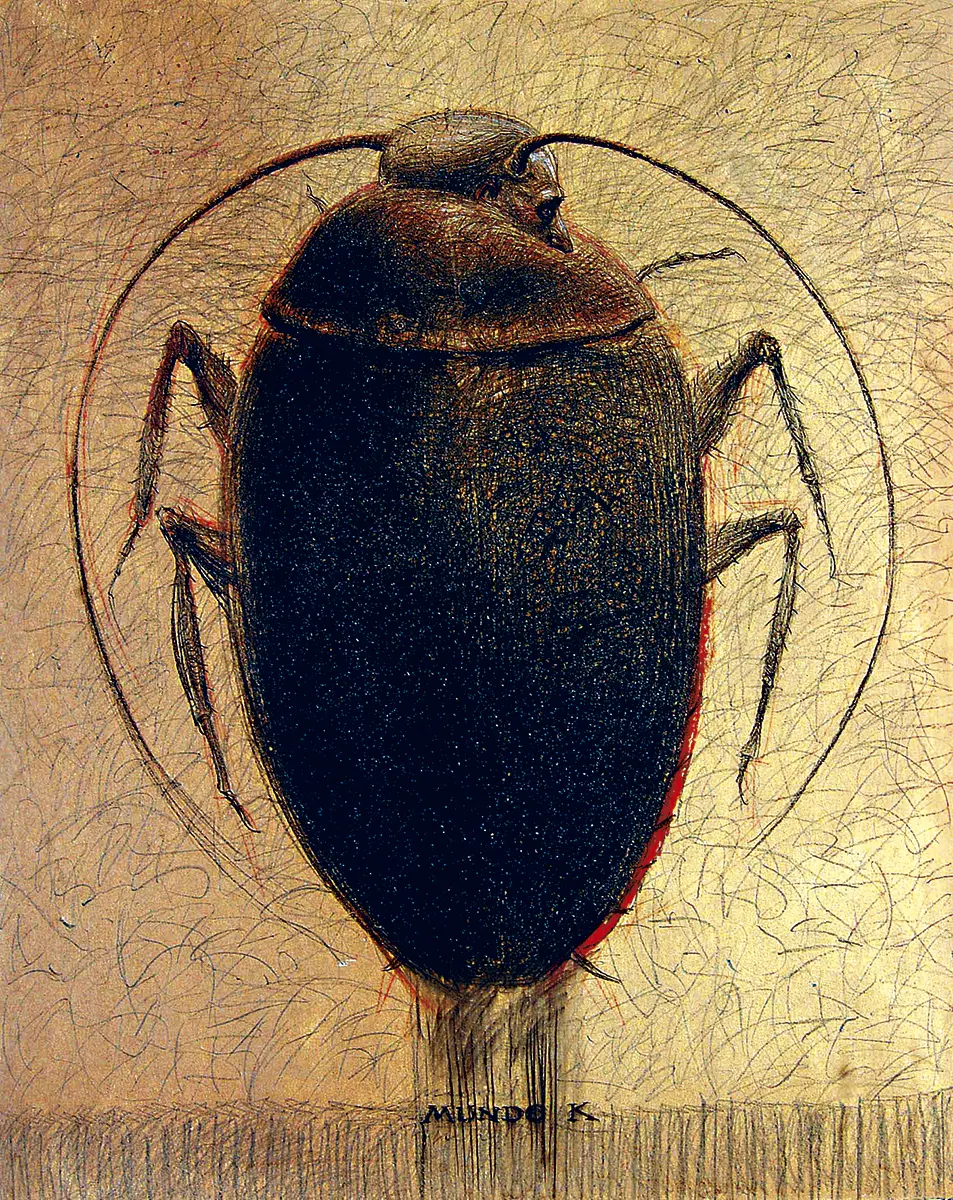
Mundos was comprised of six installational sculptures and eighteen drawings (on masonite, printed fabric, and aluminum pots.) In the exterior area of the Museo’s transitory gallery were five independent spheres, equal in size, suspended from the ceiling but within the public’s reach. Each had been covered in a different way, accentuating its expressive strength on the basis of the symbolic character of the materials employed. Petromundo, using large bullet casings, was a clear allusion to the cruelty of wars for the control of oil. Mundo K had an old-gold color derived from the more than 17,000 cockroaches used in creating it, cockroaches being the only species believed ready to survive an atomic holocaust.
The main quality of this group of works was a silent pathos; it was complemented by Mundo cero, conceived on the basis of animal bones, among which human bones were included, like a premonitory warning of the consequences of the catastrophe humanity seems poised to reach very fast, given its irresponsible and aggressive way of “developing” in conflict with the care and respect required by life and its natural environment. The cockroaches, forks, and knives of Mundo del día a día clamored for that absent food morsel that is in so many parts of the planet the daily reality of millions of human beings. A vegetal-charcoal sphere signaled the crossroads facing humanity today, after dismantling and asphyxiating its universe, a disaster that could very well prove to be definitive and irreversible. The material’s expressive richness left subtly open the possibility that reason would be enough to prevent the burning of something that would in the end destroy everything and leave only traces of our existence as in the sculpture titled Ración de mundo.
Fabelo’s drawings were on display inside the gallery and, unlike his usual work, they were laconic and tended towards synthesizing. The vast selection reiterated also the sphere and the circle as metaphors for totality, in the midst of that larger allegory of our world that was the show, where we were called to reflect on the crisis that threatens the planet; a possible extermination human being might not be able to escape in the end, if we continue acting against our own interests and those of the environment.
Through incisions, many anonymous faces were drawn on the ancient soot of cooking pots, used for years to sate people’s hunger. Among the works on masonite, some stood out: Medio mundo, a vision of our South, a geographical zone marked by latent tensions and conflicts such as hunger and poverty; Mundo de luz, a tribute to José Martí’s humanism and spirituality, where the luminous quality of the Cuban Apostle’s thought was concentrated on his forehead; while courage and valor were embodied in an unusual Retrato de Antonio Maceo, where two black spheres —pondering his testicles, his manhood— were the most precise summary of his heroic image.
The show’s drama had in the works on fabric a hopeful, less tense area. In La fuente, a woman’s breast was transformed into a universal fountain, while Mundo de reciprocidad alluded to the circle formed by a couple in a unique erotic position, highlighting the plentitude of the joy of sexuality and of life.
As an exhibition, besides making clear the challenge in terms of renovation and new explorations that Fabelo has set for himself, Mundos was a call to attention; it denounces the contemporary world’s sharp tensions, demanding that, rather than stopping to pray,, we do something to save the world. The real one, the everyday one, that world that is ours.
CARIDAD BLANCO DE LA CRUZ