
A dozen statuettes in small and medium format, placed on pedestals, are exhibited inside the Nina Menocal Gallery. They are epoxy modeling clay sculptures by young Chihuahua, Mexico-based Chilean artist Rocío Infestas.
The figures represent pre-adolescent girls poised nymphet-like to satisfy an innate human thirst for scopophilia. Suggestively posed, exuberant of breast, they spread their legs and expand coquettishly in gazes of a hypocritical innocence. The rough material gives these works greater tactile presence thanks to an almost corrugated texture in the girl’s disorganized hair. Their skin, however, is so softly sanded that they could very well be little china dolls.
The artist explores the Japanese subculture of manga drawing, and in particular hentai, a form of erotic or pornographic animation. Rocío Infesta’s images are as perverse as the Japanese erotic comic book tradition is. The positions adopted by these girls boldly displaying their genitals are nevertheless playful and provoke hilarity rather than offense. Although some sculptures show the doll engaged in the frankly masturbatory activity, the color of her dress, her unkempt presentation, and her child-like type are comic, even if the titles are equally direct and avoid euphemism.
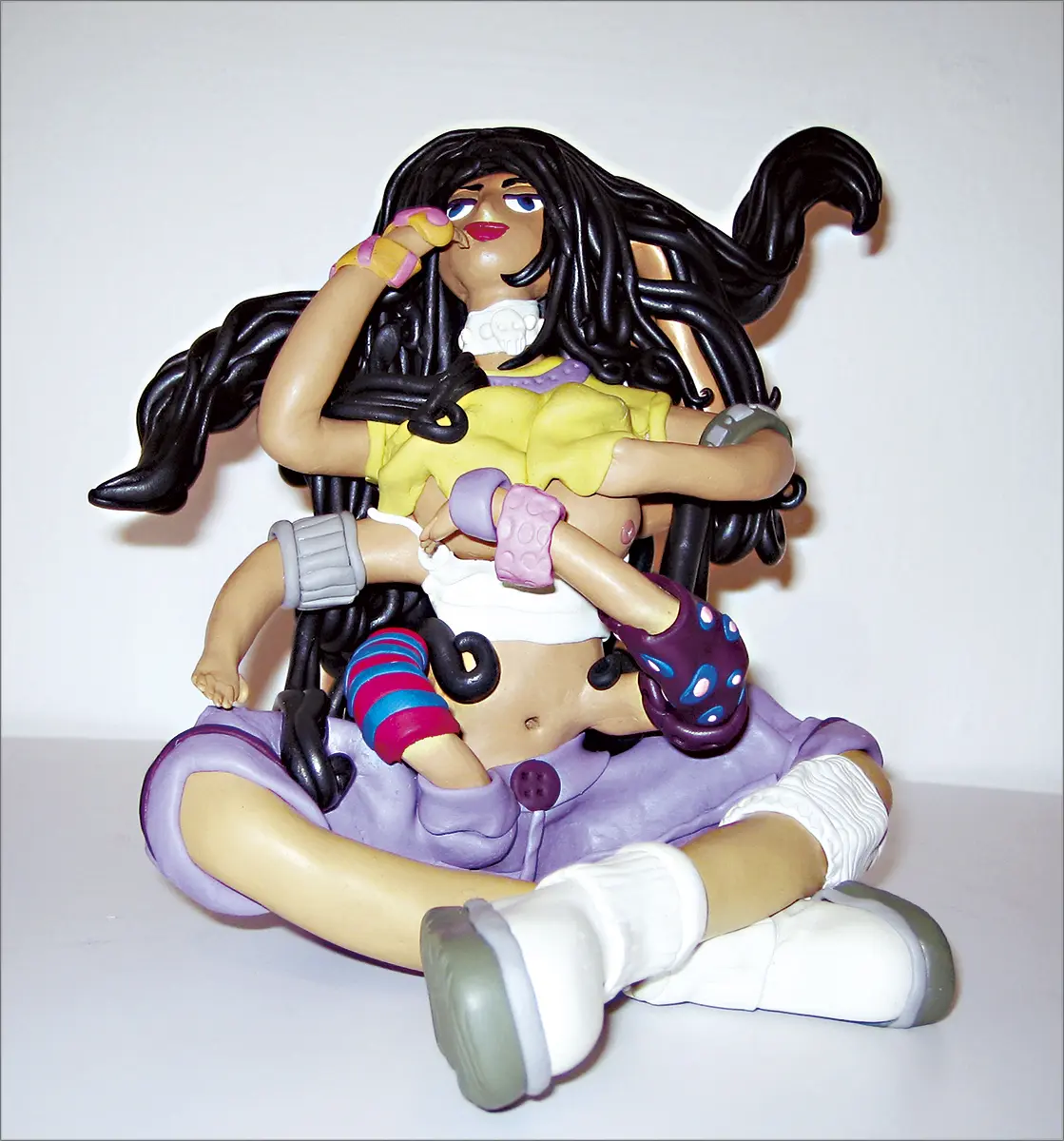
For example, Aquí estoy is an epoxy clay work just 11-cm tall in which a girl spreads her legs and offers her body to the viewer who observes and studies her to discover that, although her breasts are out, she is wearing panties. Despite the degree of modesty in the previous example, in Dulce placer, Pista trasera, or Consuelo, the statuette’s legs spread and the girl touches her genitals with her hand.
One work could be the summary of the intention behind Moods —the show’s title—, and it is the largest one. Fifty centimeters tall, a girl stands vertically in a provocative stance, boasting two large breasts on display for the viewer, although her face and her torso are practically covered by a jumble of pink hair. We are able to discern a somewhat perverse smile in this panties-clad young girl who says with great conviction: "Who cares?"
Also among the show’s highlights is Buscándome, where all that appears is the doll’s body from the waist down as if she were stuck headfirst on the ground, and all we can see is her bare sex and her legs struggling to emerge to the surface.
Infestas’ dolls seem extracted from a serial comic and, as in hentai, are capable of fantastic sexual activities, as they are fictional characters. Male characters’ sexual organs are disproportionate to their slim physiques, and women’s breasts are so large that they could only be made possible by plastic surgery. Characters of both sexes display the characteristic features of Japanese animation: large, round eyes, delicate facial features, and an expression that is generally innocent, supplicant-like, framed by sophisticated colorful hairdos that seem to defy gravity.
One of Rocío Infestas’ dolls has no head. Her body, painstakingly and delicately molded, is dressed, but our uncertainty is heightened when we discover that she carries her head in her hand and that she exclaims, in the title, ¿Qué chingados?
In Peleando por una razón or ¿Hacia dónde?, the female figures fuse their organisms like headless conjoined twins, in the case of the former by the neck and, more disturbingly, by the waist in the latter —which leaves them legless and sharing a torso like that US cartoon of a dog/cat with both animals in a single body.
Haciéndolo fácil is an almost classical sculpture in which a girl sits like an ancient fertility goddess and displays stylized sex that is just a thin vertical cut. From the waist up, however, she resembles more the Western notion of the pin-up or the Bimbo in traditional erotic publications. Her breasts are enormous, her waist tiny, her abdomen flat, her face perfectly, and a large blond wig covers her small head. At times it resembles Niki de Saint Phalle’s 1960s and 1970s nanas, with their big bodies and small heads.
The show remained open at Nina Menocal Gallery in Mexico City during November and December 2005.
LUZ SEPÚLVEDA