
In recent years, El Museo del Barrio has weathered changes in leadership and its assumed mission and has achieved a precarious yet successful balance. These days, the museum strives to be a community-based grassroots organization, a showcase of emerging Latino talent, and a professional, international, contemporary art institution. Perhaps no other exhibition reflects these multiple identities better than the museum’s biannual series of exhibitions titled The (S) Files (The Selected Files).
The (S) Files of 2005 is the fourth installment of the series, and it shows its growth and prominence by including a curator from Santa Barbara and a guest curator from Puerto Rico. This exhibition, which showcases promising Latino artists who have largely been culled from the ever-expanding artists files maintained by the museum, is widely viewed as a barometer for the next wave of emerging artists. As was true with the original installment, the current exhibition is notable for the plurality of styles, strategies, and themes in the artists chosen. This diversity, while seeming self-conscious rather than organic, is nonetheless refreshing to behold. There are surely critical voices that question the point of grouping artists who seemingly share nothing other than an ethnic heritage, especially if much of the art does not explicitly deal with issues of cultural identity. To use ethnicity as the one point in common is to take the diverse and multifaceted cultures found in the Latino world and reduce them to monolithic essentialism. Yet it is promising to see young talent showcased in its fullest range rather than prematurely limited to certain preconceived curatorial/critical labels. The curators of The (S) Files have a history of avoiding the obvious or culturally overdetermined in their choices, and this is a tradition that deserves to continue.
Of course, this avoidance of a pre-established agenda can also lead to potential randomness in such an exhibition. The curators account for the plurality of the art and the diversity of the artists included by invoking the poetic theme of “Impossible Destinations,” which is meant to suggest the complexity of nomadic existence, post-colonialism, the global village, etc. It is not the strongest thread upon which to hang a group show, so the catalog offers other sub-groupings, such as “Ritual and Repetition,” “Nomadism,” and “Hope and Exaltation.” The open-ended nature of the show, however, and the fluid installation of different groupings within the same space, indicate that the viewer can draw other relationships between the works as well.
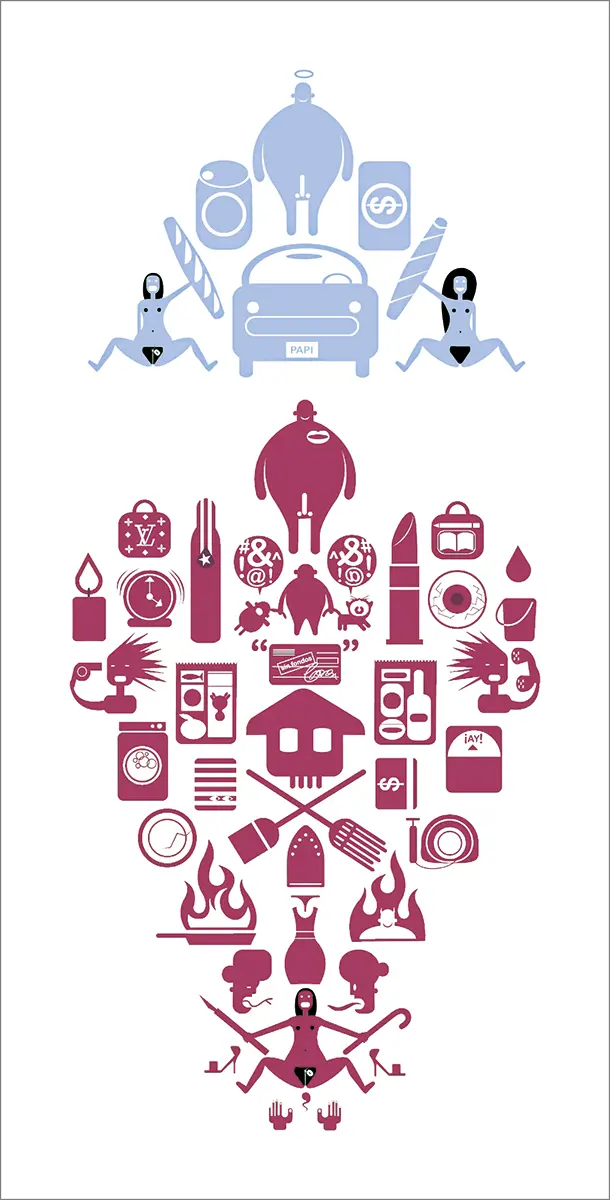
It is interesting to note that, within all the diversity, certain choices do seem to recur. The fusion of styles and coded systems is certainly a major strategy, as one can see in the works of Christina Hernandez-Botero, whose Pectorals of Light combine pre-Columbian pectorals with Yves Klein’s body paintings of the 1960s, or Carlos Aponte, whose work fuses Taino petroglyphs with corporate logos and Japanese anime in a fashion similar to that of Malcolm Morely or Ashley Bickerton.
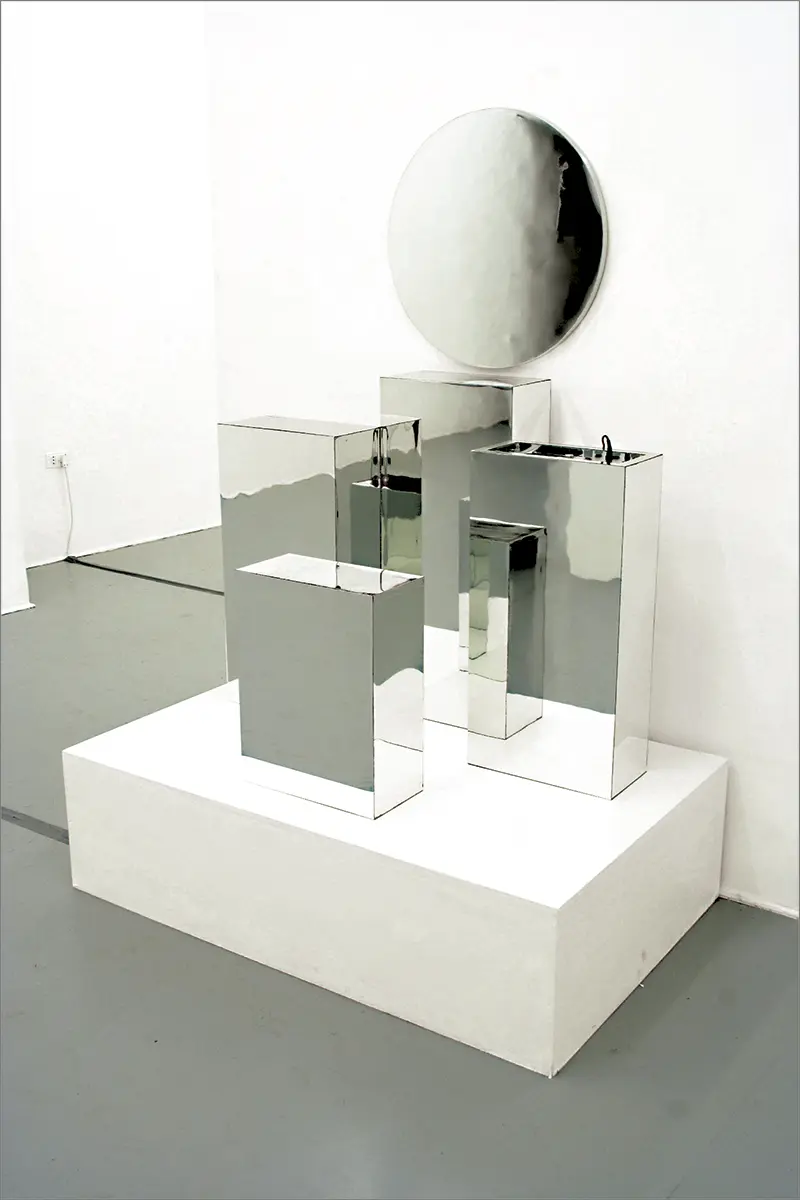
Technological installations are also present throughout the show. With Landing, Graciela Fuentes projects a black-and-white video of an aerial view of Mexico City onto a square pile of dirt, calling to mind the artist’s own migratory identity and the unfixed status of many immigrants. Meanwhile, Delia Gonzales and Gavin Russom make a post-minimalist installation whose reflective surfaces and synthesizer-music accompaniment employ a range of technological and pop-cultural references.
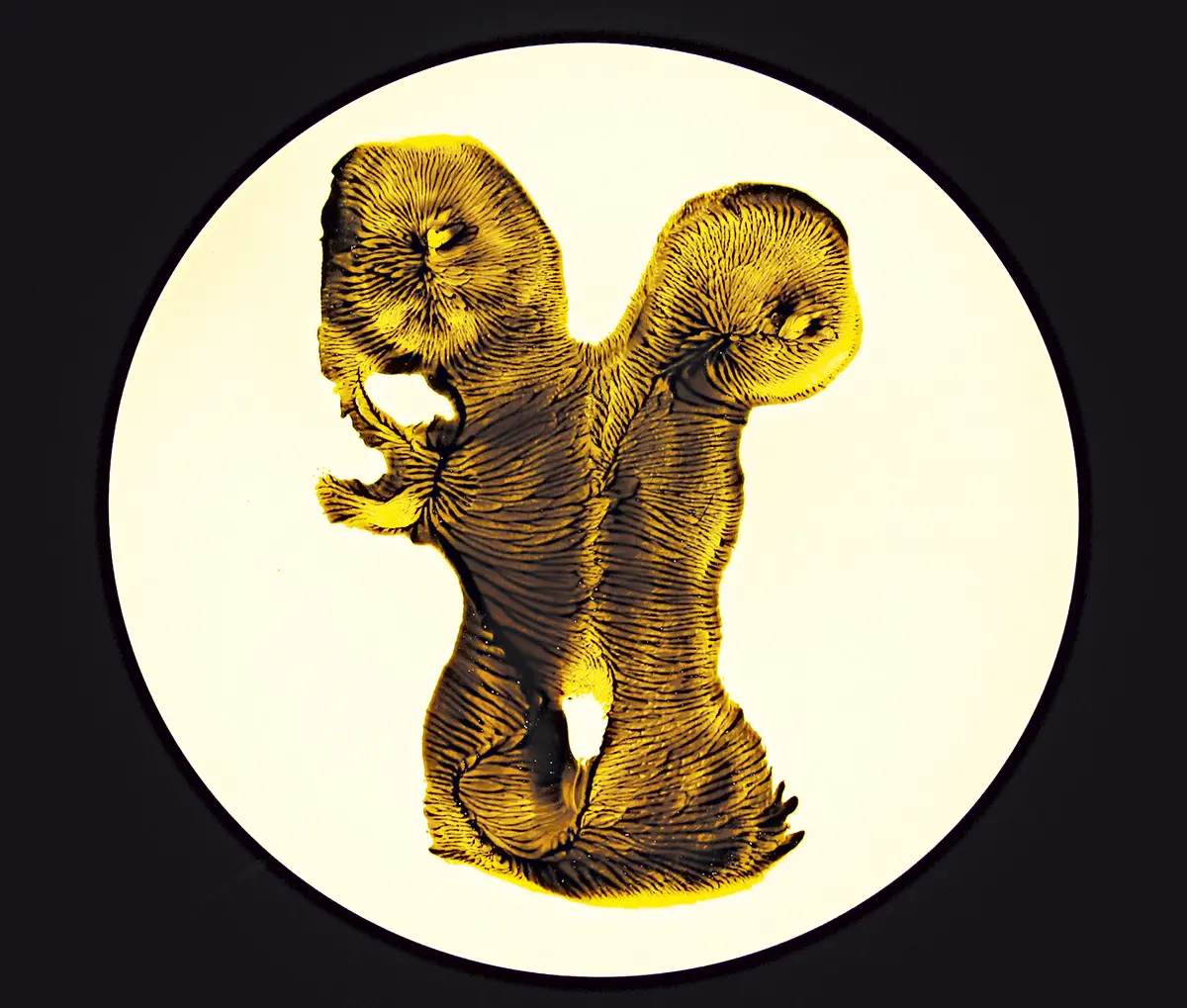
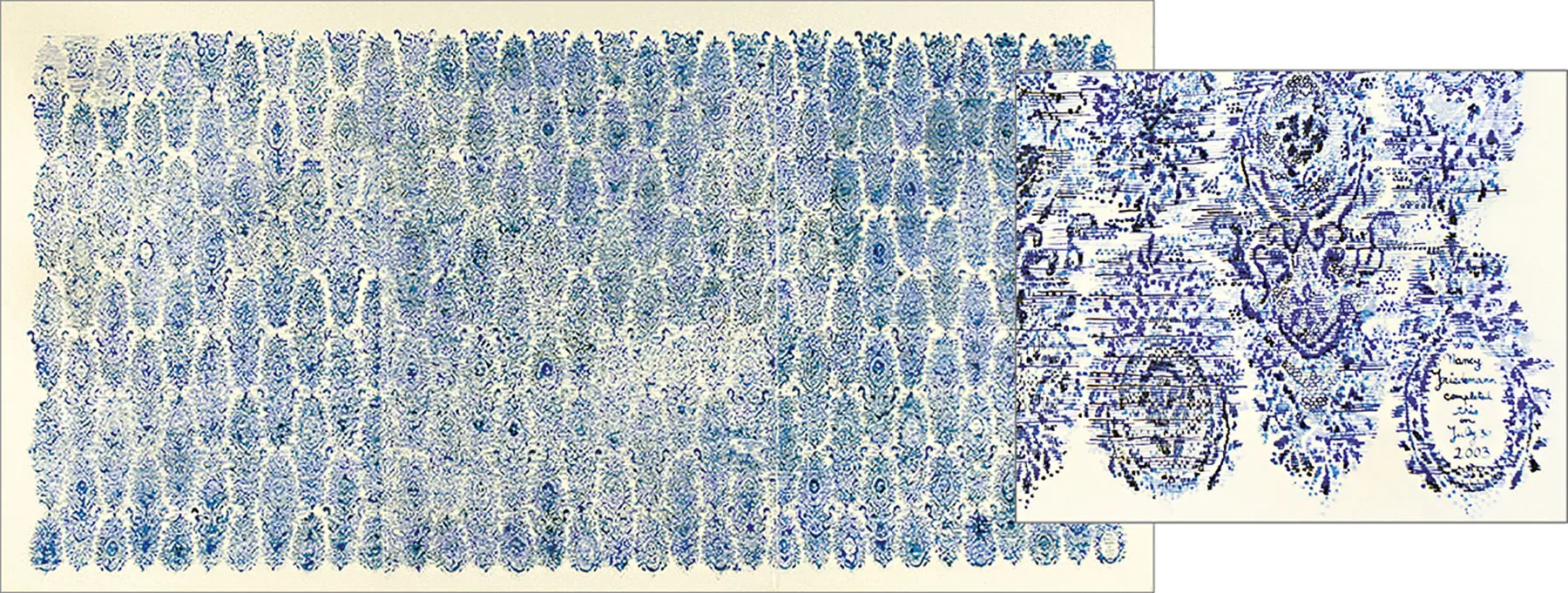
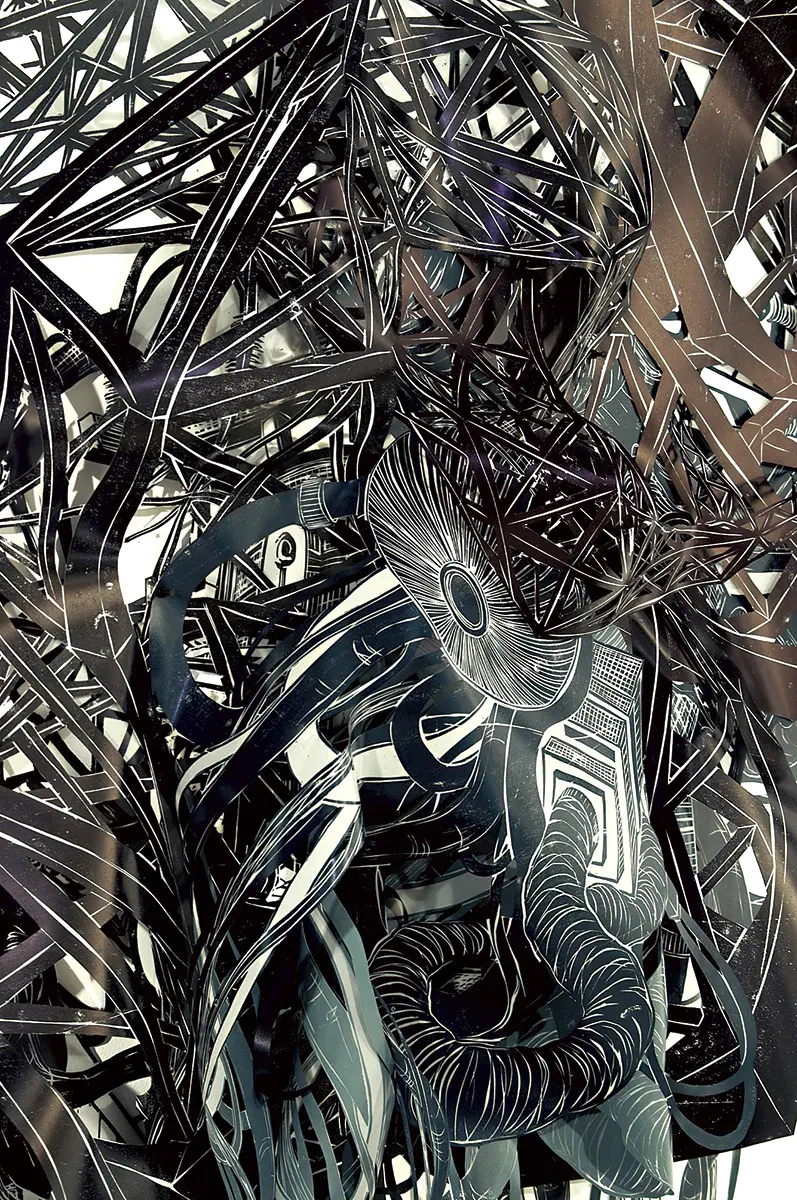
Perhaps most intriguing is the strong investment in drawing by many of these artists. In the hands of artists such as Raymond Saa, Chio Flores, and Patricia Zarate, drawing is well represented in terms of its visual fluidity, its appropriation of modes of visual discourse, and even its physical presence as installation art. One of the most intriguing of these projects is Fallen Giants by Nicola Lopez. Her series of woodblock prints on sheets of Mylar are shaped, cut up, and layered until they take over their space in the gallery, at once delicately beautiful and suggestive of destruction and industrial decay. Nancy Freidman also fuses modes of representation in Untitled. This ink on Mylar drawing is meticulously rendered to appear like a tapestry of lace and crochet that Columbian women have famously made for generations. Like many feminist artists, Freidman questions the way such handicraft has been used to downplay women’s labor, while at the same time the work celebrates the visual richness of these traditions. By translating weaving into drawing, Friedman renders the patterns as lines and repeated serial forms, fusing post-minimalism and Columbian handicraft.
Most of the artists in this exhibition show that they are unafraid to look at both the ethnic and art histories that have preceded them and, in so doing, have developed visual territories that are largely their own. It will be interesting to see where they go from here.
JOHN ANGELINE