
The new exhibition of works by Tomas Sanchez is a window into a very personal interpretation of landscape that the artist has been working on, for a long time, and which has now matured into a signature theme that he has serialized.
Tomás has worked and developed the theme of the imaginary landscape within a spiritual framework that has been compared, accurately, to traditional Chinese landscape painting. It is also a trait that was noticed very early in his career (by critics such as Gerardo Mosquera in Sus paisajes son claros, an introduction text in the catalog of the show at Galeria Arvil, Mexico D.F., November 1989). Like the painters of landscapes in the Orient, Tomás does not depict a specific site, but rather his images are the distillation of a series of places that he has seen, and to which he has added or taken away to construct a whole other additional landscape. Hence the feeling of hallucinatory experience that some of the canvases can evoke; we feel that we have seen these places before, but that somehow they were dramatically different from the paintings.
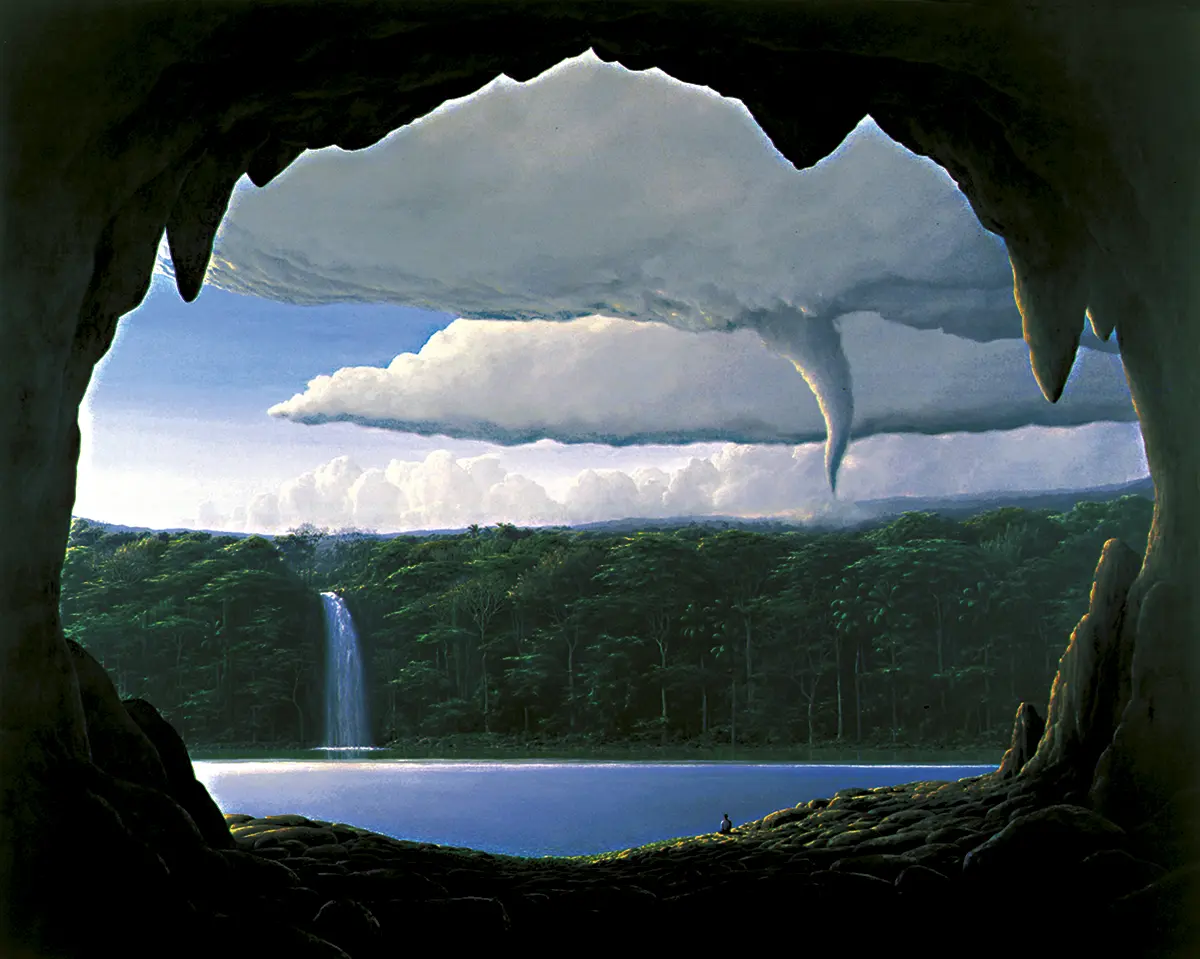
Tomás Sanchez is a Contemporary painter and his work reflects a concern with the environment that can be interpreted as ecological, but it ultimately has an alignment with an inner spiritual source that very much like in Chinese classical landscape painting, conjures the viewer to step onto the picture and discover something of himself during the imaginary voyage.
Another important element in his composition is the element of water. Water appears in Tomas’ paintings in the shape of reflecting pools, as cascades and rivers, and is always an integral part of his compositions. All except one of the works in the exhibit demonstrate the presence of a body of water. Again this is a theme that is particularly connected to Chinese and Japanese landscape painting, particularly in Japanese painting; it is associated with Kwanon, the Buddhist goddess of mercy, where the water itself is one of the attributes of this important deity of the Buddhist pantheon, as stated by Ernest. F. Fenollosa in Epochs of Chinese and Japanese Art, Vol 2, published by Dover Publications, New York, 1987.
Actually, a description of traditional Chinese landscapes, by Ernest Fenollosa in his authoritative, “Epochs of Chinese and Japanese Art”, which specifically refers to Hsia Kuei (Kakei), one of the most important classical Chinese painters from the Sung dynasty (12th Century), can well be said to be describing a Sanchez landscape:
“The drawing of trees that top the ridges on the left is so splendidly generalized into middle distance scale as to give us the very scratchy fringe which a photograph of a similar natural formation near Kamakura reveals” and further on about the theme of water, “Kakei also painted wonderful waterfalls with mist drifting across the mountains…The gleam of sunlight through the mist and from water can hardly go further” (also a quote from the work Epochs of Chinese and Japanese Art, Vol 2.).
Tomas Sanchez‘s paintings often have this same familiarity with photography, and very much like the Chinese landscape painter, he adapts this closeness to reality to provide an illusion of a real place, when in reality the picture is trying to give an insight into a state of mind with a strong emphasis on spiritual awareness.
It is also common in Classical Chinese and Japanese landscapes, to see a small figure, representing a sage or scholar, contemplating the landscape in which he seems to ponder on the mysteries of creation or simply seek illumination through meditation. Tomás himself has been an adept of yoga for many years, and the lonely small figure always portrayed in yogic meditation pose, which consistently appears in all the pictures in the exhibition, alludes to that communion (noted by Prof. Edward Sullivan in the catalog essay for Nubes sobre la laguna, published by Christie’s New York, June 2000, p. 114.).
Another important aspect of the artist’s work that connects him to the traditional painters of the Orient is the repetition of the themes. It is also interesting that Tomás meditations, like the mandalas, the paintings used for Buddhist meditation were often produced in series. (Denise Patry Leidy and Robert A.F. Thurman, Mandala, The Architecture of Enlightenment. Asia Society Galleries, New York, September 1997.).
The repetition of themes also makes the inevitable allusion to the stream of copies that were done in the Orient from one generation to the next, of well-known masterpieces (Fenollosa p. 128-129). One can see in Tomás’ work a link with this act of perpetuating, as well as the desire to project a continuity of spiritual illumination that persists from one canvas to the next.
It is precisely that fusion of the spiritual and the realistic, and the contemporary search for spirituality in art, that makes Tomás’ work so attractive and desirable to collectors. Of all the pictures in the exhibition, all but one had been sold by the closing of the opening reception.
ALBERTO BARRAL