
On Sunday, September 11, Sala Mendoza opened an exhibition that, while centered on an entirely Caraqueño reality, addresses a topic of interest to the inhabitants of cities throughout Latin America: what has happened to modernity? It is emblematic that, while we no longer speak of innovations or changes, at least not regarding the visual arts, many things have changed and have driven us to our current state of uncertainty and disquiet.
The Centro Simón Bolívar, in the El Silencio development, designed by the architect Cipriano Domínguez and planned, financed, and executed by the dictator Pérez Jiménez, is the most conspicuous and earliest icon of modernity in Venezuela and, perhaps, of other countries in the region, not only because of the period in which it was built (1949–1956) but also because of what it represented in the country’s consciousness.
The exhibition was organized by Sala Mendoza in partnership with the Fundación de Cultura Urbana and curated by Sala Mendoza’s director Ruth Auerbach, with the architect William Niño Araque as an advisor. It was “a proposal for [an] artistic investigation” of Caracas and its supposed, perhaps longed-for, suffered, violated, rejected, or detested modernity. Twenty-one young artists, including Miguel Amat, Alexander Apóstol, Juan Araujo, Alessandro Balteo, Ángela Bonadies, Muu Blanco, Mariana Bunimov, Eugenio Espinoza, José Gabriel Fernández, Alí González, Beto Gutiérrez, Eduardo Kairuz, Mauricio Lupini, Andrés Manner, Cipriano Martínez, Daniel Medina, Luis Molina Pantin, Nascimento/Lovera, Matías Pintó D’Lacoste, Manuel Carballo + Gerardo Rojas, and Javier Téllez) were invited to present their ideas on the topic according to their particular visual or artistic languages.
Torres del Silencio, a building that is known throughout the world as an emblem of Venezuela, was introduced in the exhibition with excellent photographs from the Fundación para la Cultura Urbana collection, where they constitute an important nucleus. These black-and-white photographs by renowned photographers such as Alfred Brandler, Leo Matiz, and Foto Estudios Palacios were taken at the same time the towers were being built in the first half of the 1950s. Nearby were postcards from a private collection that featured the building during various periods. The images were taken by different photographers and with different degrees of artistic quality, highlighting the various media through which modernity was seen. At the same time, a video guided the viewer in real-time through the current building’s hallways, basements, and parking garages. The curators produced this video, assisted by Alexander Apóstol’s cinematography.
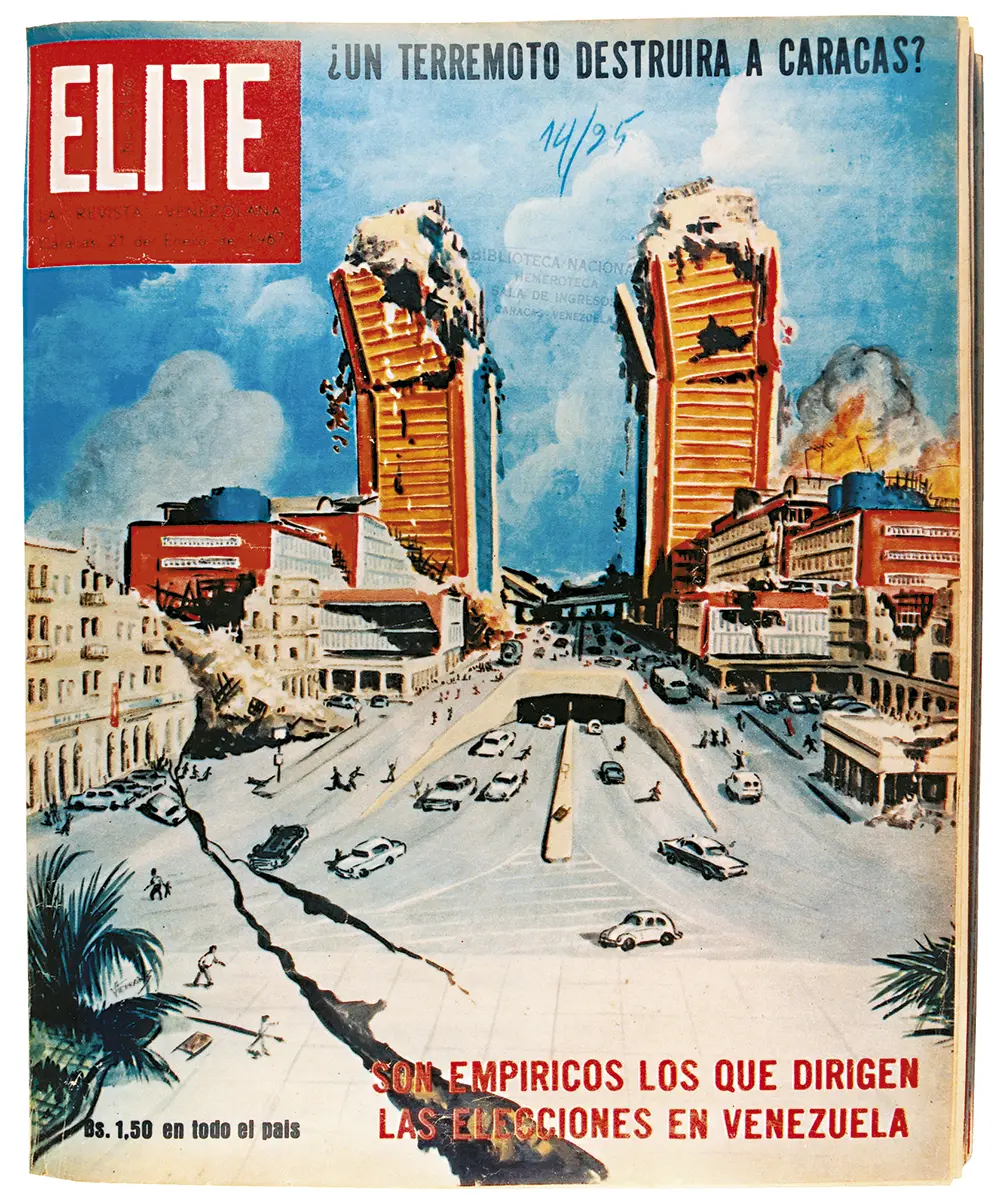
The project unfolded in the lower-level exhibition gallery. At the very entrance to the gallery were two interventions: Luis Molina Pantin’s Arqueología urbana del Centro Simón Bolívar, which photographically appropriated an Élite magazine cover from 1967, and a sound installation by Javier Téllez that related the story of the Caracas earthquake of 1967, taken from a period radio broadcast. The two pieces complimented each other with their use of metaphor.
Downstairs was more information from period magazines on the process of construction, descriptions of the building’s features, and how it aspired to spearhead a renewal of the city center.
Some of the contemporary works were created in 2005. Due to space limitations, it is impossible to review all of them. The first work encountered, even before walking down to the gallery, was No al pasado by Mauricio Lupini, a large digital print that, indicated by the emphatic negative in the title, didn’t approach the topic of the Torres. This work, devoid of any clear shapes and of a diluted atmospheric green, moved away from taking any position about the topic, which it roundly negated.
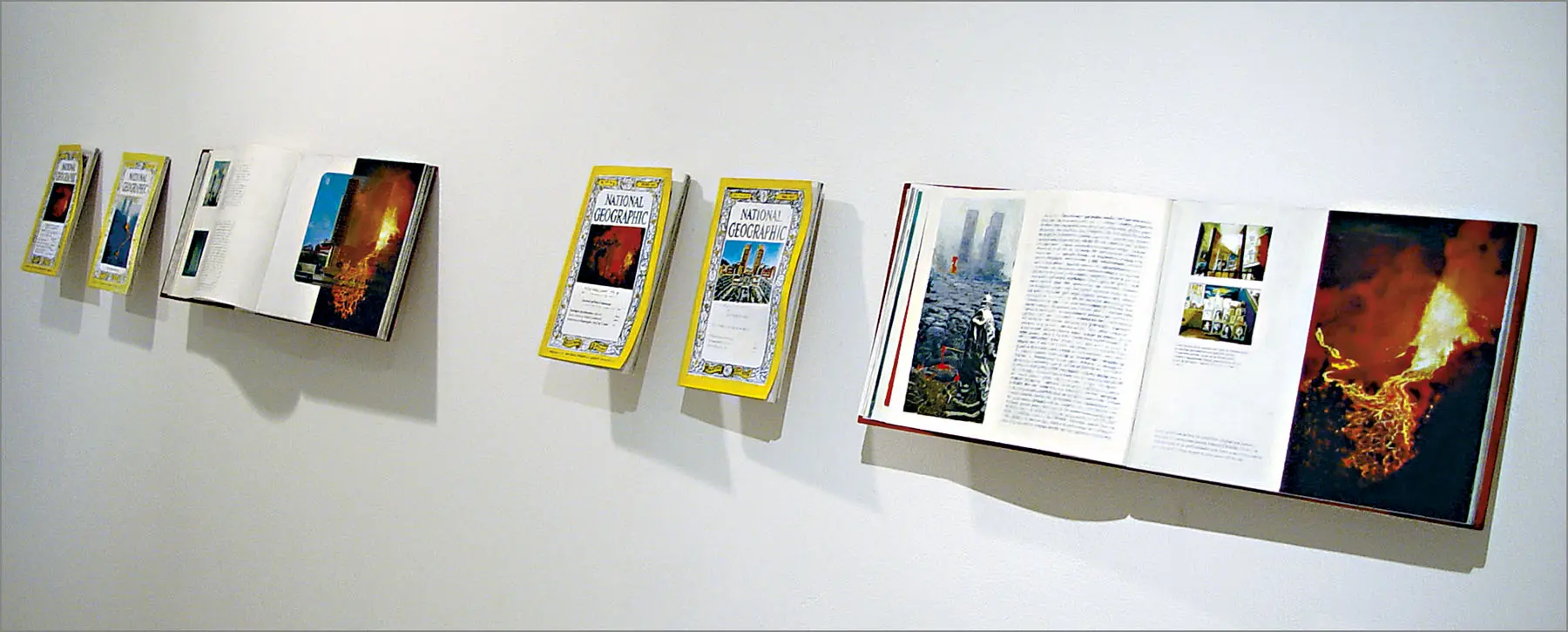
Juan Araujo showed his small paintings on paper and MDF that mimicked old National Geographic covers, offering an apocalyptic vision of the towers and comparing them to an erupting volcano.
Ángela Bonadies presented two interrelated works: Construir la plaza, comprised of several groups of photographs of the stalls in the process of setup at Caracas Square, and a DVD titled La plaza Caracas y la casa de Buster Keaton. The photographs displayed an attempt at the structure that, in combination with the process of construction in the images, made the series highly active and attractive.
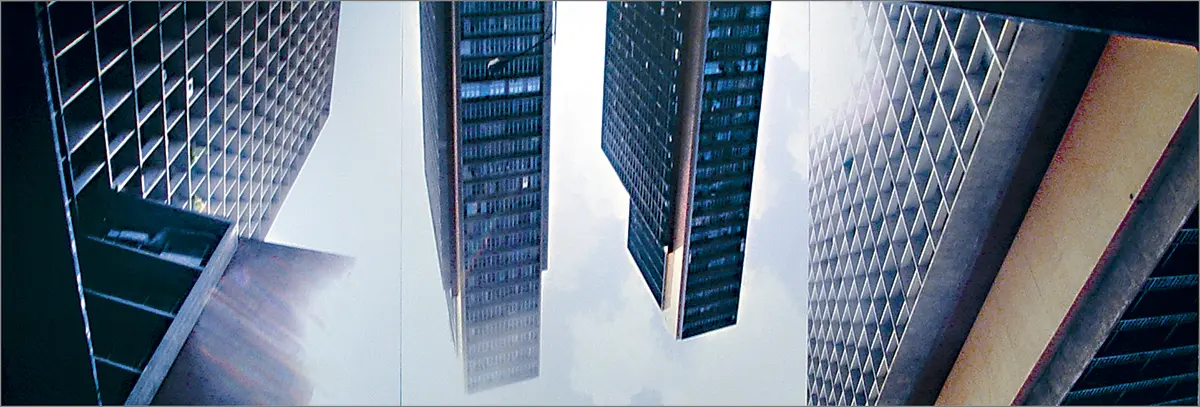
With photographs taken at an upward angle, Muu Blanco’s 2005 work, Permietral, made one feel the overwhelming weight and volume of the towers and, by extension, of the impact of modernity.
Luis Molina Pantin’s second work was perhaps the complement of the first one since it had the same title. It deployed images on various commercial items, in his recent manner. It appeared that his intention was to highlight the way in which the towers are today only an icon for tourists.
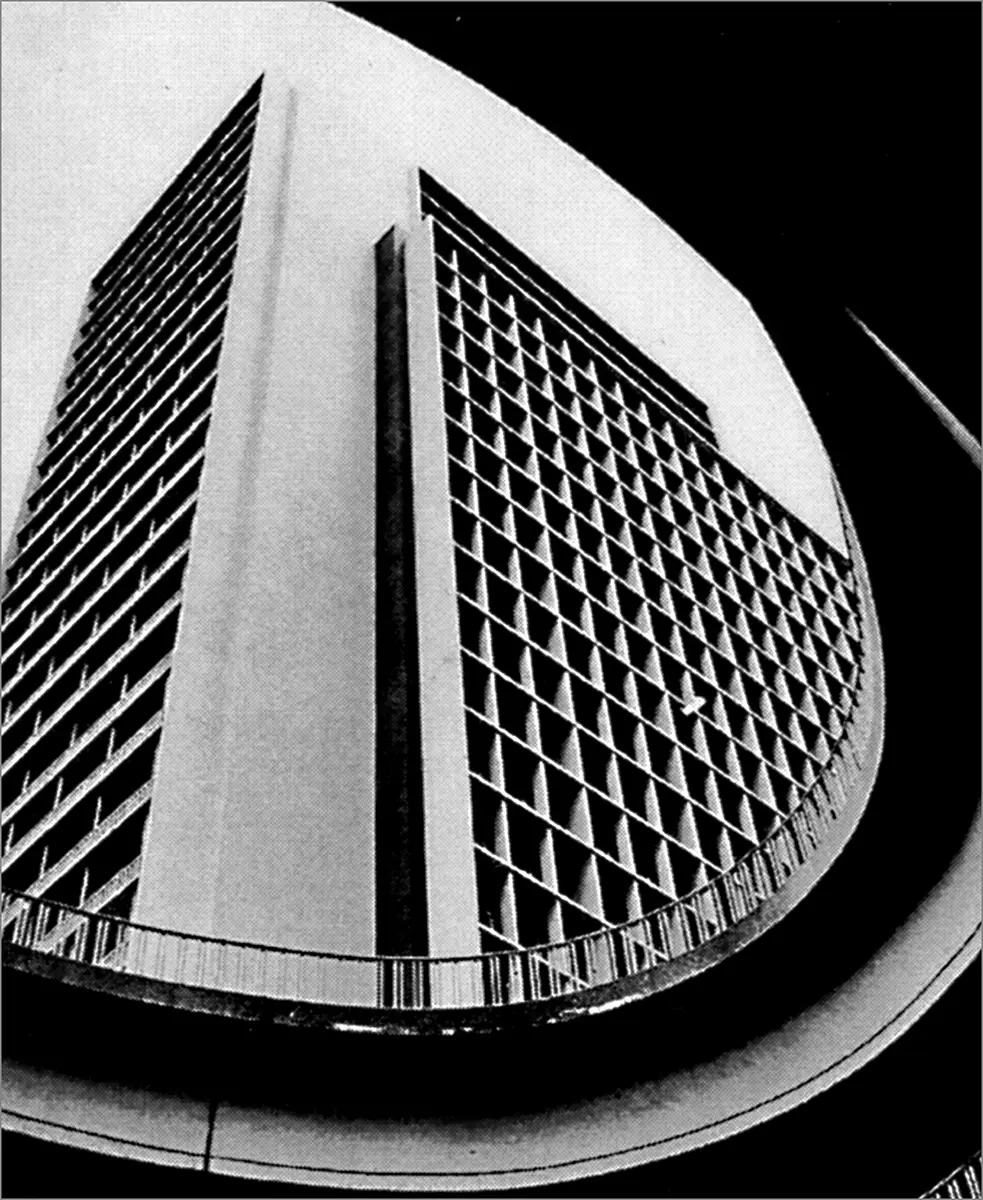
Alí González also presented two works. Perhaps an attempt to emulate Gego’s work, Planificador 1, 2, 3 from the series Cabezas tejidas featured portraits of three famous Modernist architects created using grids, one of the perforated dots on wood and another of metallic mesh. The second work, Moderno 1, consisted of a small metallic rocking chair on which the artist had woven in three dimensions a plastic-ribbon grid that appeared broken or collapsed at various points, just as modernity’s own reticules have collapsed.
Manuel Carballo’s and Gerardo Rojas’s large mosaic Escenarios “Modernos” referred to the decay or the collapse of the towers through photographs that showed many of the interior spaces as they exist today, after forty-five years of modern democracy and progress. According to these images, all those ministries, companies, and government or private offices that filled these spaces used them as they pleased, even decorating them in awful taste, but never did anything else for them. Once used, the spaces were abandoned.
Matías Pintó D’Lacoste’s Futuro pasado had an appearance of fragility that made it especially interesting. It featured a plan of Bolívar Avenue on a technical format, a tool belonging to modernity, created using AutoCAD software, a digital and ultramodern process that is used in contemporary architecture. In this way, the artist confronted two temporal realities, while showing two clashing spatial realities: the central avenue with its inverted duplicate on the city’s east side.
A large acrylic-paint-on-canvas drawing by Eugenio Espinoza, El Paraíso, traced an imaginary Caracas where the city’s expressways, instead of communicating, seem intent on doing the opposite. The structure of the drawing was apparently traced from an original drawing by Le Corbusier for a project in Brazil. Le Corbusier thought of building apartment blocks under the expressways, which look rather like walls. Espinoza thinks this is a “genius monstrosity.”
Alessandro Balteo’s 1998 work was fascinating. Its title, Caracas la sucursal del cielo, comes from a tourism industry slogan that circulated in the 1950s and 60s. A photographic-paper cone that hung from the ceiling featured a panoramic picture of the city. The photograph inside the cone reconstructed the interior of the dome of the Humboldt Planetarium, capturing the architectural outline of the city built by the dictatorial regime of the 1950s. There, the image of Caracas appears as if it were an image of the sky. There were also two photocopied Planetarium programs: one from August 1961, referred to various activities like the opportunity to marvel at the universe; another one from July–December 2005, imagined a visit to the planetarium as a scientific event.
Equally powerful in its simplicity was Eduardo Kairuz’s Un mundo mejor. Two stacked loudspeakers roughly tied to a street peddler’s rolling cart located it in current reality. But the sound that emerged from the loudspeakers was anything but current: an announcer from the 1950s, extolling the marvel of the country under General Pérez Jiménez’s regime, thanks to its public infrastructure works—not only Torres del Silencio, but also the Caracas-La Guaira expressway and others that are bringing Venezuela to a place of preeminence among the countries of the Americas.
In smaller adjacent spaces were Mariana Bunimov’s Leyes del silencio, which displayed, like the El Silencio merchants, booklets from the National Printing Press of new laws. But apparently, the artist invented these law books. Bunimov retraced the covers with ink, altering not only the appearance of the towers, the background image for these publications, but also the booklets’ titles and purposes.
Nearby, Cipriano Martínez presented Ejercicio para preservar la memoria, created in paint using a pseudo-pointillist technique—instead of dots, the image comprises small squares, like a TV screen. The Centro Simón Bolívar towers were presented in three separate pieces that, contrary to the title, do not preserve the image but show a progressively vanishing process.
José Gabriel Fernández also presented two works, Díptico and Bocetos, that shared the same spirit, to reflect the beautiful curves that repeat through the Centro’s hallways. They were differentiated by technique: three pieces of ink-on-paper sketches and two in gesso-on-wood. With fifty-eight Polaroid photographs, Tómate una foto aquí by Beto Gutiérrez invited visitors to have their picture taken against a Torres del Silencio that had been, and could still be, altered at whim.
The show concluded with an excellent DVD by Alexander Apóstol, TV Documental. Following several heroic musical fragments in a major key, it presented the interior of a shanty where a father and his two children watch a video announcing the building of the Torres del Silencio as a marvel that will change the future of Venezuela. Their home is extremely poor and seems only half-finished, just like Bolívar Avenue was after the towers were built. There are three people sitting in only two chairs; their attitude couldn’t be any more submissive, but the announcer’s voice and accompanying music such as the national anthem, as well as the editing rhythm, are heroic and triumphant, as befits the period in which the Centro Simón Bolívar was built.
This was a very interesting show, and it is possible to imagine different readings beyond what was expressed here. Such ideas could be rich and fertile propositions and alternatives to the problems and disillusions of Modernist utopia. It is interesting also to note that the show has been presented with the dwindling resources available today to private cultural institutions in Venezuela. This indicates the fact that not only is their talent but also will and great generosity both on the part of the participating artists and the curatorial team.
IRIS PERUGA