
The project is the result of Margarita Monsalve’s academic activities during her time at Universidad Nacional, where she studied for a Master’s in Art and Architecture History and Theory and was able to conduct research on the topic of modernity, the photographic image, and the city, guided in particular by Walter Benjamin’s lectures. On the other hand, this artistic project also emerges from the constant work that for a number of Years Margarita Monsalve has carried out with her students in the Visual Arts workshops, where she fostered an acknowledgment of the immediate environment: the campus, which later was widened to incorporate the relationships it establishes with the city and to explore some features of the urban world. It was in this space, where for several years she has worked as a teacher, that through a variety of experiences she formed a group, known since 2003 by the name of Trailer. Its members are Santiago García, Esteban Gutiérrez, Juan David Laserna, and Alexandra Osejo, with the collaboration of Santiago García, Camila, and Juan Antonio Monsalve.
This project takes as its point of reference the urban landscape, the city around it: Bogotá, a landscape in the permanent transformation that in recent years has seen significant changes, especially due to the works for Transmilenio, a new public transportation system intended to address the transportation needs of a large number of city dwellers that have at the same time altered the city’s appearance and its workings, creating a landscape of ruin and destruction that traverses the city from south to north and east to west in the name of “modernization.” These contrasts between, on the one hand, the image of progress implied in the construction of a better future, and on the other, the face of deterioration that accounts for the unstoppable passage of time, of a time that is always past and fleeting, is the foundation supporting the No arquitectura project, started in 2003.
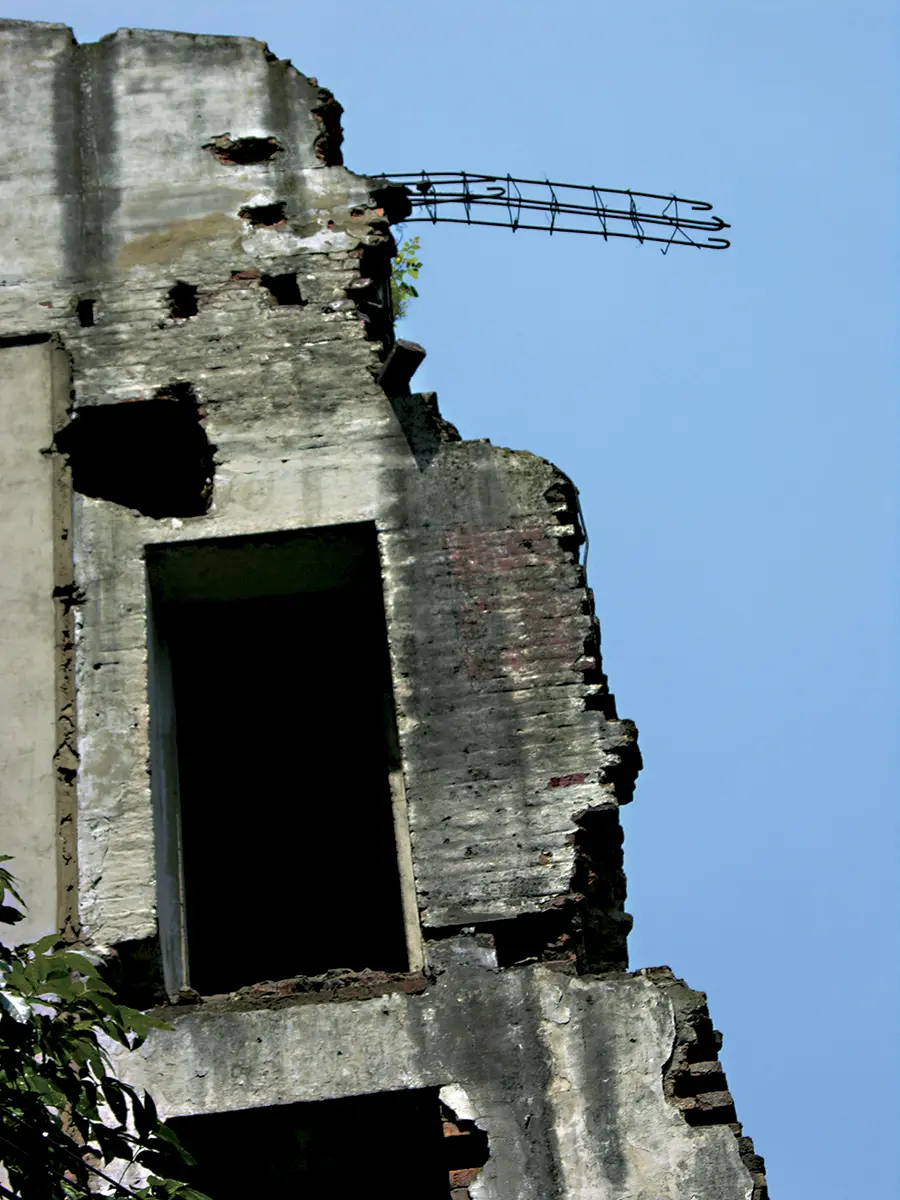
The images that comprise the project foreground the contrast of life in a big city that rebuilds and transforms itself on a daily basis. They show “the architecture of construction and destruction. A transitory architecture that courses through the entire city, revealing its inner layers: the ruin that brings to the fore structure, the private, the hidden, and puts it in the public domain in the midst of destruction.”
These large photographs clearly amplify a world that crumbles, walls that fight against their fading and that open themselves up, through enormous holes, to a timeless blue sky, which makes them even more poetic and confers them a certain grandeur. Such grandeur becomes even more noticeable in their encounter with the architecture that supports them, especially at the moment in which they intervene the walls of one of Colombian modern architecture’s most well-rounded spaces: the old Universidad Nacional printing site, today its Architecture Museum. These large photographs showing the calcareous, dusty structure of walls that crumble slowly, could be the x-rays of the white, intact walls that support them, part of a wide and well-lit space dominated by good design. The image’s grandeur is also reinforced when, as vigilant witnesses, the huge ruins take their place on the walls of the white city, commanding from on high what occurs in its Central Square or other public spaces that are part of daily life in the same Academia that has given rise to this project by Trailer.
MARTA RODRÍGUEZ